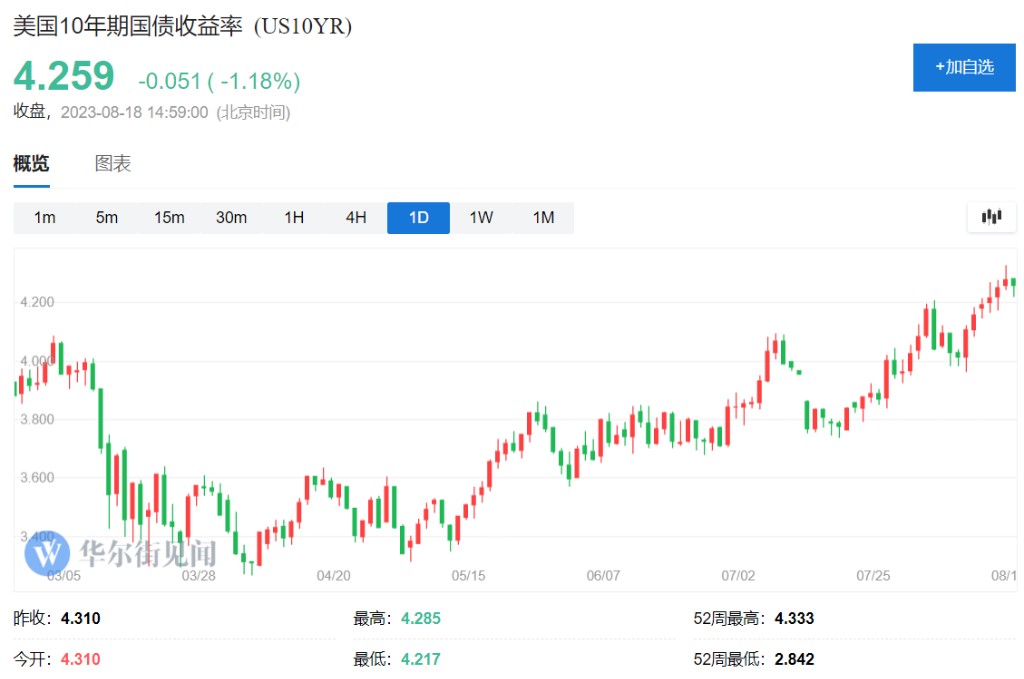
Wall Street Wakes Up: Warning that US Treasury Yield of 5% Could Become the New Normal, Inflation May Lead the Federal Reserve to Raise Interest Rates to 6%

Bank of America warned investors to be prepared for a return of 5 per cent U.S. bond yields, back to the pre-financial crisis U.S. bond market. With personal consumption spending inflation averaging 3.7 per cent in the second quarter, the Fed may be forced to tighten its policy benchmark to at least 6 per cent. At the same time, yield inversions show that the risk of a U.S. recession remains in the short term.
Recently, there has been a sharp drop in US Treasury bonds and a continuous rise in bond yields, finally making bond traders around the world realize that the era of low interest rates for US Treasury bonds may be coming to an end.
The unexpected resilience of the US economy, the growing debt and deficit, as well as the escalating concerns in the market about the Federal Reserve maintaining high interest rates for a long time, are pushing the yields of the longest-term US Treasury bonds to the highest level in over a decade.
Strategists at Bank of America are warning investors to prepare for a return of 5% yields on US Treasury bonds, bringing the bond market back to the pre-financial crisis era. BlackRock and Pacific Investment Management Company (PIMCO) suggest that inflation may stubbornly remain above the Federal Reserve's target, leaving room for further increases in long-term bond yields.
The warning from Bank of America is even more dramatic than the warning from former US Treasury Secretary Summers earlier this week.
Summers warned that the yield on the 10-year US Treasury bonds may rise further in the near future, and over the next decade, the average yield on the 10-year US Treasury bonds will reach 4.75%.
Summers stated:
I don't particularly think that the current long-term interest rate level will immediately reach any peak. I have come to this conclusion partly based on the expectation that the US government budget deficit will "become a focus of investor concern" over time.
Jean Boivin, former senior official at the Bank of Canada and current head of investment research at BlackRock, believes:
The repricing of long-term US Treasury bond yields has already risen significantly.
Despite recent progress in controlling inflation, the market increasingly believes that inflationary pressures will persist in the long term. In the coming years, macroeconomic uncertainty will remain a major concern for investors, requiring greater compensation for holding long-term bonds.
Central banks around the world are undergoing a significant shift. For years, central banks have kept interest rates far below what is considered neutral to stimulate the economy and guard against deflationary risks. But now the situation has reversed. Therefore, even if the long-term neutral interest rate remains unchanged, central banks will keep policy rates above the neutral rate to avoid inflationary pressures.
For the market, the current performance of the US bond market is a dramatic reversal: last year, the market was preparing for an economic downturn and betting on the Federal Reserve easing monetary policy; going long on US Treasury bonds was also predicted to be one of the most certain trades this year.
However, due to the increasingly clear trend of sticky inflation and the lack of restraint in the US government's budget, the bond market has caused investors to suffer the most severe losses in at least 50 years. Some analysts bluntly state that holding long-term US bonds is not a wise choice in such an environment.
In terms of inflation, although inflation has slowed significantly compared to the same period last year, recent increases in prices of food, energy, and other commodities, coupled with the gradual disappearance of base effects for the remainder of this year, have raised concerns in the market that inflation may have difficulty quickly falling to the Federal Reserve's target of 2%. Research from the Federal Reserve Bank of New York shows that by the end of this year, the short-term real neutral interest rate in the US will reach 2.5%. Given that average inflation for personal consumption expenditures reached 3.7% in the second quarter, the Federal Reserve may be forced to tighten policy rates to at least 6%. Market concerns over a soft landing of the US economy are making inflation the main risk. This point was highlighted in the minutes of the Federal Open Market Committee's July meeting, where officials expressed concerns about the need for further rate hikes. They also stated that even if the Fed decides to ease rates to reduce policy constraints, it may continue to reduce its bond holdings, which could once again weigh on the bond market.
Despite the increasing likelihood of a soft landing and the continuous rise in US bond yields, the phenomenon of an inverted yield curve has not disappeared. It is widely believed that an inverted yield curve is a precursor to an economic downturn.
There is no doubt that the rise in US bond yields will put more pressure on consumer spending, real estate sales, and various businesses. However, more importantly, this trend will increase the financing costs for the US government and exacerbate the deficit. In turn, the increase in US federal government spending also intensifies the upward pressure on US bond yields, potentially creating a vicious cycle.
From an external perspective, the Bank of Japan's adjustment of its yield curve control policy may also reduce global investors' demand for US bonds and redirect investments to Japan, triggering further selling of US bonds.
On Friday, despite a slight retreat in US bond yields, they still struggled to break free from the upward trend.