Nestle, which made you fat, is now selling weight-loss miracle drug kits.


After two years of significant price increases, Nestlé, the world's largest food company, has slowed down and stopped raising prices across the board, instead seeking growth driven by both sales volume and product innovation. In 2024, the company will focus on launching new products, including nutritional supplements tailored for the weight-loss drug semaglutide.
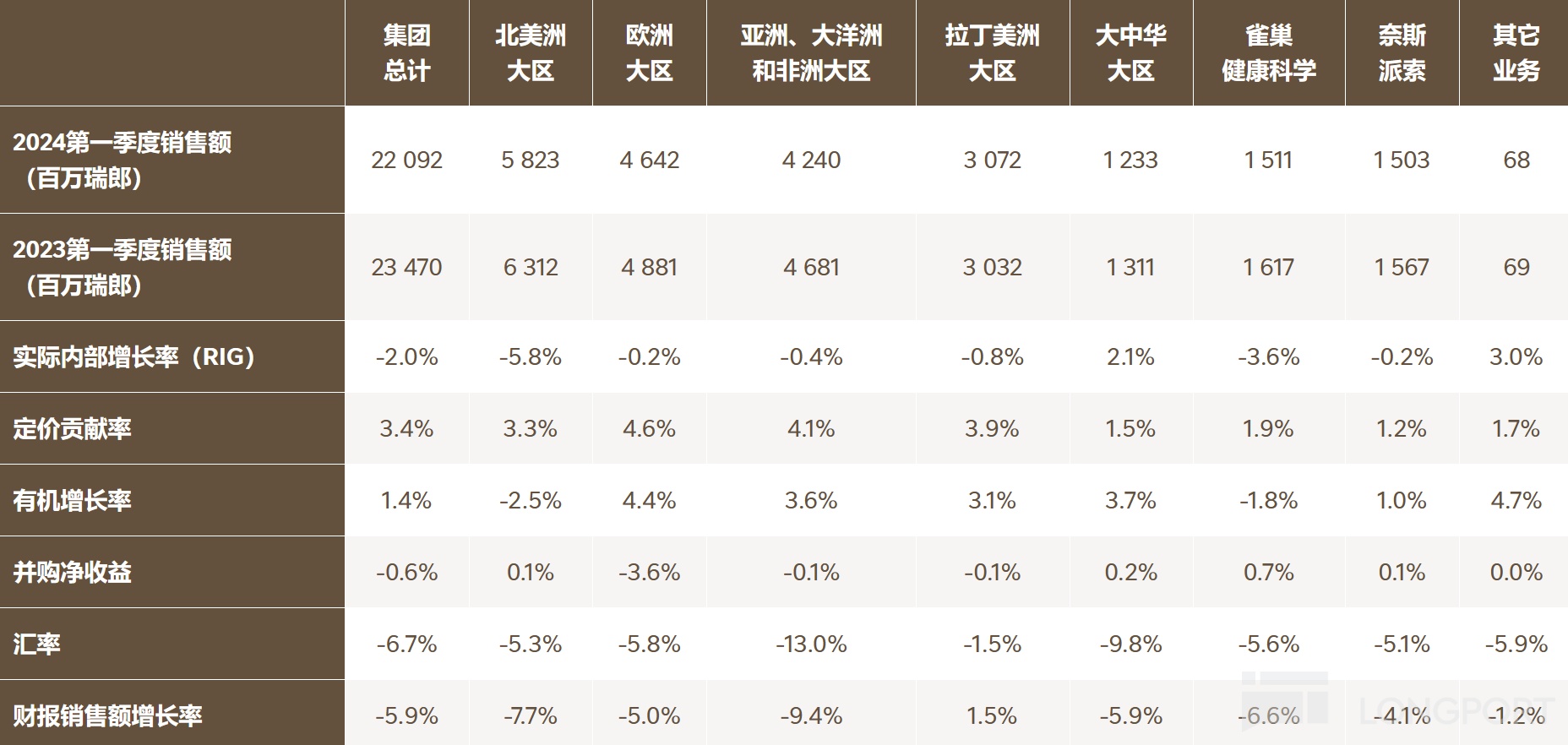
On April 25, Nestlé released its Q1 2024 operational data: total sales fell by 5.9% to 22.1 billion Swiss francs (approximately 177.1 billion yuan). Exchange rate fluctuations caused a 6.7% decline in sales, while asset divestitures contributed a negative impact of 0.6%.
Due to declining sales of frozen foods in North America and supply issues in the vitamin business, organic growth in Q1 was only 1.4% (compared to 7.2% in 2023), with price increases contributing 3.4% and the actual internal growth rate (RIG, a measure of sales volume) at -2%.
The 3.4% price increase is the lowest in the past two years, compared to 9%-10% in the second half of 2022 and the first half of 2023. During the earnings call, Nestlé CEO Mark Schneider explained the 2024 pricing strategy: "We will still pursue moderately positive pricing, but some categories and regions will remain stable or even see price reductions to maintain competitiveness."
End of Across-the-Board Price Hikes

Nestlé operates over 340 factories in 76 countries, producing seven major categories of products, including coffee, infant nutrition, pet care, and ready-to-eat meals. It owns more than 2,000 brands, 31 of which generate over 1 billion Swiss francs in sales, such as KitKat and San Pellegrino. Chinese consumers are familiar with brands like Totole, Haoji, Hsu Fu Chi, and Wyeth.
Thus, changes in Nestlé's product prices have widespread implications. From 2022 to 2023, Nestlé and other food giants continued to raise prices amid rising costs. CEO Schneider commented on the price hikes at the time: "When assessing the weakness in the food industry, it's important to view it historically. What we witnessed over the past two years was absolutely a historic surge in food price inflation. In fact, it's fair to say this was a once-in-50-years event."
For example, from Q4 2022 to Q4 2023, Nestlé's year-over-year price increases were 10.1%, 9.8%, 9.1%, 6.3%, and 5.2%, respectively.
Amid the aggressive price hikes, consumers adjusted their purchasing behavior, either buying less or switching to cheaper brands. In Q4 2022, when prices rose the most (10.1% on average), sales volume dropped by 2.6%.
Price increases slowed in the second half of 2023, with a 9.5% rise in the first half and 7.5% in the second half. In Q1 2024, price increases narrowed to 3.4%.
On April 25, CEO Schneider outlined the latest pricing strategy: "We still expect moderately positive pricing in 2024. That said, different regions have different cycles, commodity costs, and input costs, so future pricing must be more nuanced than in the past. You'll see some categories and regions adjusting prices in very targeted ways, while others may remain stable or even see slight reductions to maintain competitiveness."
"The era of across-the-board price hikes driven by rising costs, as seen in 2022, is over. Going forward, pricing will be highly specific and nuanced. The same category in different regions, or different categories in the same region (like North America), may vary significantly."
With cocoa prices soaring recently, will this trigger another round of price hikes for chocolate products? Schneider stated that the company's forward contracts largely cover production for the rest of the year, providing stability for planning and minimizing short-term impacts. However, they are monitoring price trends to determine strategies for 2025.
Rethinking Innovation
During the six quarters of price hikes, Nestlé's RIG (a measure of sales volume) was unstable. Some categories, like coffee, saw normalization post-pandemic, while others were affected by rising costs and reduced consumer purchases. Years of insufficient product innovation also impacted sales.
Stable sales volumes are more reassuring to investors. In the latest quarter, RIG was -2%, worse than in all four quarters of 2023. Nestlé's full-year 2024 outlook projects organic sales growth of about 4% and a modest increase in underlying trading operating profit margin. Whether sales stabilize in the remaining three quarters will determine if the 4% growth target is met.
CEO Schneider promised a strong rebound in RIG in Q2, with stable and positive performance for the rest of the year. The pet care business, which has seen double-digit growth for four consecutive years, remains the biggest contributor to Nestlé's organic growth. Even if it slows, new product launches will fill the gap.
For example, Nestlé is developing nutritional products for users of GLP-1 weight-loss drugs. While the company relies on coffee, confectionery, dairy, ready-to-eat meals, and condiments for revenue, GLP-1 drugs are changing eating habits—posing a challenge. "If you can't beat them, join them." GLP-1 users need products to build muscle and prevent osteoporosis.
CEO Schneider noted that GLP-1 companion products might launch in the second half of 2024 under Nestlé Health Science. "We've learned from some news outlets that potential companion products for GLP-1 patients could generate 1.5 billion Swiss francs in sales. We aim to help patients find the right solutions for issues like muscle loss, stomach discomfort, and potential vitamin deficiencies. Nestlé Health Science can be a valuable partner in their weight-loss journey."
In May, Nestlé will launch a website to help GLP-1 users find suitable nutritional products.
Schneider said: "There's renewed interest in weight loss, and momentum is building. High-protein, portion-controlled meals and vegetables are ideal for those looking to lose weight, whether or not they're on GLP-1 therapy." Nestlé's new product logic is that when people eat less, their bodies still need vitamins, minerals, and supplements to prevent muscle loss and weight regain.
This is a high-profile product innovation, but why has Nestlé lacked similar initiatives in recent quarters to boost sales? Schneider attributed this to the 2022 supply chain crisis.
"Looking back at innovation over the past four years, the pandemic in 2020-2021 initially didn't slow us down, as we had products ready from earlier years. But in 2022, the global supply chain crisis diverted energy away from innovation. We weren't alone—everyone was focused on keeping supply chains running and prioritizing core SKUs to maintain shelf stock. Innovation took a backseat."
In 2023, Nestlé resumed new product launches. In 2024, the company will invest heavily in new products to attract consumers.
Wyeth's Decline in Greater China
In March 2024, Schneider visited China for the first time in three years. At the China Development Forum, he announced Nestlé's restructuring: the global three-region structure expanded to five, with Greater China as one of them, "to ensure issues and needs from the Chinese market reach my desk directly."
In Q1, Nestlé's Greater China sales fell 5.9% to 1.2 billion Swiss francs (9.62 billion yuan), with exchange rates causing a 9.8% negative impact. The confectionery business was the biggest growth driver during the Spring Festival period.
Organic growth in Greater China was 3.7% in Q1: RIG was 2.1%, and price increases contributed 1.5%. Growth was driven by strong out-of-home and e-commerce channels. Instant coffee, confectionery, and pet food gained market share, while Wyeth infant nutrition lost ground.
By product category, confectionery was the top contributor, thanks to Hsu Fu Chi and 脆脆鲨 (Crispy Shark). Nestlé Professional achieved double-digit growth.
Coffee sales in Greater China grew at a mid-single-digit rate, slightly better than the low-single-digit global growth. Beyond Nescafé and Nespresso, this includes packaged Starbucks products for home and out-of-home consumption.
Pet care sales grew double-digits, driven by new product launches and strong e-commerce performance, particularly Purina Pro Plan and Fancy Feast. This aligns with global trends, as Purina is Nestlé's biggest organic growth contributor. In April, Nestlé announced a new 472 million euro pet food factory in Italy.
Infant nutrition sales in Greater China grew slightly, but Wyeth sales declined, offset by gains in NAN products. Globally, this segment grew at a low-single-digit rate.
Seasoning sales in Greater China dipped slightly due to declining retail channels. $Novo Nordisk AS(NVO.US) $Nestlé S.A.(NSRGF.US)
The copyright of this article belongs to the original author/organization.
The views expressed herein are solely those of the author and do not reflect the stance of the platform. The content is intended for investment reference purposes only and shall not be considered as investment advice. Please contact us if you have any questions or suggestions regarding the content services provided by the platform.