


 Likes Received
 Posts
PostsThe technical bull market in Hong Kong stocks is back! Let's discuss three high-probability investment strategies for Hong Kong stocks!

On Friday, Hong Kong stocks continued to soar, marking a full week of gains.
The Hang Seng Index (HSI) in particular surged to a high of 17,758 points on Friday.
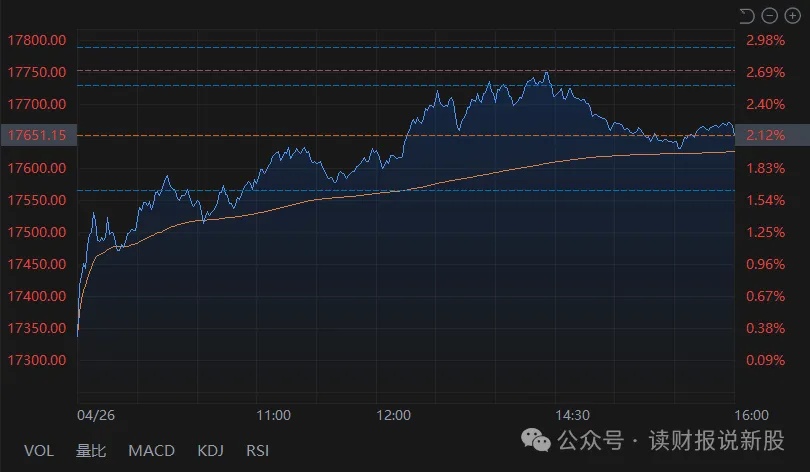
The 17,758-point level is critical. Generally, if a major index rises or falls by more than 20%, it enters a technical bull or bear market.
The lowest point for the HSI in the past two years was 14,793 points on January 22 this year. Multiplying this by 1.2 gives 17,752 points.
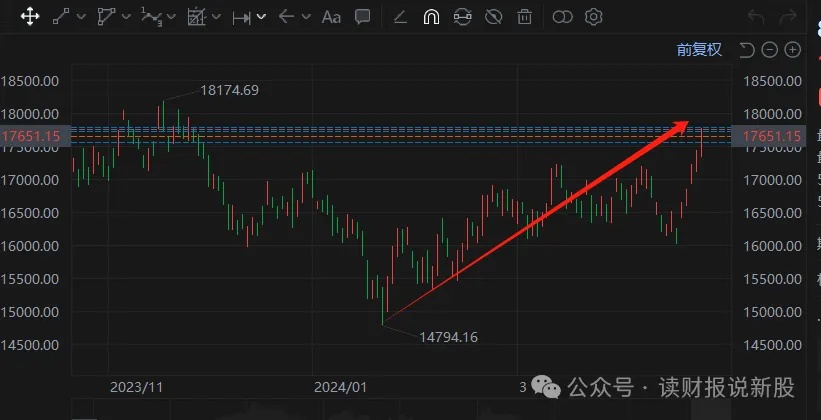
Once the HSI surpasses 17,752 points, it means Hong Kong stocks have entered a technical bull market (the Hang Seng Tech Index had already entered a technical bull market in March).
In other words, Hong Kong stocks have officially entered a technical bull market as of Friday (with both the HSI and Hang Seng Tech Index confirming the trend).
The last time Hong Kong stocks saw such a spectacle was at the end of 2022, when many stocks doubled in value, including Tencent, Meituan, Alibaba, Pinduoduo, Kuaishou, and some small-cap stocks trading below net asset value.
Will history repeat itself this time? Let’s wait and see!
However, Brother Cai must remind everyone that although the HSI briefly crossed the technical bull threshold, it retreated in the final hour, closing just below the critical level.
For cautious investors, it’s best to wait until the HSI can consistently close above 17,752 points—only then can we confirm a sustained technical bull market, not just a one-day wonder!
.......
Brother Cai invests across Hong Kong, U.S., and A-shares, with a roughly equal allocation between A-shares and Hong Kong/U.S. stocks.
Having witnessed the extreme volatility of Hong Kong stocks over the years, Brother Cai considers himself a seasoned veteran in this market.
After five consecutive days of gains last week, many of you likely saw profits in your Hong Kong stock accounts. Brother Cai wants to share his high-probability investment strategies honed over the years.
Some lessons were learned the hard way—worth referencing and discussing. Brother Cai welcomes any feedback or additions in the comments!
........
Type 1: Companies deemed unprofitable at scale—buy when they’re on the verge of or just achieving scalable profitability.
The 2020 bull run was a frenzy for Hong Kong’s internet stocks, with extreme market optimism characterized by:
- Long-term outlooks (3-5 years or more)
- Overlooking probabilities (assuming potential equals inevitability)
From 2022 to 2023, sentiment swung to the opposite extreme—short-term focus and skepticism (assuming failure where progress was lacking).
This caused Type 1 companies (transitioning to profitability but not yet there) to plummet—80% drops could become 90%, then 95%. Examples: Bilibili, pre-profit Kuaishou and Meituan.
Yet, if these companies do achieve scalable profitability, their rebounds are often multiples of their lows.
Risks:
1. Only 1-2 out of 10 loss-making companies achieve scalable profitability—how to pick the right ones?
2. Even if correct, entering too early can hurt returns (high cost basis, prolonged downturns).
Solutions:
1. Avoid companies you believe will never achieve scalable profitability, no matter how cheap.
2. Avoid those unlikely to profit within a year, even if you believe they eventually will.
3. Scalable profitability isn’t instantaneous—enter when profits are small but evident, then add as fundamentals improve.
Key factors: business model and organizational efficiency. Both weak? Unlikely. One strong? Possible with time. Both strong? Rapid turnaround likely.
Type 2: Proven scalable profit generators trading near historical valuation lows (PE/PB/PS aligned).
These blue chips may fall due to earnings volatility or external factors—but core logic remains intact.
Unlike Type 1, their valuations compress rather than collapse. If EPS grew over three years, declines are milder (even EPS declines rarely hit 90%):
1. Company A: 2020 profit = 10B yuan, expected 10-15% growth → 30-40x P/E (300-400B yuan market cap). By 2023, profits hit 15B yuan, but P/E halved to 15-20x → 225-300B yuan (75% of peak).
2. Company B: Same start, but growth missed (12B yuan by 2023), P/E 10-15x → 120-180B yuan (45% of peak).
Conclusion: With decent entry valuations and 3-year holds, profits are likely (1 year may be insufficient).
Risks:
1. Short-term EPS misses may be noise, but multi-year underperformance suggests:
- Industry growth plateau (mid-cycle optimism fades at penetration limits).
- Eroding competitiveness (market share losses despite sector growth).
2. Overpaying at entry.
Solutions:
1. Focus on firms with strong moats and stable/growing market share—watch for sustained declines.
2. Avoid P/E > growth rate (especially 1.5-2x). Mind risk-free rate impacts (P/E > 1/risk-free rate is risky). In dividend-focused markets, >15x P/E demands caution. Target 3-5%+ shareholder returns (dividends + buybacks, ideally covering stock incentives).
Type 3: Deeply undervalued stocks trading far below book value.
These are either perennially unprofitable or plagued by issues—higher risk than Types 1-2.
If Graham’s net-net valuation shows upside, rebounds can dwarf Type 1-2 gains.
In the late 2022-early 2023 technical bull run, blue chips like Tencent rose 1.5x, while Type 3 stocks often surged 2-3x.
Given the risks, diversify holdings—Brother Cai suggests ~10 positions (no need for Graham’s 50+).
All three strategies are battle-tested (with some failures), but overall returns have been strong!
Brother Cai welcomes discussion in the comments! $SENSETIME-W(00020.HK) $XIAOMI-W(01810.HK) $TENCENT(00700.HK)
That’s all for today—hope it helps! I’m Brother Cai, a 财报 enthusiast focused on Hong Kong/IPOs and long-term investing across HK/U.S./A-shares. See you next time!
The copyright of this article belongs to the original author/organization.
The views expressed herein are solely those of the author and do not reflect the stance of the platform. The content is intended for investment reference purposes only and shall not be considered as investment advice. Please contact us if you have any questions or suggestions regarding the content services provided by the platform.
