As the Hong Kong insurance industry rebounds, let's see how Prudential Insurance opens up the channel for value growth.

Compared to the difficulties before the epidemic, this "report card" from Prudential Insurance undoubtedly demonstrates the restorative power brought by the recovery trend in the Hong Kong insurance industry.
Since 2023, the long-dormant insurance market in Hong Kong has finally blossomed.
According to data released by the Hong Kong Insurance Authority, in the first half of 2023, mainland visitors invested HKD 31.9 billion in insurance in Hong Kong, a 5815% increase compared to the same period last year (HKD 539 million). This figure surpasses the peak period of Hong Kong insurance in 2016 (HKD 30.1 billion), reaching a historical high since 2005.
The increase in new business premiums from mainland visitors is mainly driven by the demand for whole life insurance and critical illness coverage. According to the statistics of new policies, these two types of insurance account for a combined 89%, with whole life insurance accounting for 55% and critical illness coverage accounting for 34%.
From the above data, it is clear that the Hong Kong insurance industry is showing a significant recovery trend. This can also be confirmed by the performance of many insurance companies after the release of their interim results, such as the industry leader, Prudential Insurance (02378).
In the first half of 2023, with the resumption of travel between Hong Kong and mainland China, Prudential Insurance has achieved outstanding performance, especially in the Hong Kong region. During the reporting period, Prudential Hong Kong achieved annual premium equivalent sales of USD 1.027 billion, a year-on-year increase of 3.52 times; new business profit reached USD 670 million, an increase of 2.18 times. Among them, the annual premium equivalent sales from mainland clients ranked first in the industry.
Benefiting from the strong rebound in annual premium equivalent sales in certain regions, Prudential Insurance's new business profit increased by 39% to USD 1.489 billion in the first half of the year. At the same time, the group's European embedded value operating profit increased by 22% to USD 2.155 billion, thanks to the increase in new business profit from the insurance business, the increased profit from its asset management business, and the reduction in central costs.
Compared to the difficulties before the pandemic, Prudential Insurance's "report card" undoubtedly proves the restorative power brought by the recovery of the Hong Kong insurance industry.
Obviously, from a deeper perspective, Prudential's initiation of the value restoration channel is not achieved overnight, and the resonance of "external factors" and "internal factors" is worth exploring in depth.
"External factors": Industry recovery and optimistic growth prospects
Multiple signs indicate that the Hong Kong insurance industry is significantly recovering.
In terms of the market, the strong demand from mainland visitors is driving the recovery of the Hong Kong and Macau insurance market, which was once known for its "insurance shopping spree".
Mainland visitors have always played a crucial role in the Hong Kong insurance market: before the pandemic, mainland customers were important customer groups in the Hong Kong insurance business, accounting for about one-third of the market.
The peak of mainland visitors' insurance purchases in Hong Kong occurred in 2016, which was regarded as the golden age of Hong Kong insurance. In the first half of that year, new business premiums reached HKD 30.1 billion, and the annual new business premiums reached HKD 72.7 billion. Among them, mainland visitors accounted for about 40% of the annual new business premiums in Hong Kong.
However, due to the impact of the pandemic, the proportion of this business has declined significantly. In 2021, new business premiums from mainland visitors dropped to HKD 700 million. In 2022, new business premiums from mainland visitors reached HKD 2.1 billion, accounting for only 1.5% of the total new business premiums in Hong Kong. Nowadays, with the full resumption of the policy allowing mainland and Hong Kong-Macao residents to travel since early February, the demand for insurance among mainland visitors to Hong Kong has once again surged.
Regarding the strong surge in insurance purchases by mainland visitors to Hong Kong, the market indicates that "the demand for Hong Kong insurance among mainland visitors has not been fully released, and in the future, insurance purchases by mainland visitors to Hong Kong will continue to increase." In other words, the recovery of the Hong Kong insurance industry is still accelerating.
According to data from UBS, among 1,000 mainland residents who visited Hong Kong before customs clearance, 47% expressed interest in purchasing overseas insurance, and about two-thirds of the residents considered purchasing insurance within one year of customs clearance. UBS stated that the demand for overseas insurance among mainland residents is strong, and by 2024, the amount of insurance purchased by mainland residents visiting Hong Kong may return to the peak level before the pandemic.
In terms of policies, industry policies are also developing in a more favorable direction, releasing positive signals and accelerating the recovery of the industry.
For example, at the end of 2022, the Hong Kong Special Administrative Region government issued the "Development Blueprint for the Insurance Industry in Hong Kong," which stated that Hong Kong is striving to establish post-sales service centers for insurance in Nansha and Qianhai, and will further study the feasible models for connecting the mainland and Hong Kong insurance markets, consolidating Hong Kong's position as an international risk management center and a mature and comprehensive insurance hub.
On February 23, the People's Bank of China, together with the China Banking and Insurance Regulatory Commission, the China Securities Regulatory Commission, the State Administration of Foreign Exchange, and the Guangdong Provincial People's Government, jointly issued the "Opinions on Financial Support for the Comprehensive Deepening of Reform and Opening-up in the Qianhai Shenzhen-Hong Kong Modern Service Industry Cooperation Zone," allowing overseas financial institutions, especially those from Hong Kong, to establish life insurance companies, property insurance companies, and insurance holding companies in the Qianhai Cooperation Zone to improve cross-border insurance business and accelerate the establishment of insurance service centers in the Greater Bay Area, including the Qianhai Cooperation Zone.
The gradual implementation of the above-mentioned policies is expected to lay a solid foundation for the new development of the Hong Kong insurance market and accelerate the recovery of the industry.
In addition to the support from policies and the market, as residents' income levels continue to rise, the demand for wealth management and inheritance, health protection (especially high-end medical care and critical illness), and global asset allocation among mainland residents is expected to gradually increase. The Hong Kong insurance market is expected to win the trust of more mainland customers with its advantages in marketization and professionalism, thereby promoting the growth of the Hong Kong insurance market.
The significant recovery of the industry undoubtedly presents a great opportunity for Prudential Hong Kong, which is in the midst of performance restoration. Prior to the pandemic, Prudential Hong Kong was already the market leader in mainland customer business. Leveraging its outstanding brand, diverse channels, and product advantages, it has laid a strong foundation for driving high-quality business growth.
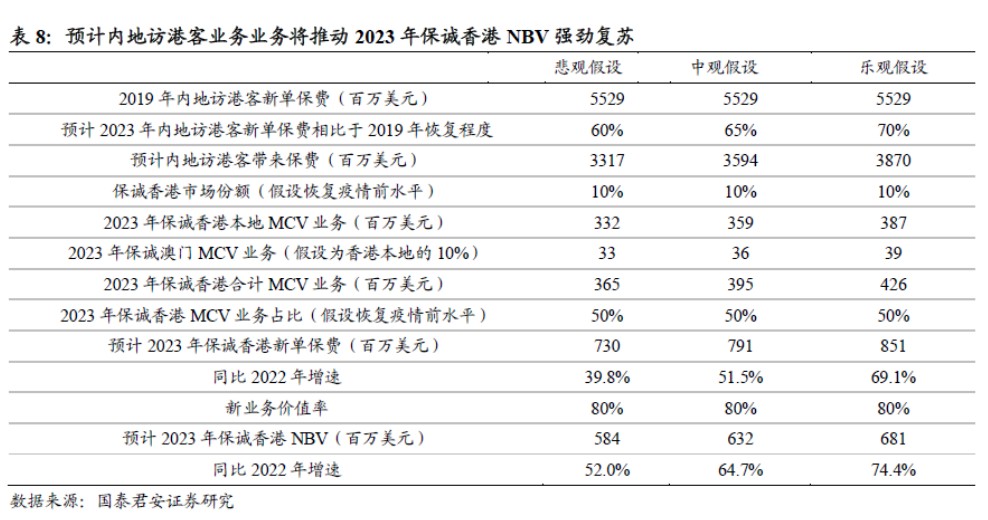
According to calculations by Guotai Junan, with the accelerated growth of mainland visitors to Hong Kong after customs clearance, and based on the assumption of a slight increase in the discount rate due to the rise in US dollar interest rates in 2022, it is expected that under the assumption of no major adjustments to the product structure, the new business value rate will rebound to 80% in 2023. It is estimated that under the improvement of both new policies and value rates, the year-on-year growth rate of Prudential Hong Kong's new business value will be 64.7%, and it will drive the year-on-year growth rate of the group's new business value to be 15.0%.
(Data source: Guotai Junan)
Nowadays, based on the company's semi-annual report, which shows that the sales of equivalent premiums and new business profits of Prudential Hong Kong have increased by 3.52 times and 2.18 times respectively compared to the same period last year, it is expected that Prudential Insurance's growth rate for the full year of 2023 may surpass Guotai Junan's estimate.
And Prudential seems to have sufficient confidence in this growth. The Group's CEO, Hu Kangyao, predicts that the momentum of mainland visitors' business will gradually normalize in the third quarter, but the momentum will still continue. The number of mainland visitors to Hong Kong has recovered to about 70% of the 2019 level in July and August, which is optimistic about the growth prospects of the Hong Kong business.
Generally speaking, the industry's ceiling is a key factor to consider for a company's performance to maintain growth. Similarly, the trend of industry recovery will undoubtedly bring significant incremental space to companies in the industry. Therefore, it is not difficult to speculate that with the significant recovery of the industry, the value restoration of Prudential is a certainty.
Internal factors: Diversified business drives high-quality performance growth
As the saying goes, one needs to be strong to forge iron. With the recovery of the industry, Prudential naturally needs some "real skills" to grow.
According to the Zhitong Finance APP, Prudential Group has been operating globally for 175 years and has entered the Asian market for 100 years, enjoying a good reputation. As of now, the group ranks among the top three in 12 of the 14 Asian life insurance markets and 4 of the 8 African markets, with a total of 18 million customers choosing Prudential. In addition, the group is also the only large-scale insurance company focused on Asia and with a scale in both agency and bancassurance channels. It also has internal investment capabilities, and its asset management business, HanYa, currently manages over $220 billion in assets.
Looking at the business structure, after divesting its European and American businesses, Prudential Group has become a financial holding group mainly engaged in life insurance and asset management in the Asia-Pacific market. Specifically, the company's business segments include Prudential Asia (14 markets), HanYa Investments (11 Asian markets), and Prudential Africa (8 markets), focusing on life insurance in Asia and Africa and asset management in the Asia-Pacific region. In particular, the emerging markets in Asia-Pacific have become the company's most focused development direction in recent years.
On this basis, Prudential also implements diversified product portfolios and multi-channel distribution strategies as part of its development strategy. With the above layout, Prudential has also built a relatively solid "moat" to drive overall high-quality performance growth, as follows:
First, Prudential implements a multi-channel development strategy to promote the growth of insurance business, enhance the flexibility and risk resistance of business expansion.
It is reported that unlike other insurance companies in the industry that focus on a single channel for the development of insurance business, Prudential implements a strategy of developing multiple channels, including agency, bancassurance, and digital sales platforms, in most of the life insurance markets it covers. Under the strategy of multi-channel development, it will help the company to choose the most suitable way to sell to customers according to local conditions, and also help to enhance the flexibility of business expansion to counter uncertain risks.
This can be seen from its latest financial data - the semi-annual report disclosed that in the first half of 2023, Prudential's agency and bancassurance channels were both substantial, accounting for 2/3 and 1/3 of new business profits, respectively. Currently, the group has more than 70,000 active agents, and 7,000 agents qualify as members of the "Million Dollar Round Table". In addition, Prudential currently has more than 200 bank partners, including 10 strategic partners. It can be seen that the large-scale agency and bancassurance channels will enable the company to have a significant advantage in reaching customers, and thus the company's performance recovery is expected to be better than its peers during the industry recovery.
Secondly, Prudential provides a variety of insurance products to meet the diverse needs of customers, opening up a broader space for incremental growth.
It is understood that Prudential adheres to a customer-centric product orientation, customizing insurance products based on the economic level and consumption preferences of customers in different regions. For example, it has launched critical illness plans targeting customers in the Greater Bay Area in mainland China, and continues to enrich the Islamic insurance product system and maintain a leading market position in Indonesia and Malaysia.
At the same time, based on the different consumption preferences of customers in various branch markets, the annual equivalent premium sales of the company's various types of products are relatively balanced. In 2022, the proportions of participating policies, non-participating policies, investment-linked policies, and health and protection policies were 26%, 30%, 20%, and 24% respectively, fully meeting customers' insurance needs for wealth management and critical illness compensation.
The customer-centric product orientation and diversified product portfolio have greatly enhanced the stickiness of the company's products, increased product repurchase rates, and thus driven significant growth in the company's performance.
In addition, in terms of asset management, Prudential has also devoted itself to building a specialized asset management platform to further enhance the company's ability to withstand market fluctuations.
Specifically, Prudential Group's asset management sector is mainly represented by Eastspring Investments, which is the professional asset management platform of Prudential Asia. This platform can provide customers with diversified asset allocation solutions to meet their needs for asset preservation and appreciation. Currently, it ranks among the top ten in six of the markets where it operates.
As the asset management platform of Prudential Asia, Eastspring Investments is positioned as a market-oriented asset management platform, with 300 investment professionals who possess deep local expertise, providing comprehensive wealth management solutions for high-net-worth and affluent clients. The asset allocation is diversified, with a relatively high allocation of equity assets in addition to fixed-income assets such as debt securities. This is mainly because the liability side of the policies is mostly long-term return-oriented with longer durations, and it has a stronger ability to withstand short-term market fluctuations.
For example, in years with significant market volatility, the cash flow contribution from the insurance business within the group effectively offsets the impact of net asset value decline, enabling Eastspring's asset management scale to maintain steady growth. In 2022, the asset management scale reached USD 229.4 billion, with a compound annual growth rate of 9.8% from 2017 to 2022. Based on the above, Prudential Insurance, which has built core advantages in the life insurance and asset management businesses, obviously has sufficient development capabilities to "advance and retreat" effectively.
Conclusion
From the performance of the secondary market, the insurance sector of the Hong Kong stock market has experienced a significant valuation recovery since the end of October 2022. Although the market's pessimistic expectations for the macro economy have somewhat suppressed the valuation of insurance stocks since May, with major insurance companies delivering a good "mid-term report card" in terms of performance, the valuation of insurance stocks is expected to accelerate its recovery.
As for Prudential Insurance, as a high-quality stock in the Hong Kong insurance sector, it should also benefit from the upward trend in industry value. Moreover, for Prudential Group, as the company continues to deepen its focus on the Asia-Pacific development strategy and relies on a strong multi-channel distribution and customer-centric product strategy, it is expected to enjoy the long-term growth dividend of the Asia-Pacific insurance market. With the combination of valuation recovery potential and long-term growth dividend, Prudential is clearly expected to open the channel for value recovery.