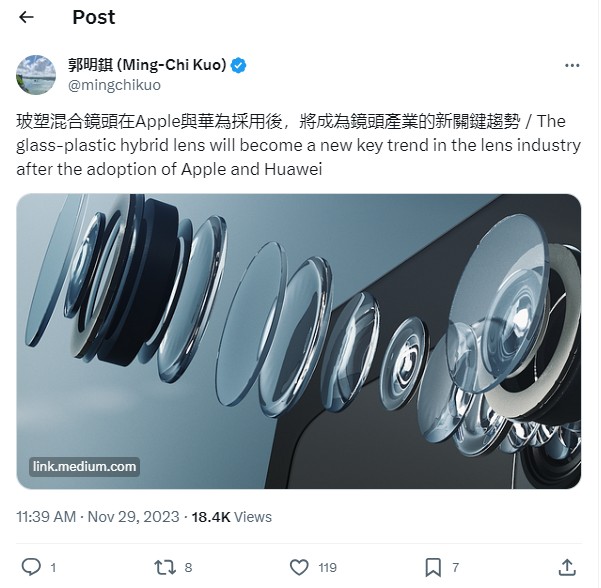
Guo Mingchi: Glass-plastic hybrid lenses adopted by Apple and Huawei will become the new key trend in the lens industry.

After being adopted by Apple and Huawei, glass-plastic hybrid lenses have become the new key trend in the lens industry. Largan Precision and Sunny Optical are the leading manufacturers of glass-plastic hybrid lenses, with the advantage of producing their own molded glass. The 1G6P lens used by Huawei has a sample price of about $12, which drops to $6-7 after mass production. Glass-plastic hybrid lenses, which use molded glass, have strong resistance to deformation. The use of glass-plastic hybrid lenses in the iPhone 15 Pro Max and P70 Art indicates a new trend in the lens industry.
Zhitong App learned that on November 29th, Tianfeng International analyst Guo Mingji published an article stating that glass-plastic hybrid lenses will become the new key trend in the lens industry after being adopted by Apple and Huawei, and other high-end models from other brands may follow suit in the future. Largan Precision and SUNNY OPTICAL (02382) are the leading manufacturers of glass-plastic hybrid lenses in the industry. The 1G6P lens that Huawei will adopt has a sample price of about $12, which is expected to decrease to $6-7 after mass production due to yield improvement. The glass-plastic hybrid lens uses molded glass instead of the less efficient wafer-level glass.
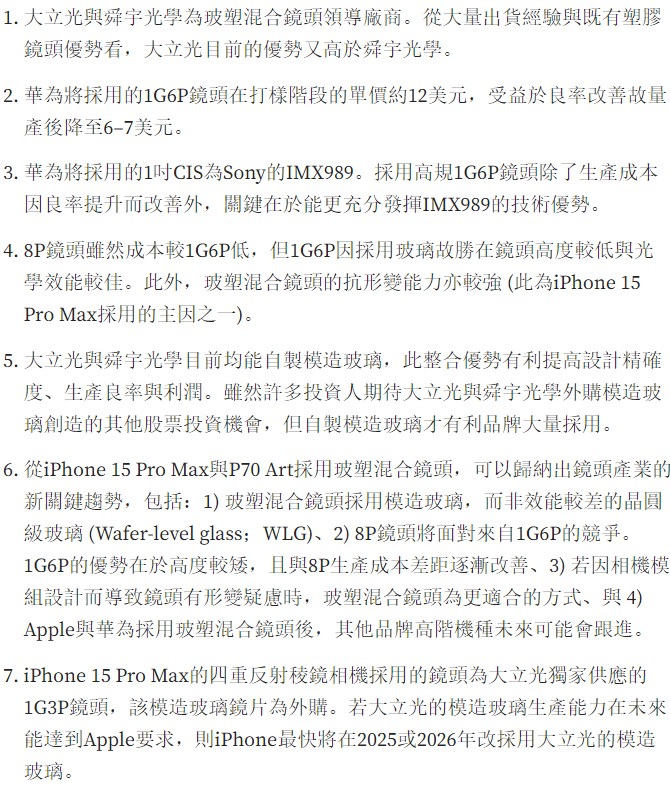
According to Guo Mingji, Largan Precision and SUNNY OPTICAL (02382) are the leading manufacturers of glass-plastic hybrid lenses. Based on their extensive shipping experience and existing advantages in plastic lenses, Largan Precision currently has a higher advantage than SUNNY OPTICAL. Both Largan Precision and SUNNY OPTICAL are capable of producing molded glass in-house, which is advantageous in improving design accuracy, production yield, and profit. Although many investors expect opportunities for other stock investments created by Largan Precision and SUNNY OPTICAL's external procurement of molded glass, it is only through in-house production of molded glass that brands can be encouraged to adopt it on a large scale.
The 1G6P lens that Huawei will adopt has a sample price of about $12, which is expected to decrease to $6-7 after mass production due to yield improvement. The 1-inch CIS that Huawei will adopt is Sony's IMX989. The use of the high-spec 1G6P lens not only improves production costs due to yield improvement but also maximizes the technical advantages of the IMX989. Although the 8P lens has lower costs than the 1G6P lens, the 1G6P lens has the advantage of using glass, resulting in a lower lens height and better optical performance. In addition, the glass-plastic hybrid lens has strong resistance to deformation (which is one of the main reasons why the iPhone 15 Pro Max uses this material).
From the adoption of glass-plastic hybrid lenses in the iPhone 15 Pro Max and P70 Art, we can summarize the new key trends in the lens industry, including:
-
The use of molded glass in glass-plastic hybrid lenses instead of the less efficient wafer-level glass (WLG).
-
The 8P lens will face competition from the 1G6P lens. The advantage of the 1G6P lens lies in its shorter height, and the production cost gap with the 8P lens is gradually narrowing.
-
When there are concerns about lens deformation due to camera module design, the glass-plastic hybrid lens is a more suitable option.
-
After Apple and Huawei adopt glass-plastic hybrid lenses, other high-end models from other brands may follow suit in the future.
In addition, Guo Mingji also pointed out that the four-fold reflective prism camera of the iPhone 15 Pro Max uses a 1G3P lens exclusively supplied by Largan Precision, and the molded glass lens is externally procured. If Largan Precision's production capacity for molded glass can meet Apple's requirements in the future, the iPhone will switch to Largan Precision's molded glass as early as 2025 or 2026.