Societe Generale warns of the biggest black swan event in 2024: the bursting of the US tech bubble.

Wallstreetcn
2023.12.23 12:10
portai
I'm PortAI, I can summarize articles.

Technical indicators show that the US stock market currently appears to be somewhat overheated.

Unknowingly, the magical year of 2023 is coming to an end.

As we enter 2024, Albert Edwards, the global strategist known as the "Societe Generale S.A. Sponsored ADR Bear," issued a warning in his last "Global Strategy Weekly" of 2023 about potential variables that could shake the global financial markets in 2024.

In the report, Edwards focused on the instability of the US technology industry and its potential impact on the overall market. He also analyzed the possibility of an economic recession in the United States.

Edwards warned that the bursting of the US IT industry bubble could be the biggest "black swan" event in 2024 that could drag the entire US market into a recession:

"The biggest surprise in 2024 could be the bursting of the US technology bubble, which would plunge the entire US market into a recession."

The Biggest Black Swan of 2024: Bursting of the US Technology Bubble

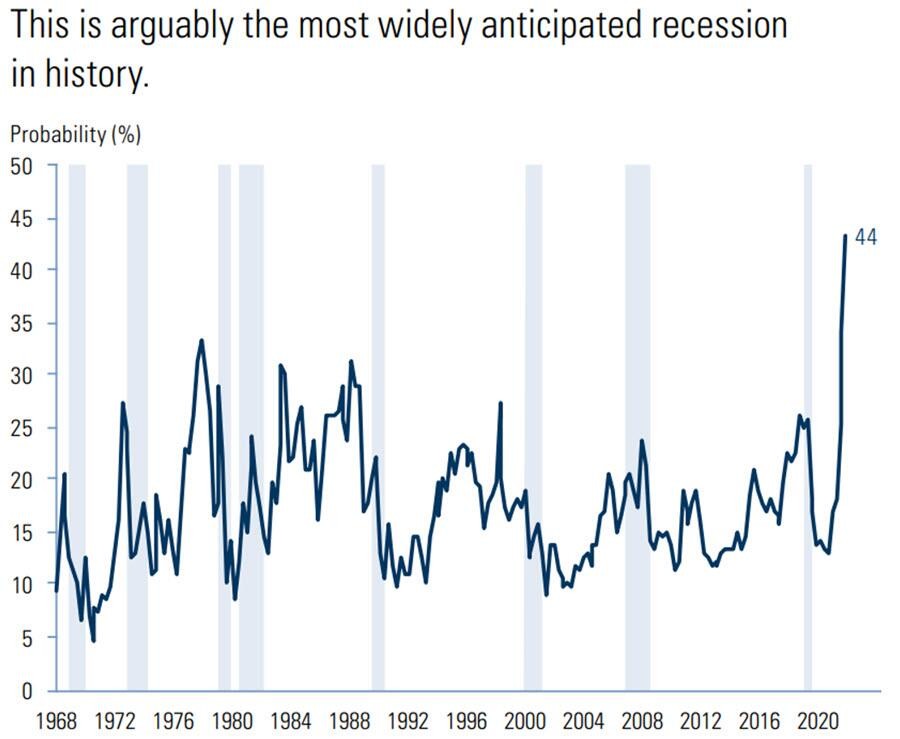
Edwards mentioned that "the widely predicted US economic recession" did not materialize, which was one of the macro "surprises" of this year. The AI boom driving the surge in the US IT technology industry was another "surprise" of this year.

He wrote in the report:

"2022 was a bad year for technology companies, as they faced both profit warnings and rising bond yields.

After the debut of ChatGPT in 2023, there was a frenzy of FOMO (fear of missing out) in the (technology stocks), which even the bond yields rising above 5% could not interrupt."

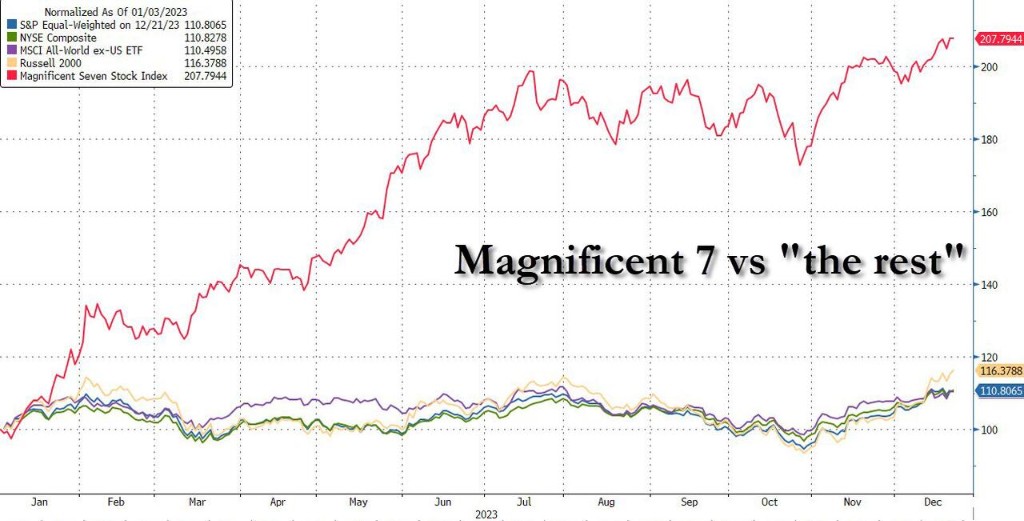
Next, Edwards acknowledged that the astonishing performance of the US "technology" this year was largely driven by the "Big Seven" technology giants - Apple, Microsoft, Google, Amazon, Meta, and the newcomers Nvidia and Tesla. Edwards exclaimed in the report:

"This means that US technology stocks now account for nearly one-third of the US market value (twice as much as five years ago)!"

Looking ahead to 2024, Edwards predicts that the US technology industry will dominate the US stock market, just like the brief frenzy in the summer of 2000.

It is worth noting that Edwards reminds us that until the "Powell Pivot" at the end of 2018, the price-to-earnings ratio of US technology stocks was only "slightly higher than the market," and the forward price-to-earnings ratio was in the teens for both. **

And now, compared to the 12-month forward P/E ratio of 27 times in the US IT industry, the overall market is less than 20 times (i.e. a premium of 7 times).

The senior strategist warned in the report:

"The biggest surprise in 2024 may be the bursting of the US tech bubble, dragging the entire US market into a recession."

Technical Analysis: US stocks seem overheated

Edwards also mentioned that technical indicators show that the US stock market currently appears to be overheated.

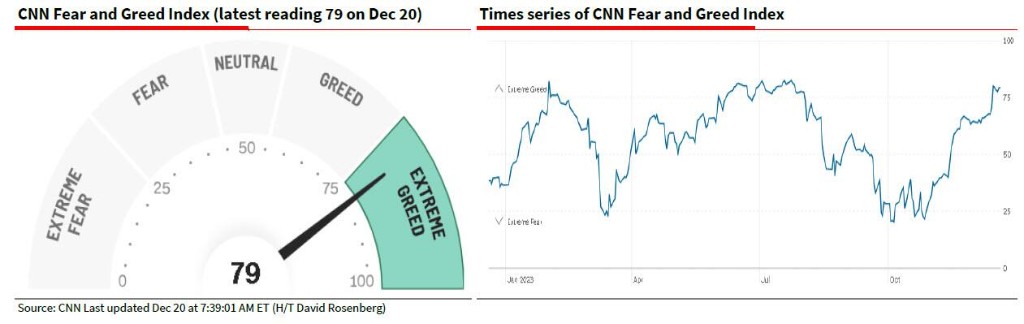
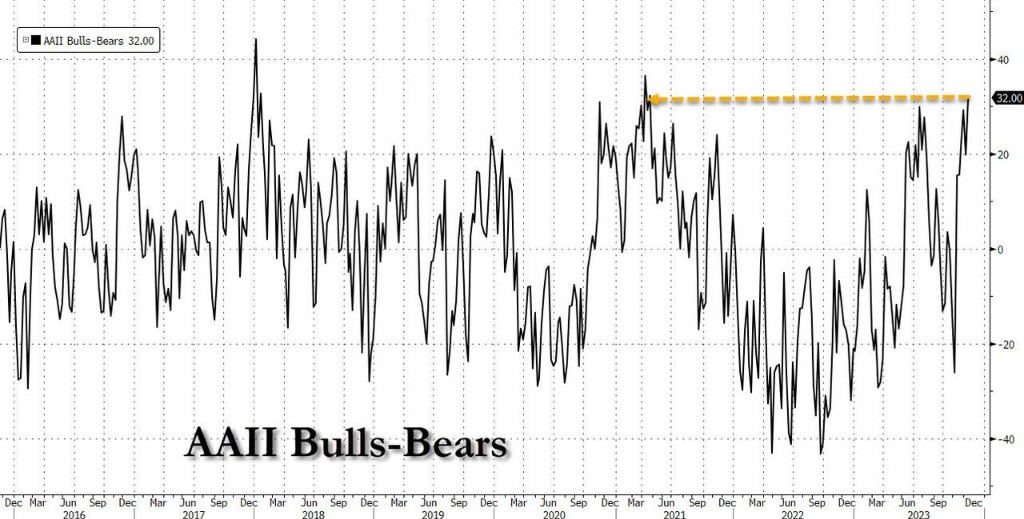
Many indicators confirm this view. For example, CNN's Fear & Greed Index shows extreme greed, while price momentum, bullish/bearish ratio, and volatility all show signs of stretching.

It is worth mentioning that in July of this year, this index was at such a high level, and in the following three months, the market experienced a significant correction of nearly 11%. In addition, the current reading of 79 on the extreme greed scale is in sharp contrast to the low fear signal of 38 at the same time last year.

In addition, the balance between long and short positions of retail investors is rapidly approaching a record high, which is also a signal that the market is about to adjust.

US economic recession? Not yet apparent

It is certain that whether the US stock market will enter a bear market in the future will depend on whether the US economy will fall into a recession.

However, the recent soaring S&P 500 index does not seem to imply a recession risk in the US economy. In the report, Edwards quoted Gerry Minack, a well-known figure in the Australian Daily, as saying:

"In the two months before the start of an economic recession, the S&P 500 index usually falls 2% from its cyclical peak."