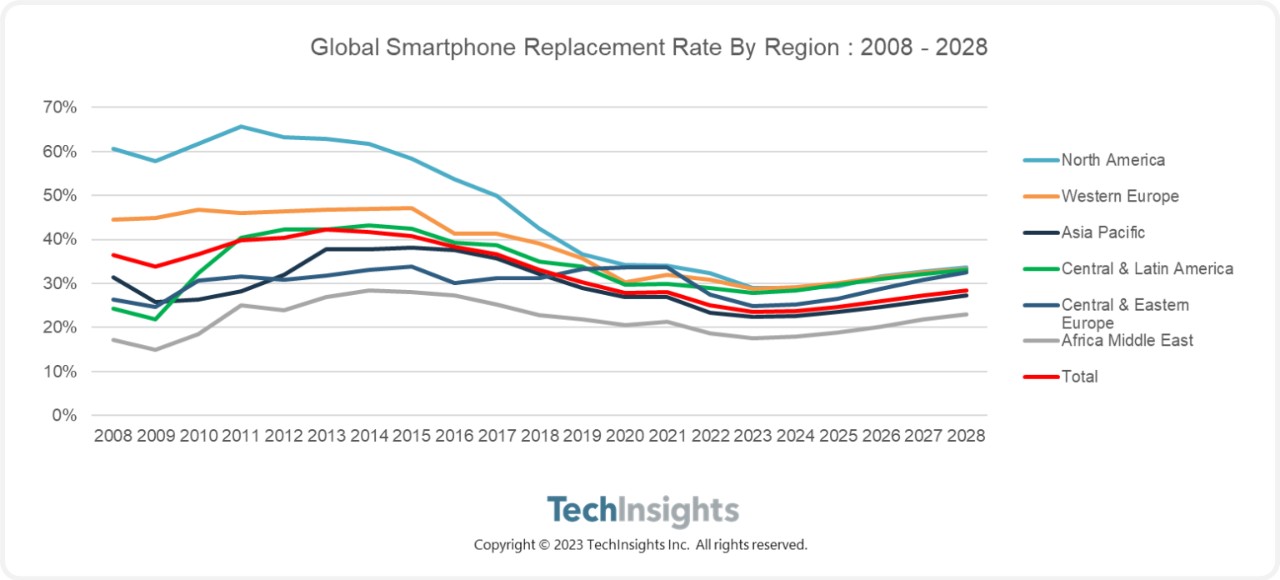
TechInsights: The global smartphone replacement rate may drop to 23.5% in 2023.

In 2023, the global smartphone replacement rate is expected to drop to a record low of 23.5%, with a replacement cycle of 51 months. Due to factors such as geopolitical tensions and uncertainties in the global economic outlook, TechInsights has lowered its forecast for global smartphone sales in 2023 and 2024, leading to a further decline in the replacement rate. From 2024 onwards, as the economy recovers and 5G migration takes place, the replacement rate will slowly rebound. The replacement rates in the Asia-Pacific, Western Europe, and North America will reach historic lows. The replacement rate in the Asia-Pacific region will show an upward trend from 2024 to 2028, but the progress of mature 5G markets will not be as strong as that of emerging markets. The replacement rates in Central Latin America and the Middle East and Africa will continue to decline, but improvements in infrastructure such as 5G network construction will drive an increase in the replacement rate. The Central and Eastern European markets will experience fluctuations, and the replacement rate at the end of the forecast period will not exceed that of 2019.
Zhitong App has learned that TechInsights has published an article stating that the replacement rate of global smartphones has been declining. Based on key assumptions such as ongoing geopolitical tensions and uncertain global economic prospects, the institution has lowered its global smartphone sales forecast for 2023 and 2024. Therefore, the replacement rate of smartphones will also further decline. Due to inflation, interest rate hikes, and uncertain economic prospects, the replacement rate of global smartphones in 2023 may drop to a record low of 23.5% (with a replacement cycle of 51 months). Starting from 2024, the replacement rate will slowly rebound due to economic recovery and 5G migration.

All six regions worldwide will follow the global pattern.
In 2023, the replacement rate in the Asia-Pacific, Western Europe, and North America regions will reach the lowest level in history, but the replacement cycle in North America will still be shorter than in other regions.
With the easing of the COVID-19 pandemic, the replacement rate in Western Europe has increased in 2021, but energy crises, inflation, and high interest rates have hindered the region's resilience.
The Asia-Pacific region is a fragmented region. From 2024 to 2028, all countries will have an upward trend, but the progress of mature 5G markets such as South Korea, Japan, China, and Australia will not be as good as that of emerging markets.
Due to channel shifts, a higher proportion of prepaid and low-income users in recent years, the replacement rate in Central Latin America and the Middle East and Africa has continued to decline. However, in the coming years, better facilities such as the construction of 5G networks will drive an increase in the replacement rate.
In recent years, the Central and Eastern European markets have been fluctuating. Starting from 2024, despite wars and unstable economies, the region is expected to recover. However, by the end of the forecast window of the institution, its replacement rate will not exceed that of 2019.