Preview of US IPOs | With a revenue of $24.306 million, can we understand the "Tea Leaf Economy" of Mindonghong?

Zhitong
2024.01.13 11:47
portai
I'm PortAI, I can summarize articles.

Mingdong Red Tea is planning to go public on NASDAQ, as the company has shown steady growth and high profitability. As a comprehensive tea product supplier in China, Mingdong Red controls the entire industry chain of tea cultivation, processing, and sales, with high-quality raw materials and cost advantages. The company's tea gardens are located in Ningde City, Fujian Province, occupying a prominent position in China's white tea industry cluster. The listing plan of Mingdong Red has been driven by the successful listing of LANCANG TEA on the Hong Kong Stock Exchange in 2023. Whether Mingdong Red can succeed in the US stock market remains to be seen.

Over the years, tea has been a representative gift that has stood the test of time. The Chinese people's habit of drinking and appreciating tea remains an indispensable part of daily life. With such a huge market demand, it has also nurtured the birth and development of many tea companies.

However, in recent years, with the rise of new Chinese-style tea drinks targeting young people as the consumer anchor, the market share of traditional tea companies has been impacted. "Seeking innovation" has become the most important proposition. Many traditional tea companies have chosen to break the conventional business mindset, from cross-border operations to IP marketing, in order to get as close as possible to the young consumer group. Naturally, there are also some tea companies that have set their sights on the path of going public for financing.

Under the incentive of Lincang Ancient Tea successfully listing on the Hong Kong Stock Exchange at the end of 2023, Min Dong Hong Tea, which failed to impact the Hong Kong stock market in 2021 and turned to a US IPO, has recently updated its prospectus and plans to list on NASDAQ with the code "ORIS". In the US stock market, where the "tea-drinking" atmosphere is not strong, can Min Dong Hong Tea "adapt like a fish to water"?

Steady growth in performance and high profitability

Zhitong App has learned that Min Dong Hong is a comprehensive tea product supplier in China. The company has been engaged in the production and sales of tea since March 2014, and has been deeply involved in the tea industry for over 9 years. After years of accumulation, Min Dong Hong has completed the vertical integration of its business, covering tea planting, processing, and sales of tea products to Chinese tea operators and end customers.

The advantage of forming a complete industry chain is that Min Dong Hong can effectively control the raw material end, ensure the quality of tea products, and to a certain extent, form a cost advantage. It can also form a more integrated model in terms of sales.

From the perspective of raw materials, Min Dong Hong's tea gardens are located in Tuorong County, Ningde City, Fujian Province. Up to now, the company has signed contract management and planting rights agreements with tea gardens covering approximately 7.212 million square meters in Fujian Province. According to a report by CITIC Corporation, Fujian accounted for 67.2% of the total production of white tea in mainland China in 2021. Obviously, Fujian is the location of China's white tea industry cluster.

It is worth noting that in 2020, Min Dong Hong ranked tenth in Ningde City with a tea garden area of 5.136 million square meters. Currently, the tea garden area of Min Dong Hong has increased by more than 2 million square meters, and the market scale continues to expand.

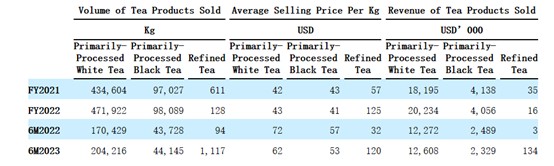
In terms of financial performance, the development of Min Dong Hong Tea over the years has been relatively stable. In 2021 and 2022, its revenue was $22.368 million and $24.306 million, respectively, with net profits of $9.383 million and $11.853 million during the same period. As of the first half of 2023, its revenue was $15.071 million, a year-on-year increase of 2.08%, but its net profit was $8.499 million, a year-on-year decrease of 4.53%.

From the perspective of product categories, the main tea products of Mindonghong include raw tea (white tea and black tea), as well as refined white tea and black tea. Among them, raw white tea has become the core product of Mindonghong. In the first half of 2021 to 2023, the proportion of raw white tea in the company's total revenue was 81.3%, 83.2%, and 83.7% respectively, making it the undisputed "pillar".

Therefore, it is not difficult to see that the growth of Mindonghong's revenue is mainly driven by the increase in tea sales volume. According to the prospectus, in 2021 and 2022, the average selling prices of processed white tea and black tea remained stable, but the sales volume of processed white tea and black tea increased by 8.59% and 1.1% respectively in 2022, driving the overall revenue growth of the company by 8.66% in 2022.

In terms of profit margin, the gross profit margin of Mindonghong was 51.33% and 52% in 2021 and 2022 respectively. Based on the growth of revenue, the stability of gross profit margin, and the company's cost reduction and efficiency improvement during the period, the net profit of Mindonghong in 2022 increased by 26.32%.

As we enter 2023, although the sales volume continues to grow steadily, the prices of the company's main products, processed white tea and black tea, have decreased by 13.89% and 7% respectively. The decrease in prices has affected the growth of total revenue driven by sales volume. During the reporting period, Mindonghong's revenue only increased by 2.08%. Market price fluctuations are inevitable, and for companies with a high proportion of a single product, they are often affected by market price fluctuations.

However, this does not change the high profitability of Mindonghong. In the first half of 2021 to 2023, Mindonghong's net profit margin was 41.95%, 48.77%, and 56.4% respectively. It is worth mentioning that this tea company from Fujian does not seem to be driven by "money" alone. As of June 30, 2023, the company's total assets were USD 62.922 million, total liabilities were USD 4.438 million, and the asset-liability ratio was only 7.05%. Moreover, nearly half of the total assets of USD 62.922 million are in cash and cash equivalents.

Traditional tea companies face constraints in IPO and are difficult to break through.

With the continuous emergence of marketing strategies and tactics, the competition in the tea sales market has become increasingly fierce. Mindonghong, which seems to have no worries about sales volume, also has its own "difficulties".

From the perspective of the overall competitive landscape of the industry, in 2020, there were more than 50,000 players in the Chinese tea industry, and the market competition was intense and sufficient, with the majority being small and medium-sized enterprises. Mindonghong, with its tea plantation area, ranks among the top ten in Ningde, one of the largest tea production cities in Fujian, indicating that Mindonghong has already achieved a certain scale. The reason why tea companies have been able to stand strong for many years is naturally related to their stable demand. In the fiscal years of 2021 and 2022, as well as the first half of 2023, sales to the top five customers accounted for 57.1%, 40.5%, and 41.8% of the total revenue of Mindonghong, respectively. Although the company has consciously reduced its reliance on the top five customers, their purchases are still important for Mindonghong's sales.

However, according to industry trends, the concentration of China's tea industry is still relatively low, with a large number of dispersed enterprises, and the industry is currently dominated by small and medium-sized enterprises. Even the market share of leading companies such as China Tea and Bama Tea is very small. Being in this environment, Mindonghong, which has not yet expanded nationwide, seems to have no clear advantage.

In its prospectus, Mindonghong stated that in recent years, the company has been unable to fulfill all the purchase orders from customers. In the fiscal years of 2021, 2022, and the first half of 2023, the amount of purchase orders received but not undertaken by the company was USD 12.69 million, USD 14.26 million, and USD 6.88 million, respectively. It can be seen that the main problem currently plaguing Mindonghong is insufficient production capacity.

The cause of the insufficient production capacity does not seem to be a financial issue, but rather a consistent pain point in the tea industry: although China's tea industry is large in scale and has a wide variety of tea products, it is still in a relatively primitive stage of production.

On the one hand, the tea industry is labor-intensive, and with the transfer of rural labor, there is an increasingly severe shortage of labor. According to the research results of the National Tea Industry Technology System Economic Research Office, there is a shortage of about 20% of tea-picking labor in tea-producing areas in China every year, and in severely affected areas, it can reach up to 30%.

On the other hand, most tea gardens in China are not suitable for mechanized operations, and coupled with a lack of key equipment, high-quality teas still rely on manual picking. The mechanization rate of cultivation, fertilization, weeding, and other processes is also not high. This can also explain to some extent why Mindonghong finds it difficult to expand its business scale.

These difficulties in scaling, standardization, and cross-regional operations, combined with the challenges of relying on weather conditions in tea gardens and the difficulty in controlling raw material quality, collectively contribute to the tea industry's inability to improve production efficiency and gain long-term favor from the capital market.

In addition, the current classification of traditional tea companies by major sectors does not seem to be favorable for them. Tea companies cannot avoid the issue of industry classification, and how to classify them has become a dilemma. This is also one of the reasons why many tea companies withdraw their IPO applications after failing to receive reasonable valuations from the capital market.

If Mindonghong wants to break free from the shackles of market competition and become an industry leader, it needs to enhance itself comprehensively. This includes industry expertise, scale and mechanized production capabilities, management capabilities, cost control capabilities, and brand building capabilities. It also requires continuous expansion of high-quality tea garden scale. Perhaps, this is also an important factor driving Mindonghong's urgent pursuit of listing.