


Fed's rate cut expectations in March shattered! Goldman Sachs and Bank of America "surrender" and turn their attention to May

Expectations for a rate cut by the Federal Reserve in March have been pushed back to May, as Wall Street economists have abandoned their predictions for a rate cut in March. Federal Reserve Chairman Powell stated that there would be no rate cut until the inflation rate approaches 2%, which caught the market by surprise. Key employment and inflation data are expected to be released before the May meeting, making economists more cautious. Goldman Sachs and Barclays expect the Federal Reserve to cut rates for the first time in May. JPMorgan and Deutsche Bank are calling for a rate cut in the second quarter. Traders have increased their bets on a rate cut in May, with expectations of more than two 25 basis point cuts in June. The probability of a rate cut in March has now dropped to about one-third.
According to Zhitong App, Wall Street economists have abandoned their predictions of a rate cut by the Federal Reserve in March and shifted their focus to May.
After the conclusion of the Federal Reserve policy meeting on Wednesday, banks such as Goldman Sachs, Bank of America, and Barclays, which had previously predicted that the Fed would start lowering interest rates in March, have postponed their rate cut expectations.
The Federal Reserve stated clearly in its statement that it does not expect to cut rates until it has greater confidence that inflation is approaching 2%. Fed Chairman Powell also indicated that a rate cut is unlikely at the March 19-20 meeting, which surprised the market.
Before the Fed's May meeting, there will be several key employment and inflation data releases, which have made even economists who previously predicted a rate cut in June more cautious.
Bank of America, including economists Michael Gapen and Mark Cabana, stated after the Fed meeting, "When the Fed Chairman essentially ruled out the possibility of a rate cut in March, we have to accept this signal."
Bank of America has pushed back its expectation of the first rate cut by the Fed from March to June, citing the lack of inflation data before May and the Fed's preference to make policy adjustments at meetings where new quarterly economic forecasts are released. However, they added that "a rate cut in May is still on the table" and have pushed back their expectations for the Fed to slow down its balance sheet reduction from March to May.
Goldman Sachs economist Jan Hatzius and his team currently expect the Fed to make its first rate cut at the meeting on April 30 to May 1, instead of the previously expected March meeting, although they still expect a total of 125 basis points of rate cuts this year. Barclays also expects the Fed's first rate cut to be in May instead of March.
After Powell's statement, traders have increased their bets on rate cuts in May and June.
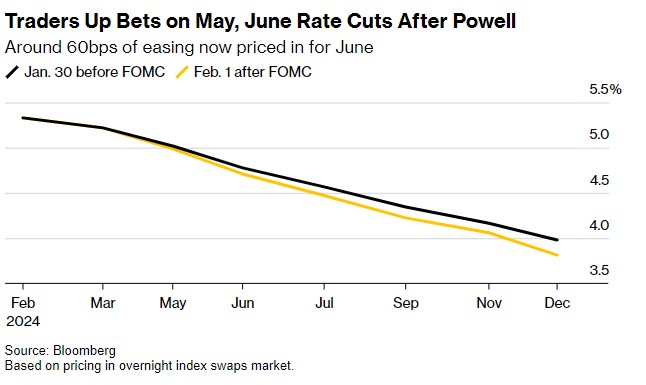
Interest rate swap traders have also increased their bets on a rate cut in May and expect more than two 25 basis point cuts in June. The probability of a 25 basis point rate cut in March has dropped to about one-third.
For investment banks such as JPMorgan and Deutsche Bank, Powell's comments and the Fed's statement have confirmed the call for rate cuts in the second quarter, but have also prompted them to consider the possibility of action at the Fed's meeting on April 30 to May 1.
Nevertheless, some still believe that the Fed's commitment to data-dependent decision-making leaves the possibility of a rate cut, including in March, still open. Anna Wong, the leader of Bloomberg Economics team, insists that the Federal Reserve should cut interest rates in March because "continuously weak inflation data and even weaker labor market data will eventually give officials enough confidence."
