Annual Carbon Market Report by LSEG: Global carbon market trading volume continues to grow in 2023, with diverging trends in carbon prices.

Zhitong
2024.02.20 08:20
portai
I'm PortAI, I can summarize articles.

Based on the information provided, this is the financial information about the LSEG Carbon Market Report. In 2023, the global carbon market trading volume continued to grow, but carbon prices showed differentiation. Influenced by factors such as global economic slowdown, geopolitical conflicts, and falling gas prices, carbon prices in most regions fell, contrasting with 2022. However, carbon quota prices in China and the United States rose, while carbon prices in other regions dropped significantly. The EU Emissions Trading System remains the largest market globally, accounting for around 87% of the total value of the global carbon market. Both the national and pilot carbon market trading volumes in China have increased, and actions are being taken to promote the development of the carbon market.

Zhitong App learned that on February 20th, according to the news from Refinitiv, LSEG Carbon Research Group released its annual flagship report "2023 Carbon Market Year in Review: Growth Amid Controversy". Due to the global economic slowdown, geopolitical conflicts, and fluctuating gas prices, most regions saw a downward trend in carbon prices in 2023 compared to 2022. However, there were differentiated trends in carbon prices among different regions - in the past year, carbon quota prices in China and the United States have been on the rise, while in other regions, due to oversupply and weakening demand, carbon prices have dropped significantly.

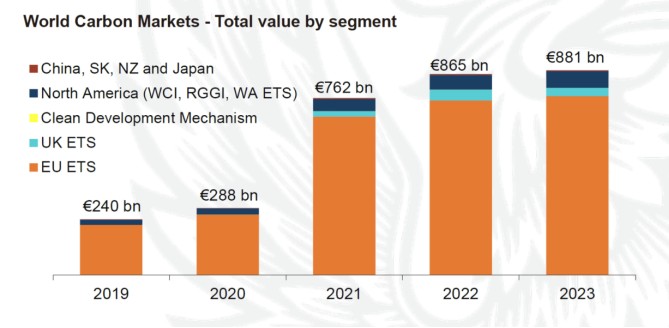
Overview of the total trading volume in the global major carbon markets from 2019 to 2023

Source: LSEG 2023 Carbon Market Year in Review

The European Union Emissions Trading System (EU ETS) remains the largest market globally, accounting for around 87% of the total value of the global carbon market in 2023. In 2023, the EU continued to implement its ambitious climate and environmental policies through Fit for 55, including substantial reforms to the EU ETS. Increased trading activities and tightened quota allocations pushed carbon prices briefly above €100 per ton in February last year, maintaining high levels in the first three quarters. However, impacted by a weak winter natural gas market and economic downturn pressure, carbon prices sharply declined in the fourth quarter. The EU will hold European Parliament elections in 2024, which may hinder further climate-related legislative processes in the short to medium term.

Overall trading volume in China's national and pilot carbon markets has increased. In 2023, as the national carbon market entered its second compliance period, buying sentiment surged in the second half of the year, with both listed trading and bulk trading prices hitting historic highs. Relevant departments of the Chinese government have been taking actions to continue promoting the development of China's carbon market in 2023, including expanding industry coverage research and launching the China Voluntary Carbon Market (CCER).

Although trading activities in the North American carbon market slightly decreased in 2023, carbon prices rose overall. The latest carbon market in the United States - the Washington Cap-and-Invest Program - made a strong start in 2023, with prices continuously rising in the first three auctions, followed by policy adjustments by the government leading to a slight decline in carbon prices in the fourth quarter. Meanwhile, prices in the Western Climate Initiative (WCI) market steadily rose throughout the year, hitting historic highs, as the California Air Resources Board (CARB) explores plans to tighten the quota cap in the coming years. The prices of RGGI (Regional Greenhouse Gas Initiative) have also reached a new high, despite uncertainties about whether Virginia and Pennsylvania will participate in the program.

In 2023, carbon market mechanisms continue to expand to new regions, with Egypt, Japan, Indonesia, and Taiwan, China introducing new plans. Indonesia, Japan, and Taiwan, China are all voluntary carbon markets, with Indonesia's voluntary carbon market covering the power sector and using carbon credits, actively encouraging business participation. Over the past year, India, Brazil, and Turkey have been preparing for their upcoming carbon trading systems, and we expect these regions to launch carbon trading within the next one to three years. These emerging carbon trading systems will mostly be based on carbon credits, starting with voluntary principles and transitioning to mandatory compliance-based carbon emission trading systems in about a decade.

The Voluntary Carbon Market (VCM) has had a challenging year. Due to concerns about the quality of carbon credits, the prices of many standardized contracts have fallen to below $1 per ton. Given that buyers are more inclined to make purchasing decisions on a project-by-project basis, the spot market has become more flexible. This impact is most evident in REDD+ projects, which have faced significant media scrutiny throughout the year. The long-running Zimbabwe forestry project Kariba has been abandoned by the certification body Verra and project developer South Pole. Industry initiatives such as ICVCM (The Integrity Council for Voluntary Carbon Market) and VCMI (Voluntary Carbon Markets Integrity Initiative) have issued new guidelines to address concerns related to carbon credit integrity. So far, these industry initiatives have been well received by the sector.

At the 28th United Nations Climate Conference held in Dubai, the rules concerning bilateral ITMO (Internationally Transferrable Mitigation Outcome) agreements under Article 6.2 and carbon credit trading between countries under Article 6.4 were not agreed upon by the parties, delaying the carbon market until 2024. This means that new UN-approved carbon credits are unlikely to appear on the market before 2025 (that is, a full 10 years after the signing of the Paris Climate Agreement). This delay could also bring greater pressure to the voluntary carbon market. In the voluntary market, buyers, sellers, and international voluntary emission reduction standard organizations are already exploring the use of Corresponding Adjustments mechanisms to establish carbon credits compliant with Article 6.