Overseas warehouse benefits continue, but is there hidden concern for GigaCloud Tech, whose valuation has doubled?

Zhitong
2024.03.07 10:42
portai
I'm PortAI, I can summarize articles.

GigaCloud Tech is a company engaged in B2B transactions for large-scale exports, and its stock price has hit a new high under the influence of the surging Nasdaq index. GigaCloud Tech mainly operates three major businesses, including a self-operated platform, a shelf platform, and external e-commerce platforms. The company's valuation has doubled mainly due to the demand for overseas warehouses. However, the true quality of the company may be overshadowed by the rapid growth in valuation.

From October 26 last year to March 1 this year, Invesco QQQ Trust rose from a low of 12,543.86 points to 16,302.24 points, with a maximum interval increase of 29.96%, setting a historical record. Riding on this surge, GigaCloud Tech also reached a new high stock price of $43.56 on March 4.

However, in the following two trading days, Direxion Nasdaq 100 Equal Weight Index shares experienced a pullback, and GigaCloud Tech's stock price also saw a slight decline, mirroring the overall market trend. Looking back at GigaCloud Tech's performance since the end of October last year, the company's valuation doubled in just over 4 months, not only due to its fundamentals but also the external bullish market environment. Consequently, under the backdrop of low base high growth, the company's true value might be overshadowed by rapid valuation growth.

The "Overseas Warehouse Boom" of low base high growth

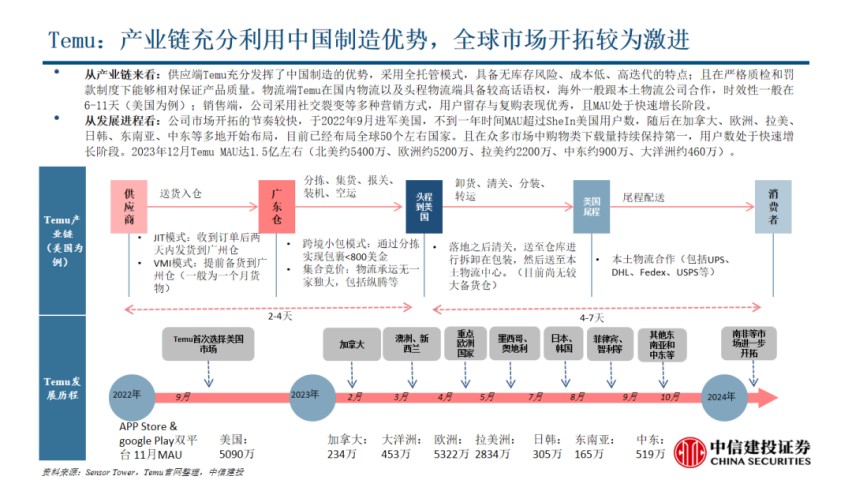
In September last year, ByteDance officially launched ByteDance Shop in the U.S., kicking off a new cross-border e-commerce feast. As ByteDance Shop in the U.S. only supports local delivery from overseas warehouses and strictly cracks down on virtual warehouse shipments, "finding an overseas warehouse for cooperation" became a must for ByteDance sellers. This brought "overseas warehouse concept stocks" into the spotlight, with GigaCloud Tech being one of them.

According to Zhitong App, GigaCloud Tech mainly operates a B2B trading platform for large-scale exports, integrating all aspects of discovery, payment, and logistics tools into one platform, providing comprehensive online or offline cross-border trading and delivery services for large-scale goods worldwide.

In terms of business segments, GigaCloud Tech has three main businesses, including GigaCloud 3P, GigaCloud 1P, and external e-commerce platforms. Under the 1P model, the company operates as a self-owned platform, purchasing goods and selling them on its own platform GigaCloud or third-party platforms, similar to JD.com's self-operated model; under the 3P model, the company acts as a shelf platform, providing transaction matching services for sellers and buyers on the platform and charging service fees, similar to Taobao.

Due to the higher costs of large products in cross-border transportation and storage compared to the small commodities previously focused on by cross-border e-commerce, and the relatively small market size and number of participants before the pandemic, GigaCloud Tech's overseas warehouse business saw significant growth post-pandemic, continuing until 2023.

The Q3 2023 financial report shows that GigaCloud Tech's total revenue for the period reached $178 million, a year-on-year increase of 39.2%; while the net profit for the same period was $24.2 million, a significant year-on-year increase of 3357.1%. At present, it can be seen that the performance growth brought by the previous market's low base dividend is significant for the company. From the operational data perspective, during the reporting period, the GMV of GigaCloud Marketplace platform was $685 million, a YoY increase of 40.8%; the number of active 3P sellers was 741, a YoY increase of 43.3%; the number of active buyers was 4,602, a YoY increase of 9.6%. At the same time, the GMV of 3P sellers on GigaCloud Marketplace was $369 million, a YoY increase of 67.0%, and the GMV of 3P sellers on GigaCloud Marketplace accounted for 54.0% of the total GMV of GigaCloud Marketplace.

As a cross-border e-commerce platform, the performance of GigaCloud Tech has always been affected by the leasing costs of overseas warehouses and shipping costs. According to Zhitong App, the company currently has 31 large physical warehouses in the United States, Germany, the United Kingdom, and Japan, with a total area of over 7 million square feet. Among them, there are 23 large warehouses in the United States.

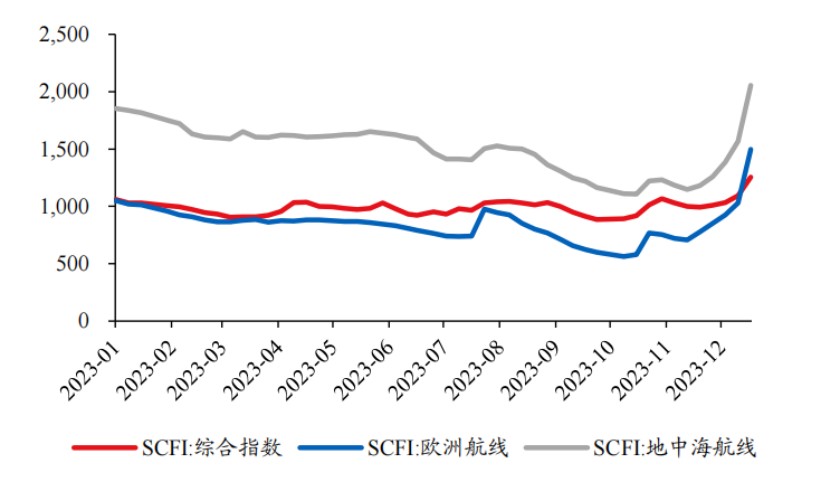
Affected by the crisis in the Red Sea, on December 18 last year, HMM and Yang Ming Shipping announced that they would bypass the Suez Canal, detouring around the Cape of Good Hope in South Africa or waiting at safe locations. As a result, the top nine shipping companies, which account for approximately 82% of global capacity (Alphaliner December 2023 data), have all suspended passage through the Red Sea. Against this backdrop, the SCFI (Shanghai Containerized Freight Index) closed at 1,255 points on December 22 last year, with a MoM increase of +14.8%, including a significant 46% increase on the European route.

The impact of fluctuations in shipping costs on the company's revenue and costs can also be seen from the financial report. In the third quarter of 2023, GigaCloud Tech's revenue costs were $129 million, a YoY increase of 22.7% compared to the same period last year.

Although the most significant route for the company's interests, the China-US route, has not been affected by the crisis in the Red Sea, looking back at 2020-2021, the international shipping industry at that time was affected by the epidemic. Shipping companies collectively raised prices, coupled with events such as strikes by US port truck drivers, significantly impacting China's cross-border export shipping routes, leading to a substantial increase in shipping costs. In 2021, the company's gross profit margin and net profit margin decreased by 6.54 and 5.64 percentage points YoY, respectively, affecting the company's overall profitability.

How long can intermediaries stay in business?

Due to the popularity of cross-border e-commerce, some in the market believe that overseas warehouse companies can rival CXOs in the biopharmaceutical industry and become the "water sellers" of cross-border e-commerce companies. After all, from statistical data, it can be seen that the warehousing and logistics costs of 40% of cross-border e-commerce enterprises account for 20-40% of their operating income, while for over 20% of enterprises, the proportion is between 40-60%. The reason why the income cost of e-commerce sellers is relatively high is that it takes more than half a year from product selection, finding factories, sampling, production to quality control, resulting in high time costs. The shipping process by sea also incurs high time costs, with products taking an average of 60 days from domestic shipment to being listed. Companies specializing in large-item overseas warehouse operations are few and have higher pricing. There is a risk of unsold products, and the freight cost for small-batch products is also high.

GigaCloud Tech's "Supply Chain Front-loading Model" allows factories to manufacture products in advance and transport them overseas for direct sales to end-users. In short, this model can help cross-border sellers overcome constraints in the supply chain such as minimum order quantities and capital investment, enabling them to operate in a light-asset mode.

However, from the perspective of sellers, logistics and warehousing costs are the biggest obstacles to profit growth, and cost control is essential. The service fees of GigaCloud Tech actually require sellers to sacrifice profit margins for transaction convenience, similar in essence to Temu's "Fully Managed" model, but less convenient in terms of ease of use.

In addition to competition from the Fully Managed model, the Independent Station model is also an important competitor for GigaCloud Tech in the future.

According to Zhitong App, the Independent Station refers to websites or applications independently built and operated by companies, selling through their own domain names or third-party platforms, with considerable operational flexibility. It is easy to collect and analyze user data to operate private traffic, showcase brand image and product features, and improve user stickiness and conversion rates. According to iMedia Research data, the number of independent stations established by Chinese companies overseas reached 200,000 in 2021, showing a continuous rapid growth trend.

In comparison, the focus of the Fully Managed model is on trading volume for price, while the Independent Station model has the advantage of high flexibility. The Supply Chain Front-loading Model implemented by GigaCloud Tech is limited by the risk of inventory, mainly suitable for small-scale wholesale or retail, but cannot completely bypass intermediary platforms like Independent Stations.

In summary, as an intermediary, GigaCloud Tech's Supply Chain Front-loading Model does not match up in terms of cost-effectiveness compared to the two models mentioned above, and its future growth potential seems to have a visible ceiling. On the other hand, due to the rapid rise in valuation following the Direxion Nasdaq 100 Equal Weight Index shares, GigaCloud Tech's valuation is clearly on the high side, and at this point in time, any negative news may trigger market profit-taking sentiment, thus posing a certain risk of chasing highs.