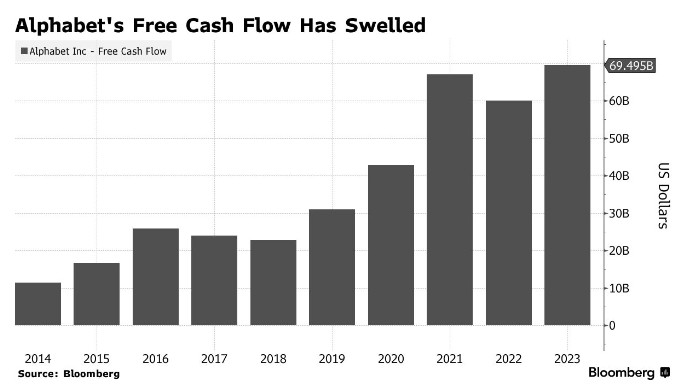
How does Google spend its huge cash pile? Wall Street offers advice: dividends

Google is creating more cash flow, and investors hope the company will start paying dividends. Dividends are a way to further drive the stock price up, similar to Meta's move in February. Google and Amazon are the only two tech companies that do not pay quarterly dividends. Google's stock price has risen by 10% this year. Google's revenue is expected to grow by 14% this year, and the company's free cash flow is projected to reach a record $83 billion in 2024
As Google (GOOGL.US) generates more cash flow, investors are increasingly hoping that the company will follow Meta's (META.US) strategy and start paying dividends.
According to the Securities Times app, the search giant has been using excess cash for stock buybacks for many years. Many investors expect that when Google announces its earnings on April 25th, the company will allocate another $70 billion for buybacks. However, analysts from Morgan Stanley to Truist Securities believe that paying a small dividend is a way to further boost the stock, similar to Meta's move in February when the stock surged by 20%.
Andrew Zamfotis, portfolio manager at Ami Asset Management Corp., said, "Dividends will be welcomed. While investors are still looking for growth in these companies, cost discipline is also valuable now. The decision to initiate dividends indicates that management will act cautiously and attempt to allocate capital in a balanced manner between growth and capital return."
Traditionally, dividends have been seen as the domain of more mature, slower-growing companies, but this policy is becoming increasingly popular among tech companies. In addition to Meta, Salesforce (CRM.US) and Booking Holdings (BKNG.US) have also started paying dividends in recent months. Among the six largest tech companies in the US by market capitalization, Google and Amazon (AMZN.US) are the only two that do not pay quarterly dividends.
Google's stock price has risen by 10% so far this year, outperforming Microsoft (MSFT.US) and the Nasdaq 100 index. Optimism about its generative AI strategy has recently supported the stock's performance, despite falling to a three-month low in March following disappointing earnings reports and concerns that AI tools could challenge its dominant position in the search advertising space.
According to compiled data, Google's revenue is expected to grow by 14% this year, with cost-cutting measures supporting profitability. It is expected that the company's free cash flow will reach a record $83 billion by 2024. As of the end of 2023, Google's cash and cash equivalents exceeded $110 billion.
Tejas Dessai, research analyst at Global X ETFs, said, "We believe Google may follow Meta in paying dividends this year. Given the favorable advertising market and recent cost-saving measures, now seems to be the right time to take this step, and investors are generally positive about it." Indeed, Google still faces other cash needs, such as increasing artificial intelligence computing power. Compiled data shows that the company's capital expenditure reached a record $32 billion last year, with this expenditure expected to grow by another 27% in 2024. However, Wall Street feels that Google has sufficient cash for infrastructure spending and larger capital returns.
Furthermore, market professionals no longer see the initial dividend distribution as a sign of reduced investment opportunities for these companies, but rather as a sign of strengthened capabilities.
Jenny Harrington, CEO of Gilman Hill Asset Management, said, "For companies, holding cash in this environment is still a suboptimal choice. Even if their cash return rate is 5%, the credit they gain from returning cash to shareholders through dividends, or the benefits they receive from buybacks, means that these are better capital allocation decisions."