From Baidu-SWQ1 financial report, looking at the triple transformation brought about by the reconstruction of the entire business of Wenxin Big Model

Zhitong
2024.05.16 15:02
portai
I'm PortAI, I can summarize articles.

Baidu-SW released its first quarter performance for 2024, with revenue of 31.5 billion RMB and net profit of 7 billion RMB, a year-on-year increase of 22%. Baidu achieved a triple transformation by restructuring its entire business, accelerating the value fusion of the entire ecosystem. Goldman Sachs predicts that Baidu will bring in approximately 3 to 6 billion RMB in incremental revenue through general artificial intelligence in 2024. Baidu's cloud service revenue growth will also accelerate, and efficient execution of operating expenses will achieve a stable operating profit margin. This financial report demonstrates the true industrial value and business prospects of Baidu as a leading AI large-scale model enterprise in China

As the wave of generative AI sweeps across the globe, one year is enough to completely transform a company into a "brand new" entity.

As the first enterprise globally to directly benchmark against the ChatGPT large model, Baidu-SW (09888)'s "Wenxin Yiyuan" development and exploration in commercialization have attracted significant attention from the global AI community and capital markets. One year after the launch of "Wenxin Yiyuan," Baidu has delivered impressive results.

On May 16th, Baidu released its first-quarter 2024 performance report. The data shows that Baidu's revenue for the reporting period was 31.5 billion RMB, with a net profit attributable to Baidu (non-GAAP) of 7 billion RMB, a 22% year-on-year increase. Both revenue and net profit exceeded market expectations.

Behind the impressive performance is Baidu's shift from an internet-centric approach to an AI-first strategy, which has led to a thorough restructuring of Baidu's entire business with AI, unlocking value. AI search has not only enhanced product experiences for C-end users but also improved advertising efficiency for B-end users. Cloud services have achieved innovative breakthroughs under the drive of AI, and autonomous driving empowered by AI has successfully established a commercial model. The triple transformation of the three major businesses has accelerated the value fusion of Baidu's entire ecosystem.

Goldman Sachs stated that Baidu is accelerating towards a revenue/profit structure centered around general artificial intelligence. As enterprise users and advertisers adopt its general AI solutions, this is expected to bring Baidu an incremental revenue of approximately 3 to 6 billion RMB in 2024. Additionally, the revenue growth of cloud services is expected to accelerate from the level in 2023, and efficient execution of operating expenses will enable Baidu to achieve a stable operating profit margin.

Through this financial report, we can glimpse into the real industrial value and business prospects of Baidu as a leading AI large model enterprise in China. How to reassign a matching valuation to it will be a question that investors need to deeply consider.

AI-empowered search business is expected to reshape the market competition landscape

As the cornerstone of Baidu's entire business system, the mobile ecosystem business is known as the "cash cow," with its stable profits and cash flow laying a solid foundation for Baidu's long-term high-pressure investment in artificial intelligence. Search, as the core application of the mobile ecosystem, is the foundation of Baidu's mobile ecosystem. With the rise of generative AI, the search industry has ushered in a new transformation.

Search is one of the main ways for the public to obtain information and an important channel for human-computer interaction, making it a massive traffic entry point. In the AI era, AI-empowered search can generate more accurate and direct results, satisfying user needs in one step. Currently, it is believed in the industry that due to the essential nature of search and the excellent user experience of AI-empowered search, search is the most likely application to become the Killer App in the AI era. Therefore, whoever can reshape the search landscape with AI will control the new traffic entry point. Google and Meta are also using AI for relevant transformations, exploring the latest AI+ search models As a leader in the domestic search field, Baidu has been deeply cultivating the search industry for many years and is also the earliest company in China to explore intelligent search. After the launch of Wenxin Yiyuan, Baidu quickly completed the reconstruction of its search business with AI large models. The new search product has three main features: ultimate satisfaction, recommendation stimulation, and multi-round interaction, which not only improves the quality of search but also expands the application scope of search, broadening the boundaries of the product.

Currently, about 11% of Baidu's search results are generated by AI, providing users with more accurate, organized, and intuitive answers. At the same time, Baidu has recently added an "Interactive" section in its search, completely changing to a question-and-answer search format. These actions all indicate that the speed of AI reconstructing search is accelerating.

According to a conference call, the stickiness of Baidu's AI search products is continuously increasing, and more and more search results on Baidu are generated by AI, with formats becoming more diverse, such as text, images, third-party links, points of interest, etc., to meet users' comprehensive search needs.

At the same time, the release of intelligent agents can be said to be an important "lever" for Baidu to improve its search business, enriching Baidu's content ecosystem, enhancing the search experience for C-end users, and effectively improving the advertising efficiency for B-end clients.

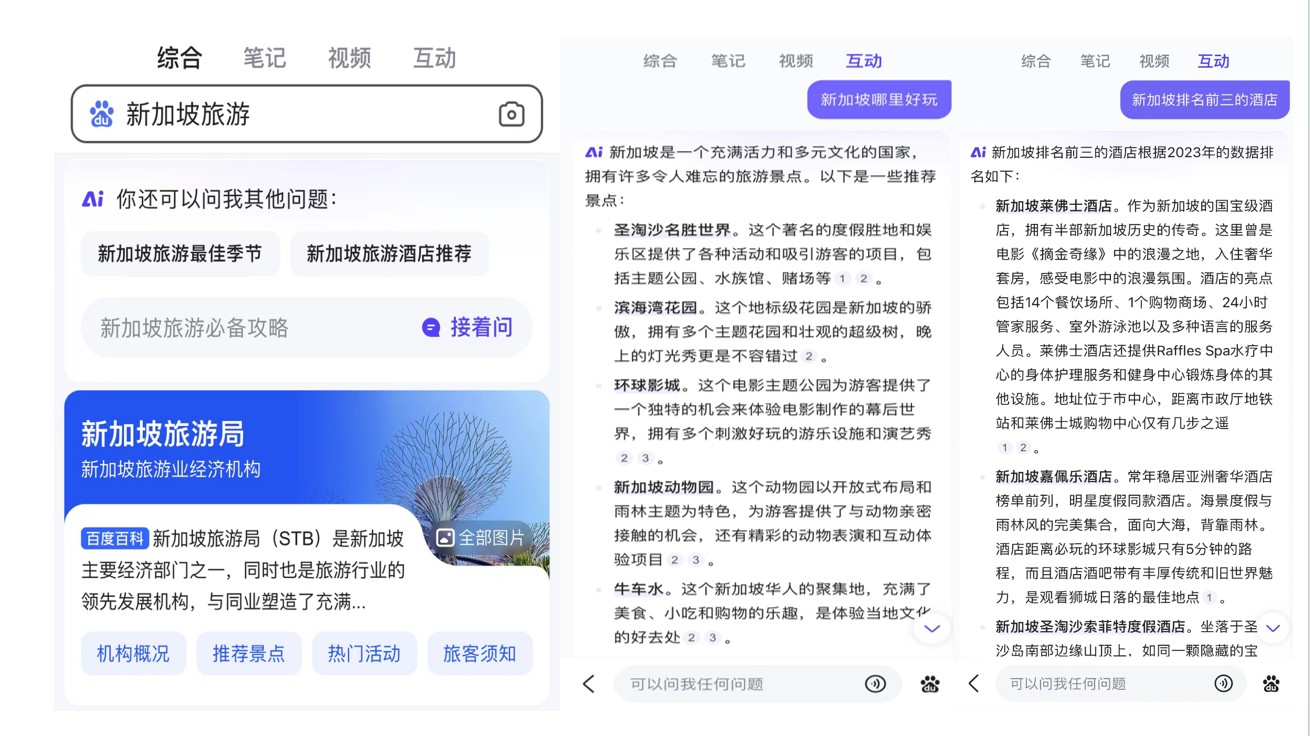
For example, on the C-end, by searching for "Singapore tourism" on the Baidu App, the first result is the "Singapore Tourism Board" intelligent agent. Users can directly inquire about popular attractions, food highlights, travel strategies, as well as practical information such as entry and exit procedures, local transportation, etc., highlighting the accuracy and efficiency of information interaction.

On the B-end, more and more small and medium-sized enterprises are also starting to use Wenxin intelligent agents. Businesses can use natural language to create a dedicated intelligent agent on AgentBuilder in just a few sentences, making it a 24/7 online premium salesperson, bringing businesses closer to users and better understanding user needs.

For example, EduStart Education created a study abroad consultant who understands the business and students through AgentBuilder. In the first week of launch, it successfully distributed 1.55 million times, interacted with users 58,000 times, saw a sharp increase in lead conversion volume, significantly reduced the conversion cost of effective leads, and greatly improved operational efficiency. In addition, the well-known home furnishing brand Sophia created an intelligent agent that can not only answer users' decoration needs but also actively confirm specific requirements with users, recommend offline stores, and achieve a 30% decrease in the cost of effective leads.

Due to its ease of use and efficient distribution efficiency, Baidu's intelligent agents are widely welcomed by customers. As of now, more than 50,000 developers and tens of thousands of companies have joined the Wenxin intelligent agent platform. Every day, new intelligent agents are being created, with an average daily distribution of millions of times, serving various vertical fields such as education, law, B2B, and tourism. In the future, with the continuous iteration of intelligent agent technology, user intent will be matched with the most relevant product supply in a more natural way Undeniable, AI-generated content will have a certain impact on the revenue of online marketing business in the short term, but investors should also recognize that under the empowerment of AI, the improvement of search and the launch of intelligent agents have greatly enhanced user experience, increased user stickiness, search usage, and user duration. Intelligent agents may become the "mini programs" of the AI era, and the formation of an intelligent agent ecosystem is expected to make Baidu a super traffic entrance. Currently, the number of Wenzhen Yiyu users has exceeded 200 million, doubling compared to the data publicly released in December last year.

With the first-mover advantage and innovative business models in intelligent agents, Baidu is expected to rapidly expand its market share in the search field, reshaping the competitive landscape of the entire search industry and further consolidating the company's leading position in the search field. Therefore, from a long-term perspective, after the reconstruction of AI, the fundamentals of Baidu's search business are becoming more solid, and the intrinsic value continues to increase.

Large models drive the rapid development of cloud services, bringing long-term new opportunities with the explosion of inference demand

As a mid-term growth point for Baidu, cloud services achieved rapid growth during the reporting period, with revenue increasing by 12% year-on-year to 4.7 billion RMB, of which the revenue contribution from generative AI reached 6.9%, gradually expanding its proportion. Behind the impressive performance of this business lies the growth in market demand and the rapid decrease in Baidu's cloud service usage costs and thresholds.

The rise of generative AI significantly drives the demand in the AIaaS market because pre-training large models requires massive computing power, and deploying them for fine-tuning or secondary training on the user side also requires a certain level of computing power. At the same time, the application of large models and the migration to the edge side drive a strong growth in inference demand.

However, due to the concentrated release of market demand and constraints at the chip end, AI training costs and inference costs remain at a relatively high level. Therefore, whoever can provide high-performance cost-effective stable computing power can quickly seize the AI cloud service market.

Facing strong market demand and potential industry pain points, Baidu, which has long been the leader in the AI public cloud service market, continues to optimize and iterate the performance of large models, reducing the cost for enterprises and developers to call models.

After upgrading the Wenzhen large model to version 4.0 in October 2023, Wenzhen has reached the industry-leading level in understanding, generation, logic, and memory capabilities, and has further significantly improved its general capabilities such as code generation, code interpretation, and code optimization, reaching an internationally leading level.

While the performance of the Wenzhen large model soared, the inference cost was significantly reduced. Based on the unique advantages of the four-layer technology stack, Baidu can form an efficient feedback loop in chips, frameworks, large models, and terminal application scenarios, helping large models continuously optimize and iterate. Compared to a year ago, the algorithm training efficiency of the Wenzhen large model has increased by 5.1 times, with a weekly training effectiveness rate of 98.8%, the inference performance has improved by 105 times, and the inference cost has been reduced to 1% of the original cost In order to avoid resource waste and further reduce customer usage costs, Baidu launched AI native application development tool AppBuilder and model customization tool ModelBuilder in the cloud business during this reporting period. Based on the 3.5 and 4.0 versions of the Wenxin flagship model, 3 lightweight models and 2 specific scenario models were introduced, forming a method of MoE (cooperation of large and small models). Enterprises can call models on the newly launched ModelBuilder to reduce costs and improve response speed. For example, Xiaodu used this mode, with general Q&A calling small models and solving math problems using 4.0, ultimately achieving a 2x speed increase and a 99% cost reduction.

It is worth noting that AppBuilder significantly reduces the development threshold, allowing developers to develop an AI native application in just three steps using natural language, and easily publish and integrate it into various business environments. Taking the 24-hour "Resident Assistant" launched in Zhumadian, Henan as an example, the product, based on the AppBuilder knowledge Q&A application (RAG framework), can accurately answer questions with regional characteristics, improving the efficiency of grassroots grid staff serving residents by 15%, increasing the response speed of resident services by 30%, and improving resident satisfaction by 50%.

With outstanding performance, rapidly reduced usage costs and thresholds, more and more enterprises and developers are calling or developing AI native applications based on the Wenxin flagship model, leading to a rapid increase in Wenxin model calls. Currently, the daily average call volume of the Wenxin flagship model API has exceeded 200 million, a 300% increase compared to the disclosed over 50 million calculations in Q4 of 23. The Wenxin flagship model has become the most advanced and widely used AI basic model in China.

At the same time, well-known companies in various industries are accelerating cooperation with Baidu Intelligent Cloud based on the Wenxin flagship model. During this quarter's conference call, Robin Li revealed that following the cooperation with China Samsung and Honor last quarter, this quarter, smartphone manufacturers such as Xiaomi, OPPO, and vivo have all accessed the Wenxin flagship model API. The cooperation scope of the flagship model has expanded from smartphones to PCs and electric vehicles, with Lenovo and Nio reaching cooperation with Baidu this quarter. Robin Li stated that the expansion to smart devices provides ample opportunities for the Wenxin flagship model to be adopted by a larger user base.

IDC believes that in the next 5 years, large models and generative AI-driven next-generation artificial intelligence are expected to drive the overall industry through the downturn and return to a high-growth era. Starting this year, with the accelerated popularization of intelligent terminals, the demand for inference is expected to experience a big explosion this year and next. Dongwu Securities stated that it is optimistic about Baidu's AI model capability improvement and scenario expansion driving cloud computing revenue growth. Subsequently, with the improvement of the model matrix to explore more customer demands, the cloud business is expected to continue to contribute incrementally It is worth noting that Baidu's GPU Cloud has been widely recognized by existing and new customers for its high performance, low cost, and low threshold. With the continuous increase in the number of GPU Cloud customers, Baidu can cross-sell CPU cloud services to GPU Cloud customers, which is expected to enable customers to switch to Baidu's public cloud, further opening up growth space for Baidu Intelligent Cloud business. It can be foreseen that as one of Baidu's new growth curves, the intelligent cloud business will continue to drive Baidu's revenue growth in a steady manner.

Industry turning point is approaching, Luobo Kuai Pao's scaled application is expected to accelerate

As the strongest embodiment of Baidu's artificial intelligence technology, autonomous driving may become Baidu's biggest breakthrough this year, as the autonomous driving industry has reached an important turning point, and scaled applications are expected to accelerate starting this year.

On April 6th, Elon Musk announced on social media platform X that "Tesla will release autonomous driving robotaxis on August 8th." Tesla's entry proves the feasibility of autonomous driving technology. Furthermore, Musk's visit to China on April 28th indicated that Tesla's FSD entry into China is almost certain, awaiting only a specific timetable. Tesla's FSD entry into China plan will undoubtedly accelerate the commercialization and application of autonomous driving technology in China.

Baidu may be the only domestic company that can compete with Tesla in autonomous driving. As the first and only company in China to provide fully autonomous driving services to the public on open roads, Baidu has accumulated sufficient experience in autonomous driving. Since 2013, Baidu has been laying out autonomous driving and has been persistently investing in R&D with a marathon-like effort, driving long-term development with technological innovation. Currently, Baidu's Apollo L4 level autonomous driving safety operation test mileage has exceeded 100 million kilometers, with over 5000 autonomous driving patents, ranking first globally in high-level autonomous driving patent families.

Baidu's commercialization platform for autonomous driving, Luobo Kuai Pao, has deployed fully autonomous driving fleets in Beijing, Shenzhen, Wuhan, Chongqing, and Shanghai. As of April 19th, Luobo Kuai Pao has completed over 6 million travel services nationwide. During the reporting period, Luobo Kuai Pao's service volume reached 826,000 times.

It is worth noting that in Wuhan, the number of Luobo Kuai Pao's fully autonomous orders is more than four times that of the same period in 2023. In China, only Baidu has achieved fully autonomous driving, especially in complex road conditions like Wuhan. Tesla will need quite some time, at least 3 years and up to 5 years, to reach the current level of full autonomous operation by Baidu.

Furthermore, at the Apollo Day 2024 open day on May 15th, Baidu announced the latest developments in its intelligent driving business. It released the world's first automatic driving large model Apollo-ADFM that supports L4 level autonomous driving applications, which is the core technological foundation for Baidu to achieve city-level autonomous driving. With Apollo ADFM, deploying L4 fully autonomous travel in a city from 0 to 1 only takes half a year Baidu Luobo Kuaipao officially launched the unmanned vehicle equipped with the Baidu Apollo sixth-generation autonomous driving system solution. The overall cost of the vehicle has decreased by 60% compared to the 5th generation, costing only 200,000 yuan. The riding experience surpasses the Mercedes-Benz S-Class, rivals Maybach, and once again refreshes the industry record. Starting today, the first batch of the sixth-generation unmanned vehicles will be gradually deployed in Wuhan. By the end of the year, 1,000 unmanned vehicles will be deployed in Wuhan, allowing more users to enjoy green, safe, and pleasant travel.

With the continuous iteration of the system to improve efficiency and the significant reduction in the cost of the sixth-generation autonomous driving unmanned vehicle, Luobo Kuaipao's unit economic benefits have been continuously optimized under the stimulus of economies of scale, demonstrating profit potential. Baidu stated that Luobo Kuaipao is expected to achieve a balance of income and expenditure in Wuhan by the end of 2024, and will enter a full profit period in 2025, making Luobo Kuaipao the world's first platform to achieve commercial profitability in autonomous driving.

More importantly, once Luobo Kuaipao achieves profitability in Wuhan, it represents the breakthrough of Baidu's autonomous driving operation model, validating its commercial feasibility to the market. This will accelerate the expansion of Baidu's autonomous driving to more cities. With the support of Apollo-ADFM, Baidu's autonomous driving can complete the deployment in a city in just 6 months, completely opening up the scale application of Baidu's autonomous driving.

In addition to autonomous driving, another commercialization model of Baidu's intelligent driving sector, the intelligentization of vehicles, will also see accelerated development with ASD. Currently, the only domestically produced pure visual city navigation assisted driving product, ANP3, has fully applied the technology of the Apollo ADFM large-scale autonomous driving model, upgrading to Baidu ASD (Apollo Self-Driving). This product is about to be mass-produced and will be first launched on the Zeekr series, enabling intelligent driving nationwide and wherever Baidu Maps are available. In the future, mass-produced passenger cars equipped with ASD can also become "safe and reliable good drivers" like Luobo Kuaipao, allowing more users to enjoy the safe, comfortable, and efficient travel experience brought by leading autonomous driving technology.

It can be seen that Baidu's strategy for the diversified commercialization of intelligent driving has gradually entered a period of harvest. Autonomous driving is at a turning point, and the intelligentization of vehicles with ASD is expected to accelerate. These are all specific manifestations of Baidu's accelerated commercialization of intelligent driving. With the comprehensive empowerment of the leading Wenxin large model in China and the combination of Baidu's globally leading autonomous driving technology, intelligent driving as the foundation of Baidu's long-term emerging growth engine will become more solid.

Summary

As a leader in the AI industry, the leading position of Baidu's Wenxin large model and the potential value released by the comprehensive restructuring of its business are evident in the market. The reshaping of the search landscape, the accelerated growth of cloud services, and the imminent profitability of autonomous driving will undoubtedly drive the reassessment of Baidu's intrinsic value. However, from the perspective of the capital market's response, there has not been a timely and effective pricing, indicating that Baidu's true value has not been fully reflected Looking at the value of Baidu from a different perspective will be more convincing. Generative AI is bringing about the fourth industrial revolution, which has become a market consensus. In the new era, there will definitely emerge era giants that follow the industry trends. Baidu has become an indispensable core target in the era of artificial intelligence. Its strength in AI has the potential to develop into a global giant. Currently, Baidu is just at the beginning of embracing the new AI era, which is also a good opportunity for long-term layout of Baidu