This week's market focus: U.S. May non-farm payrolls data is coming, AI investment boom faces a test

This week, the market focus is mainly on the release of the US May non-farm payroll report and job vacancy data. Investors' enthusiasm for artificial intelligence seems to have cooled down, while the prospect of the Federal Reserve maintaining higher interest rates for a longer period remains the most concerning issue. In addition, CrowdStrike, Lululemon, and Dollar Tree will announce their financial reports this week. The US May non-farm payroll report is expected to add 180,000 jobs, with the unemployment rate expected to remain at 3.9%. Wells Fargo economists believe that job growth will slow down and the labor market will continue to cool. In the coming week, a series of employment market data will be released, testing investors' confidence in the Federal Reserve's policy path
According to the Zhitong Finance and Economics APP, the US stock market closed lower in the last week of May as investors' enthusiasm for artificial intelligence seemed to wane, and the prospect of the Federal Reserve maintaining higher interest rates for a longer period remained the top concern. In the upcoming week, the US May non-farm payroll report will be the focus of investors, along with the release of job vacancy data. In terms of corporate earnings reports, CrowdStrike (CRWD.US), Lululemon (LULU.US), and Dollar Tree (DLTR.US) will announce their financial results this week.
US May Non-Farm Payroll Report Coming Soon
Data released at the end of May showed that the US April PCE increased by 2.7% year-on-year, in line with expectations; it increased by 0.2% month-on-month, the lowest monthly increase since 2024, lower than the market's expected 0.3%; core PCE increased by 2.8% year-on-year and 0.3% month-on-month, both in line with expectations.
Although economists called this "better news on the inflation front than the first quarter," it did not change investors' expectations of a rate cut. Investors expect less than two rate cuts this year, with little change compared to the previous week. Prior to this, Federal Reserve officials stated that they needed "greater confidence in the decline in inflation" before starting rate cuts.
In the upcoming week, a series of labor market data will test investors' confidence in the Federal Reserve's policy path. The most anticipated is the US May non-farm payroll report. Economists expect the US non-farm payroll to increase by 180,000 in May, slightly higher than April's 175,000; the unemployment rate is expected to remain at 3.9%, and the average hourly wage growth rate is expected to remain at 3.9% year-on-year.
A team of Wells Fargo economists led by Jay Bryson stated in a report that strong job growth at the beginning of the year and unexpected inflation increases led the Federal Reserve to "delay rate cuts at least until the second half of this year," but the bank expects labor market conditions to cool down from now on. Economists said, "Job growth is slowing down as we enter the second quarter. We believe that the pace of job growth in the coming months will be closer to that of April."
Additionally, the US April JOLTs job vacancies will be released on Tuesday, and the US May ADP employment data, also known as "mini non-farm payroll," will be released on Wednesday AI Craze Cools Down
NVIDIA (NVDA.US)'s strong performance fueled the Nasdaq index to achieve its best monthly performance since 2003 in May. However, in the last week of May, the optimism towards AI deteriorated as Dell Technologies (DELL.US), Salesforce (CRM.US), and MongoDB (MDB.US) failed to impress investors with their performances. These companies have been favored in the AI craze over the past year.
Scott Chronert, a stock strategist at Citigroup in the U.S., stated that last week's non-cyclical reports highlighted pressure on fundamentals and performance guidance in the current valuation environment. He said, "Some areas of the market may rely on the continued upward momentum this year to prove that current prices are reasonable."
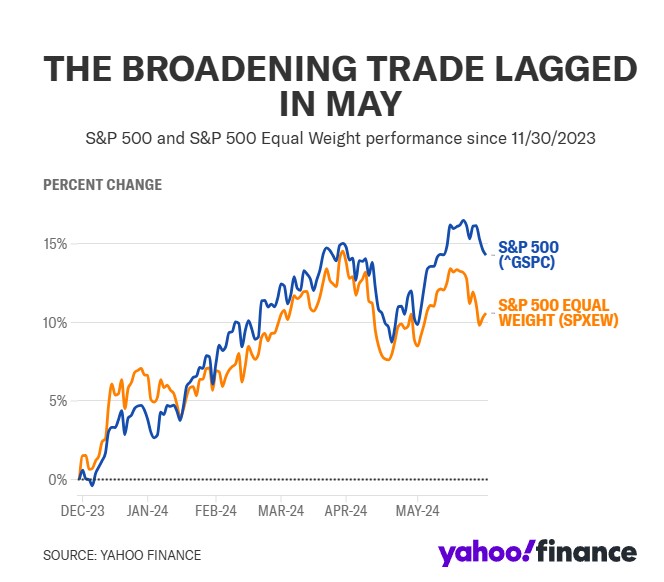
Furthermore, amidst the recent record highs in the U.S. stock market, investors are concerned about market breadth. Michael Hartnett, an investment strategist at Bank of America, pointed out that market breadth is at its worst level since 2009 when evaluating the correlation between the equal-weighted S&P 500 index and the market-cap weighted S&P 500 index. Data shows that since early May, the S&P 500 index has risen by about 4%, while the equal-weighted S&P 500 index has increased by less than 2%.
Ed Clissold, Chief U.S. Strategist at Ned Davis Research, noted in a report that "several market breadth indicators" have not followed the recent rebound higher, and a narrow leadership from large-cap tech stocks over the past month could be a concerning issue. The strategist believes that this situation sometimes occurs when the market rebound is peaking.
However, Ed Clissold stated, "Most importantly, despite divergences developing throughout the year, most of the divergences have only emerged in recent weeks." "If the market is in the process of topping out, it is likely in the early stages. There is not enough evidence to suggest that we should adjust our overweight recommendation for U.S. stocks."
Meanwhile, Bespoke Investment Group emphasized that currently lower market breadth is actually often favorable for the market, and at the current breadth levels, stocks typically perform better over the next three months, six months, and the full year than any other breadth indicator.
On the other hand, Sam Stovall, Chief Investment Strategist at CFRA Research, stated: "If market breadth does not expand again, then we may retest the low point of the S&P 500 index seen on April 19."