


China Passenger Car Market: Retail sales of 1.685 million vehicles in May, a 3% year-on-year decrease

In May, the retail sales of passenger vehicles reached 1.685 million units, a year-on-year decrease of 3% but a month-on-month increase of 10%. The cumulative retail sales this year have reached 8.052 million units, a year-on-year increase of 5%. Nationwide, passenger vehicle manufacturers wholesaled 2.01 million units, a year-on-year increase of 0% but a month-on-month increase of 3%. The cumulative wholesale volume this year has reached 9.56 million units, a year-on-year increase of 8%
According to the VZT Finance APP, on June 5th, the China Passenger Car Association data showed that in the preliminary statistics from May 1st to 31st, 1.685 million passenger cars were retailed, a 3% year-on-year decrease and a 10% month-on-month increase. The cumulative retail sales this year reached 8.052 million units, a 5% year-on-year increase. From May 1st to 31st, the national passenger car manufacturers wholesaled 2.01 million units, a 0% year-on-year increase and a 3% month-on-month increase. The cumulative wholesale volume this year reached 9.56 million units, an 8% year-on-year increase.
In the preliminary statistics from May 1st to 31st, the new energy vehicle market retailed 790,000 units, a 36% year-on-year increase and a 17% month-on-month increase. The cumulative retail sales this year reached 3.242 million units, a 34% year-on-year increase. From May 1st to 31st, the national passenger car manufacturers wholesaled 903,000 new energy vehicles, a 33% year-on-year increase and a 15% month-on-month increase. The cumulative wholesale volume this year reached 3.643 million units, a 31% year-on-year increase.
1. Gradual Recovery of National Passenger Car Retail Market in May 2024
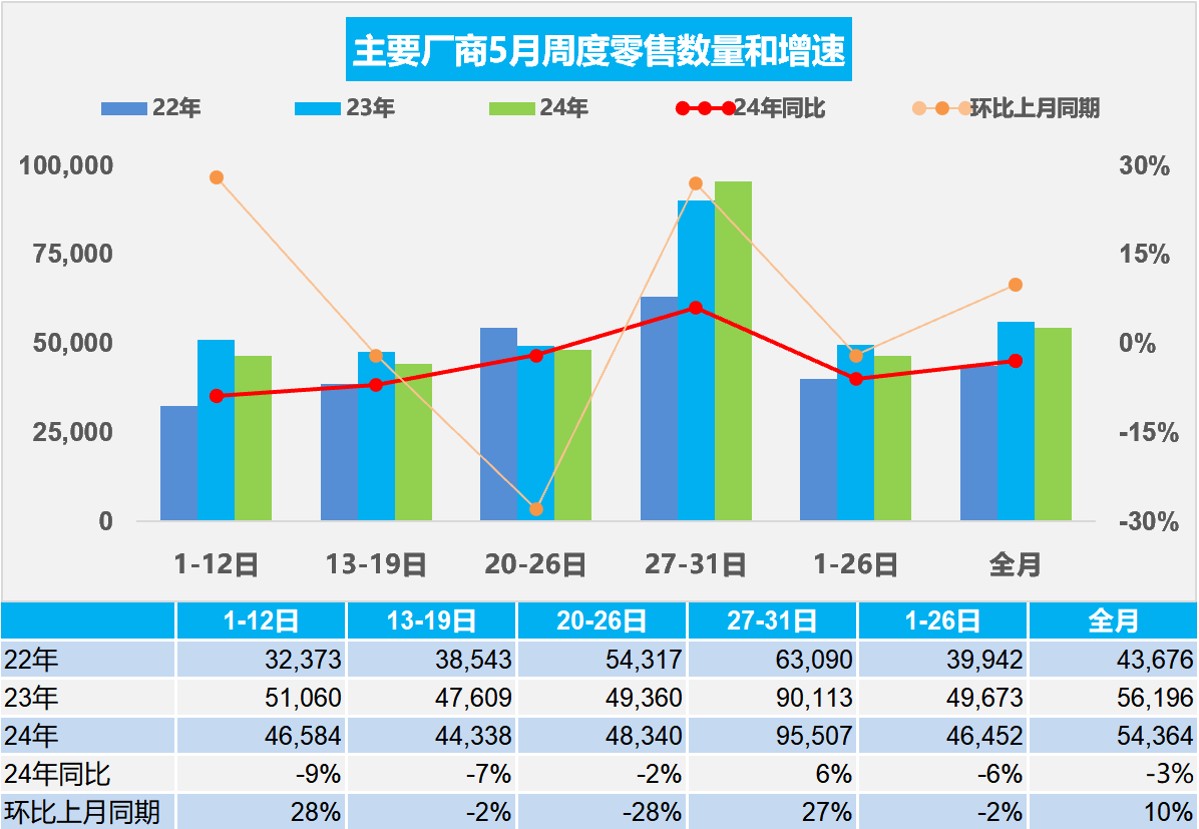
In the first week of May, the average daily retail sales of passenger cars were 47,000 units, a 9% year-on-year decrease compared to the same period last year, and a 28% increase from the previous month.
In the second week of May, the average daily retail sales of passenger cars were 44,000 units, a 7% year-on-year decrease compared to the same period last year, and a 2% decrease from the previous month.
In the third week of May, the average daily retail sales of passenger cars were 48,000 units, a 2% year-on-year decrease compared to the same period last year, and a 28% decrease from the previous month.
In the fourth week of May, the average daily retail sales of passenger cars were 96,000 units, a 6% year-on-year increase compared to the same period last year, and a 27% increase from the previous month.
Preliminary statistics: From May 1st to 31st, the retail sales of passenger cars were 1.685 million units, a 3% year-on-year decrease and a 10% month-on-month increase. The cumulative retail sales this year reached 8.052 million units, a 5% year-on-year increase.
With the arrival of the "May Day" holiday and the successive launch of car exhibitions across the country, marketing activities have been rolled out, further attracting consumers' attention and enthusiasm for car purchases. Combining with manufacturers' policies, the customer acquisition effect has been good.
As the summer market off-season approaches, the automotive market is entering a stable period. In April, the China Manufacturing Purchasing Managers' Index (PMI), Non-Manufacturing Business Activity Index, and Comprehensive PMI Output Index were 50.4%, 51.2%, and 51.7% respectively, all remaining in the expansion zone, which has significantly promoted the stability of the automotive market.
Recently, the cost reduction of new energy vehicles and materials has been prominent, giving them a competitive edge over traditional fuel vehicles, putting more pressure on traditional fuel vehicles. The continued sluggishness in consumption of conventional fuel vehicles is an important factor inhibiting the full recovery of the automotive market. Policies such as the old-for-new program have effectively ensured the replacement demand of traditional fuel vehicle consumers, which is of great significance for the stable development of the automotive market It is also conducive to the gradual stabilization of the car market in May. In early May, the performance of fuel vehicles was slightly better than that of new energy vehicles compared to April. Due to the synchronization of the end of the month, the last week of April had a long duration and a high base, so the week-on-week growth in May was abnormally low. It should recover next week, and retail sales for the whole month should show a slight positive growth.
2. National passenger car manufacturers' sales volume steadily rebounded in May 2024
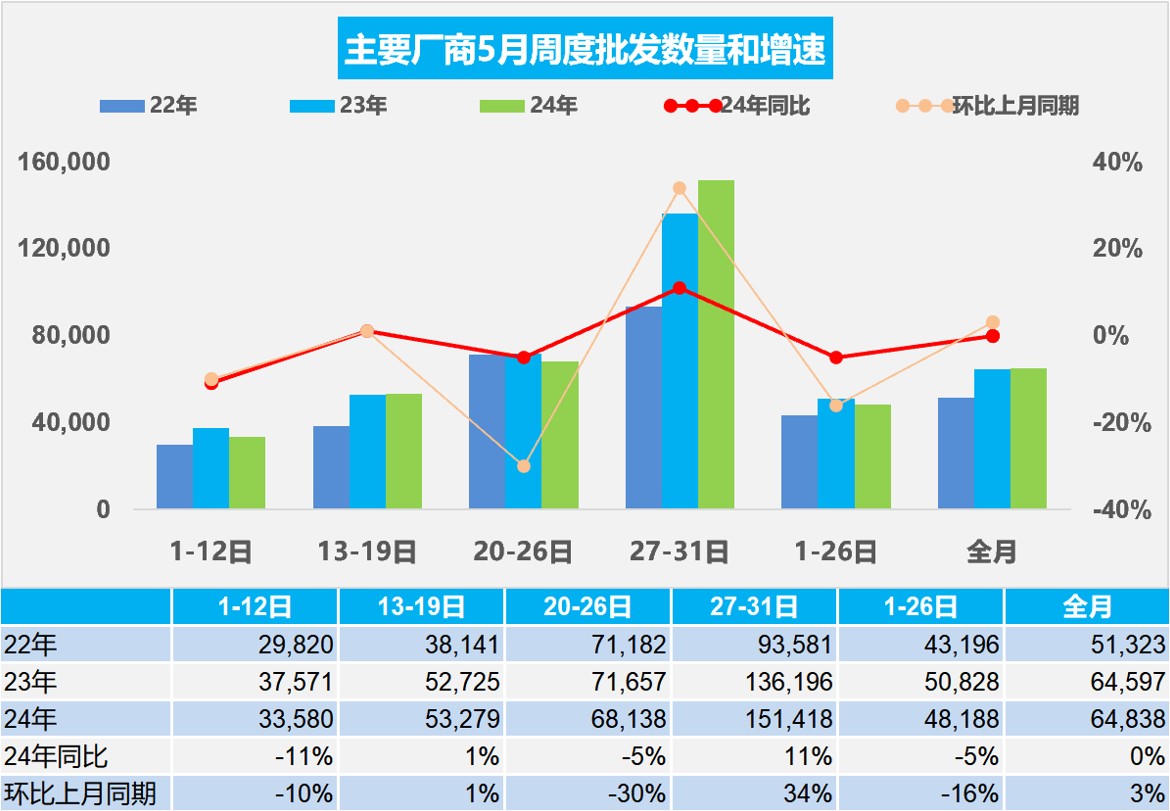
In the first week of May, the average daily wholesale of passenger cars was 34,000 units, a year-on-year decrease of 11% compared to the same period last year in May, and a month-on-month decrease of 10%.
In the second week of May, the average daily wholesale of passenger cars was 53,000 units, a year-on-year increase of 1% compared to the same period last year in May, and a month-on-month increase of 1%.
In the third week of May, the average daily wholesale of passenger cars was 68,000 units, a year-on-year decrease of 5% compared to the same period last year in May, and a month-on-month decrease of 30%.
In the fourth week of May, the average daily wholesale of passenger cars was 151,000 units, a year-on-year increase of 11% compared to the same period last year in May, and a month-on-month increase of 34%.
Preliminary statistics: From May 1st to 31st, national passenger car manufacturers wholesaled 2.01 million units, a year-on-year increase of 0% and a month-on-month increase of 3%. Cumulatively, 9.56 million units have been wholesaled since the beginning of the year, an 8% year-on-year increase.
May of this year had a total of 21 working days, the same as last year, but the continuous 5-day holiday compressed the production and sales time interval in May. With the approaching off-season in the summer market, the car market has entered a stable period. Some fuel car companies have increased holiday efforts to achieve production reduction, stabilize prices and demand, and rational production reduction has brought a stable effect of supply-demand balance to the market. Manufacturer production and sales were relatively low in the third week of May, but with accelerated dealer purchases at the end of the month and the inclusion of export data, the whole month will return to a year-on-year positive growth state.
With the implementation of the national policy of replacing old vehicles, the follow-up of corresponding policies in various regions, and the temporary cooling of the market due to price wars of new car models, the enthusiasm of the market-watching consumer group has been stimulated. The market has entered a relatively good stage, with new energy vehicles performing better than expected. Expectations are for the domestic retail market of fuel vehicles to gradually recover vitality.
3. Wholesale of new energy passenger cars in May is expected to reach 910,000 units
In May, the national economy operated steadily. Despite factors such as holiday mismatches and high base numbers compared to the same period last year, with the implementation of the national policy of replacing old vehicles, the introduction and follow-up of corresponding policy measures in various regions, and the temporary cooling of the market due to price wars of new car models, the enthusiasm of the market-watching consumer group has been stimulated. In May, the national new energy passenger car market has entered a relatively good development stage Recently, the market advantage of leading new energy companies continues to expand, and market differentiation intensifies. According to preliminary data, in the national passenger car market, the wholesale sales volume of new energy vehicles in April 2024 from manufacturers with sales of over 10,000 vehicles accounted for 86.6% of the total new energy passenger car sales volume in April. The estimated sales volume of these companies in May is 790,000 vehicles, and based on the structure ratio of the previous month, the national sales volume of new energy passenger cars in May is estimated to be around 910,000 vehicles.
The top 10 manufacturers in May for new energy passenger car sales are: BYD with 330,488 vehicles, Tesla China with 72,573 vehicles, Geely with 58,673 vehicles, Changan with 55,800 vehicles, GAC Aion with 40,073 vehicles, Chery with 39,413 vehicles, Li Auto with 35,020 vehicles, SAIC-GM-Wuling with 33,872 vehicles, Seres with 32,377 vehicles, and Great Wall Motors with 24,549 vehicles.
In summary, based on comprehensive monthly preliminary data estimates, the wholesale sales volume of new energy passenger car manufacturers in May nationwide is 910,000 vehicles, a year-on-year increase of 35% and a month-on-month increase of 16%.
4. China's Market Share in the World's Automobile Industry was 34% in April
In April 2024, global automobile sales reached 7 million vehicles, a year-on-year increase of 3% and a month-on-month decrease of 15%. Compared to the peak in April 2018, sales in April 2024 were slightly lower by 10%, remaining at the median level over the years. Sales from January to April 2024 reached 28.36 million vehicles, a year-on-year increase of 4%. In April 2024, Chinese auto companies held a 34% market share globally.
From a global perspective, the Chinese automobile market showed strong recovery in April, with Chinese companies such as Geely and Changan showing the most prominent rebound, while Asian groups represented by Toyota and Kia performed poorly. The international chip shortage in the past two years had a relatively small impact on the Chinese car market, instead driving strong Chinese car exports, seizing a significant international market supply-demand gap, and gaining rare development opportunities. In high-monopoly industries like automotive chips, the current supply-side tightening will bring significant opportunities for the rise of the Chinese supply chain, while the development of electrification is causing some international car companies to gradually decline.
5. China Held 64% of the World's New Energy Vehicle Market Share in January-April 2024
In the first four months of 2024, global automobile sales reached 28.36 million vehicles, with new energy vehicles reaching 4.49 million vehicles. The penetration rate of new energy vehicles in the world from January to April 2024 reached 15.8%, with pure electric vehicles reaching a penetration rate of 10.4% and plug-in hybrids reaching a penetration rate of 5.4%.
In April 2024, global sales of new energy passenger cars reached 1.19 million vehicles, a year-on-year increase of 24% and a month-on-month decrease of 10%. From January to April, global sales of new energy passenger cars reached 4.36 million vehicles, a year-on-year increase of 22%. In Europe, the incremental growth of new energy passenger cars from January to April was only 70,000 vehicles, with a year-on-year growth rate of 8%. New energy passenger car sales in Europe in April reached 220,000 vehicles, an increase of 14%. In the United States, sales of new energy vehicles from January to April were 480,000 vehicles, with a growth rate of 9%, showing a slowdown in growth The growth rate of sales of new energy vehicles in Europe and the United States is slowing down and worth paying attention to. Currently, early adopters and environmentalists have already purchased electric vehicles, but mainstream consumers still have significant concerns about charging infrastructure, battery life, and insurance costs. Even with higher interest rates, the increase in sales penetration for autonomous driving has not met expectations.
Recently, the growth rate of new energy passenger vehicles in China has been stronger than the world average. In 2023, China accounted for 64% of the global market share, maintaining this share from January to April 2024, with China's market share reaching 67% in April. In 2023, China's share of pure electric vehicles reached 62% globally, and from January to April 2024, this share remained stable at 59%. China's dominance in the global plug-in hybrid market is particularly strong, with a market share of 70% in 2023 and increasing to 71% from January to April 2024.
Due to the impact of a high base and the withdrawal of subsidies in various countries, the new energy passenger vehicle market in Europe and the United States started weakly in 2024, with Europe's market continuing to weaken. From January to April 2024, China's new energy vehicle exports performed well, especially in the South American and Southeast Asian markets, showcasing the strength of China's industrial chain and the dual growth of a strong domestic market and exports.
In the first four months of 2024, the automotive industry's revenue was 3 trillion yuan, an 8% increase, with profits of 142.8 billion yuan, a 29% increase, and a profit margin of 4.6%.
In April, as macroeconomic policies were implemented and market demand continued to recover, the effects became more evident. From January to April 2024, the automotive industry's revenue was 3.0742 trillion yuan, an 8% year-on-year increase; costs were 2.6882 trillion yuan, an 8% increase; profits were 142.8 billion yuan, a 29% year-on-year increase; and the profit margin of the automotive industry was 4.6%, lower than the average profit margin of 5% for the entire industrial sector. With the expansion of the automobile production scale, the Producer Price Index (PPI) declined, upstream lithium carbonate costs decreased, and overall profits of car companies slightly improved.
The production and sales of the automotive industry in the first four months of 2024 performed well due to a low base, but intense competition led to profits mainly relying on exports and high-end luxury vehicles. Most other enterprises experienced a sharp decline in profits, increasing the pressure on their survival. Domestic effective demand remains insufficient, the external environment remains complex and severe, and the foundation for the recovery of industrial enterprise efficiency still needs to be consolidated. While traditional fuel vehicles are still profitable, the market is shrinking rapidly; new energy vehicles are experiencing high growth but significant losses, leading to considerable conflicting pressures. Therefore, the central and local governments are stabilizing automobile production, actively stabilizing fuel vehicle consumption, and the overall situation of the automotive industry is stable and improving
