


Brothers in arms? Nike's performance falls short of expectations, Under Armour's first quarter is "a bit tough"
Global sportswear giant Nike announced its fourth-quarter performance ending on May 31, which fell short of expectations and lowered its outlook for the next year. Revenue in the fourth quarter decreased by 2%, while net profit increased by 45%. The Nike brand performed poorly in North America, Europe, the Middle East, and Africa, while showing better performance in the Greater China market and the Asia-Pacific region. Converse brand revenue declined by 18%. Nike has revised its 2025 fiscal year performance guidance
On June 27th local time, global sportswear giant Nike (NKE.US) announced its fourth-quarter performance ending on May 31st, which fell short of expectations. To make matters worse, Nike also lowered its outlook for the coming year.
As a result, Nike (NKE.US) stock plummeted over 12% after hours.
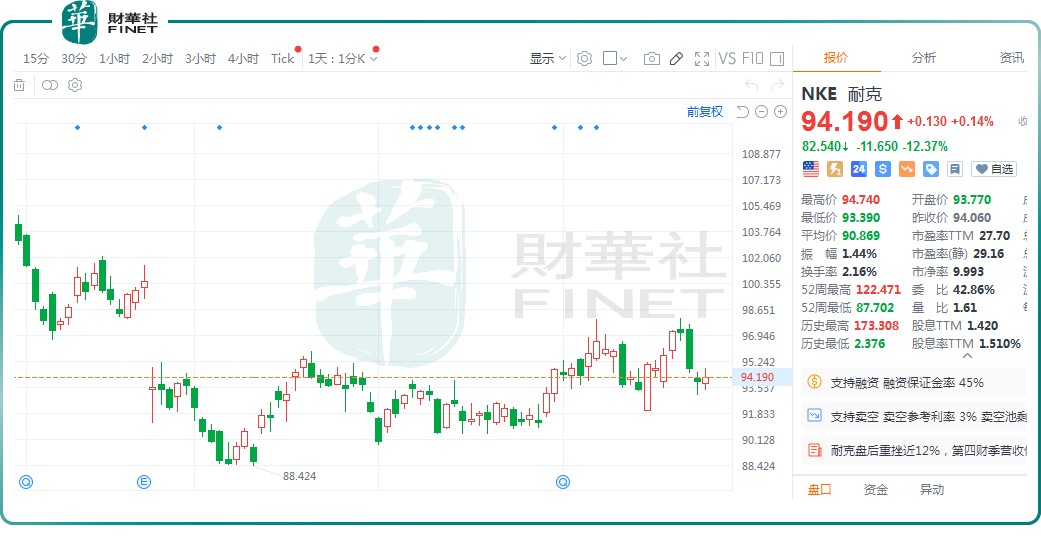
The latest financial report shows that in the fourth quarter, Nike's revenue decreased by 2% year-on-year to $12.61 billion, below the market's expected $12.86 billion. Due to continued cost-cutting measures yielding results, net profit increased by 45% year-on-year to $1.5 billion, exceeding expectations. The gross profit margin was 44.7%, below analysts' expectations of 45.3%; as of May 31, 2024, Nike's inventory was $7.52 billion, below analysts' expectation of $7.99 billion.
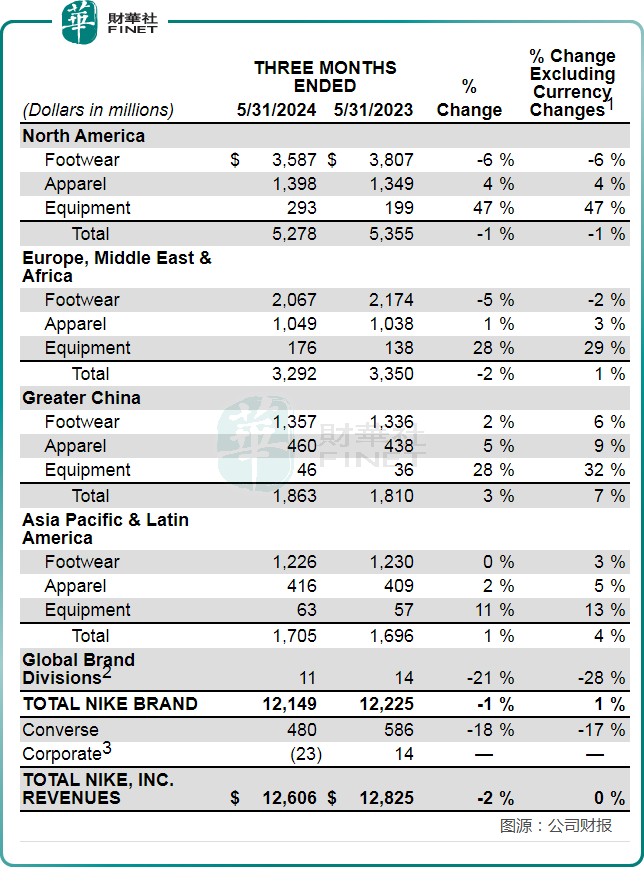
By brand, Nike brand's revenue was $12.15 billion, down 1% year-on-year. In terms of regional performance, Nike performed poorly in North America, Europe, the Middle East, and Africa, with revenues of $5.278 billion and $3.292 billion respectively, down 1% and 2% year-on-year, dragging down overall revenue. The Greater China market, Asia-Pacific, and Latin America performed relatively well, with revenues of $1.863 billion, $1.705 billion, up 3% and 1% year-on-year respectively. The Greater China market was the only geographic region that exceeded market expectations.
Converse brand's revenue was $480 million, down 18% year-on-year, mainly due to declines in North America and Western Europe.
Nike's Chief Financial Officer Matthew Friend stated that the fourth quarter performance was "challenging," leading the company to update its full-year outlook. Following a slowdown in consumer demand, the company is taking "aggressive" actions to reposition inventory in Nike's own stores and digital channels.
Looking at the full year, Nike's 2024 revenue was $51.4 billion, essentially flat compared to the previous year. This marks Nike's slowest annual revenue growth since 2010 (excluding the first year of the pandemic). Nike's performance in North America, Europe, the Middle East, Africa, Asia-Pacific, and Latin America all fell below expectations.
Given the decline in store and online sales, the downturn in classic shoe businesses like Air Force 1, and Nike's "uneven consumer trends" globally, Nike has lowered its 2025 fiscal year performance guidance, expecting a single-digit decline in revenue in the first half of the year, which is more pessimistic than earlier expectations During the conference call, CEO John Donoho stated that the fiscal year 2025, ending in late May next year, will be a "transition year" as over two years of inflation have made consumers cautious.
The performance outlook falling short of expectations has raised more concerns among investors about Nike's future. Nike's CFO Matthew Friend stated during the conference call that the company is adjusting its product lineup to reignite consumer interest, but this statement did not effectively alleviate market panic.
Similarly, in the business ecosystem, partners in the upstream and downstream often share the same woes. Nike (NKE.US) performed poorly, and its largest first-tier distributor in the Chinese market - Topbo (06110.HK) is also facing challenges.
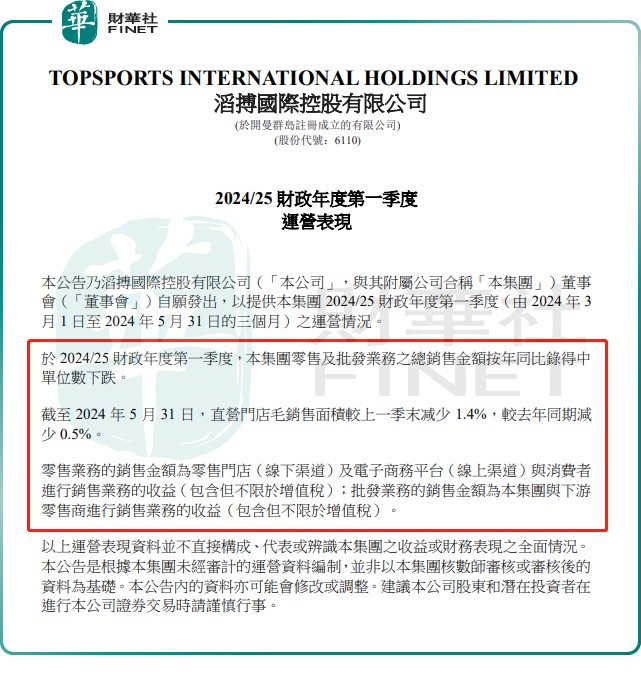
On June 27, Topbo (06110.HK) released the operating data for the first quarter of the 2024/25 fiscal year. The announcement showed that in the first quarter of the 2024/25 fiscal year (from March 1, 2024, to May 31, 2024), the total sales amount of Topbo's retail and wholesale business recorded a mid-single-digit year-on-year decline.
As of May 31, 2024, the gross sales area of directly operated stores decreased by 1.4% compared to the previous period and decreased by 0.5% year-on-year. The sales amount of the retail business refers to the revenue from sales to consumers through retail stores (offline channels) and e-commerce platforms (online channels) (including but not limited to value-added tax); the sales amount of the wholesale business refers to the revenue from sales to downstream retailers by the group (including but not limited to value-added tax).
Following the release of this operating data, several institutions have successively lowered Topbo's target price . Among them, a report from Daiwa pointed out that Topbo's total sales in the first quarter fell by a mid-single-digit percentage on a quarterly basis, mainly due to weak consumer sentiment, especially in offline channels, along with the impact of a high base and changes in new product launches for the preparation of the 2024 Summer Olympics.
The bank has lowered its earnings per share forecast for Topbo for the fiscal years 2025 to 2027 by 7 to 11% to reflect weak consumer sentiment on the mainland, and accordingly reduced the 2025 price-earnings ratio forecast from 15 times to 13 times, equivalent to the average level of the past three years. The bank maintains its "buy" rating on the stock, with the target price lowered from HKD 6.6 to HKD 5.3.
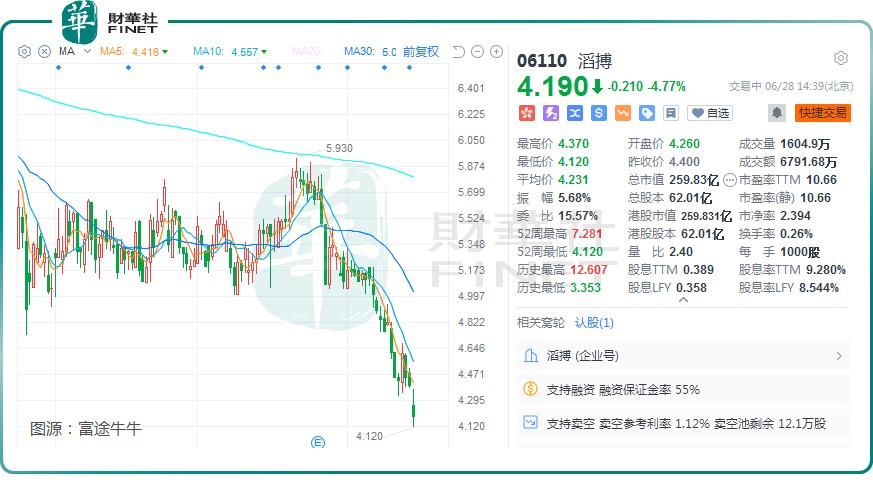 On June 28, the capital market reacted to the news, with Taobo (06110.HK) opening low and moving lower. Intraday, it fell to a low of HKD 4.12, hitting a new low since 2023. As of the time of writing, the stock has fallen by 4.77% to HKD 4.19 per share
