


Amidst the low battery prices, hedge funds quietly buy physical cobalt

This year, electric vehicle sales have been weaker than expected, with the cobalt market experiencing a record oversupply. Spot cobalt prices have fallen to a seven-year low. The cobalt futures price for delivery in one year is already 20% higher than the spot price. The significant spot discount has created arbitrage opportunities
As one of the key metals in battery manufacturing, there are signs of "smart money" quietly returning to the market and becoming cautiously optimistic amidst the low battery prices.
Recently, the media learned that two hedge funds, Anchorage Capital Advisors and Squarepoint Capital LLP, are quietly buying physical cobalt. Squarepoint has been buying cobalt metal from traders, while Anchorage has been purchasing cobalt metal and cobalt hydroxide. The latter is an intermediate product for producing cobalt sulfate, which is used in electric vehicle batteries. Anchorage has been actively trading on the Chicago Mercantile Exchange (CME) market.
The two hedge funds acquiring physical cobalt are doing so at a time when cobalt prices are at a low point. Due to a significant increase in cobalt production in the main supplying countries of Congo and Indonesia, spot cobalt prices have fallen to the lowest level in over seven years. For most of this year, prices have been between $12.5 and $15 per pound, significantly lower than the peak price of around $40 per pound during the electric vehicle boom in 2022.
Some analysts believe that given cobalt's crucial role in transitioning to clean energy and achieving zero emissions, the cobalt market may soon return to supply-demand balance even amid estimated oversupply and declining demand for electric vehicles.
The media points out that the actions of the aforementioned hedge funds are the latest signs of financial institutions participating in physical metal trading. Since the beginning of this year, a large amount of funds has flowed back into commodities, creating opportunities for these funds to profit from buying at low spot prices in some previously oversupplied metal markets. Compared to commodities like copper or oil, cobalt belongs to a relatively smaller niche market. Ten years ago, funds like Pala Investments took advantage of low cobalt prices to bet on emerging energy transitions and made substantial profits.
Unlike in the past, when the futures market had poor liquidity and bullish cobalt positions could only be achieved through buying physical cobalt, now cobalt futures are also rising on the Comex market under CME, providing traders with a way to hedge physical positions in the futures market. Cobalt futures prices for delivery a year later are already 20% higher than spot prices. The significant spot discount creates arbitrage opportunities, where owners of physical cobalt can sell it at a profit if spot prices surge, or lock in returns by selling futures even if spot prices remain unchanged. However, this arbitrage also carries risks, as funds holding cobalt need to find buyers in the relatively illiquid physical market when closing positions, and currently, there is a severe oversupply in the cobalt market.
The media states that the surge in supply in the electric vehicle industry and softer-than-expected sales have led to a record oversupply in the cobalt market this year, causing many in the industry to hold a pessimistic view on the prospects of cobalt price rebound. The increasing popularity of lithium iron phosphate batteries without cobalt materials also poses a threat to cobalt demand. However, China's strategic reserve institutions have been absorbing excess cobalt metal stocks in record quantities this year, highlighting the strategic value of this metal in the electric vehicle and defense sectors Observing the ETF ProShares S&P Global Core Battery Metals ETF (ION), which tracks companies generating positive income and value from lithium, nickel, or cobalt mining, it can be seen that the fund has been trading sideways since reaching its peak in 2022.
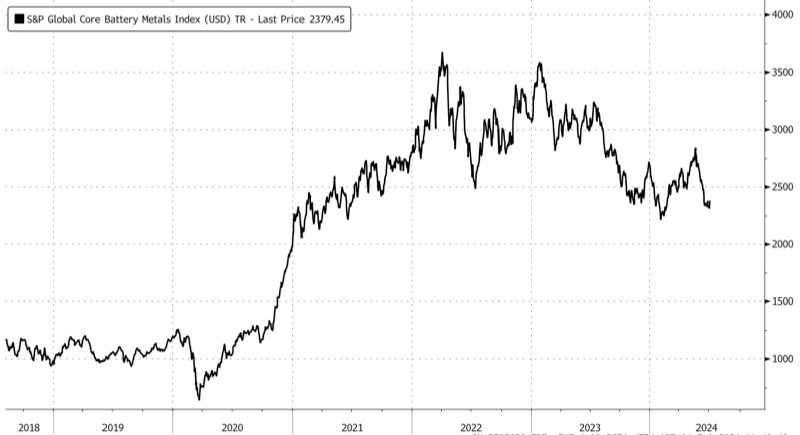
CarbonCredits, a platform serving clean energy and emission reduction-related investments and business activities, stated in an article in April this year that while the bottom of cobalt prices is still uncertain, some analysts expect prices to gradually improve over the next few quarters.
A recent report by the International Energy Agency (IEA) predicts that as cobalt plays a crucial role in achieving global net zero emissions goals in the coming decades, the value of cobalt is expected to increase sevenfold by 2030 and tenfold by 2050, with the market exceeding $400 billion
