


How to value Xiaohongshu?

Xiaohongshu recently raised funds in a Pre-IPO round and has intentions to go public. As a leading content community, Xiaohongshu's valuation logic is mainly based on user scale and user growth rate. According to Metcalfe's Law, the value of an internet company is directly proportional to the square of the number of users. Therefore, the larger the user scale and user interaction of Xiaohongshu, the greater the value. Specific financial reports have not been disclosed yet, but Xiaohongshu, as one of the largest three-party content platforms in terms of user scale, is highly anticipated
Take a moment to remember, how long has it been since you last downloaded a new non-tool app on your phone?
Since the birth of Douyin, the mobile internet market seems to have entered a platform period of stock game, making it difficult for a new national-level product full of imagination and user growth to emerge in the market.
Correspondingly, the pricing of most platform-type companies in the mobile internet by the capital market has become relatively transparent. After all, there has been no record of any enterprise with a national-level product entering the A-share or Hong Kong stock market in the past two years.
And Xiaohongshu (Little Red Book) may be the hottest target in the undercurrent. According to data from QuestMobile in 2024, Xiaohongshu is currently the third-largest third-party content platform in terms of user scale, apart from the Alibaba, ByteDance, and Tencent ecosystems.
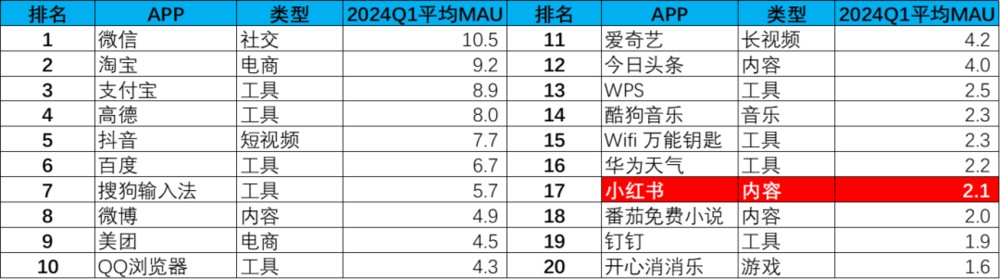
Image: Spring 2024 user scale TOP1 APP monthly active list, Source: Questmobile compilation
At the end of April, there were market rumors that Xiaohongshu had conducted a Pre-IPO round of financing. Although the company quickly denied it, the intention to go public of this popular company that has been around for ten years is an open secret.
The most important issue for going public is how to price Xiaohongshu as the leading content community with a strong label?
Today, let's talk about the prelude to the valuation of Xiaohongshu: the valuation logic of content communities with different business models.
It needs to be clear that before disclosing specific financial reports, Xiaohongshu still wears a shy and mysterious veil to the market. Therefore, traditional meticulous valuation methods are limited, so we have decided to roughly sort out the industry valuation and comparison methods.
I. Anchored by User Scale
Valuing based on user scale, user growth rate, and customer acquisition cost is the valuation logic native to the internet era and the core basis for the valuation of most platform-type internet companies.
The theoretical basis of user scale valuation comes from Metcalfe's Law proposed by Robert Metcalfe, the founder of 3Com, in 1993: The value of a network is equal to the square of the number of nodes in the network, and the value of the network is directly proportional to the square of the number of connected users, expressed in the formula V=K×N².
From the perspective of Metcalfe's Law, the core of determining the value of an internet company under the same business model is the number of users, and the number of users has the characteristic of geometric growth, with the value increasing as a single user interacts more.
Of course, the absolute number of users cannot intuitively demonstrate the development potential of an enterprise. With the development of multi-terminal interfaces in the mobile internet and the continuous expansion of scale, the value growth brought by user volume has actually been lower than the growth driven by the business model. If the value is still simply determined by N squared, it is obviously biased In the evolution path of Internet company valuations, different valuation logics based on user numbers have emerged, such as customer acquisition costs and retention rates in the SaaS model.
We believe that the core lies in business model synergy and user scale growth. The higher the business model synergy and the faster the growth, the higher the valuation. Therefore, we are more inclined to another expression: V=K*K1...*N*(1+ user growth rate).
Based on this, let's take a closer look at the variables of the value coefficient K.
II. Value Coefficient of Advertising Business
Currently, the mainstream content community business models mainly fall into three categories: advertising, e-commerce, and paid content, with Xiaohongshu mainly involved in the first two.
Let's start with advertising. The current valuation ceiling of the advertising business is beyond advertising.
Taking four listed content community targets similar to Xiaohongshu as examples, Weibo and Zhihu, with lower unit user values, have relatively lower business model value coefficients.
In the latest financial report, Weibo disclosed that the proportion of advertising business reached 86%, while Zhihu's advertising and membership business accounted for 81%, showing relative certainty but lacking imagination.
In contrast, platforms like Bilibili and Kuaishou have broader business models and faster growth rates. Bilibili's advertising business only accounts for 29% of the overall business, while membership value-added services and gaming business account for 70%, leading to a higher business value coefficient that can be utilized by individual users. Kuaishou is similar, with advertising business accounting for 57%, but some internal advertising revenue serves their own e-commerce business, and the rapid growth of the e-commerce business brings ample room for imagination to the market.

Figure: Calculating the contribution of individual users based on user scale and market value, Source: Choice Financial Client, Jin Duan calculation
From this table, we can roughly see the value of different business models. Based on this, we add data on user interaction duration.
Taking Weibo, which has the highest proportion of advertising business, as an example, limited by the shortage of the business chain, Weibo's ARPU is approximately around 0.7 yuan. According to QuestMobile data, the average usage time of Weibo is about 45% of Kuaishou's, with an economic output of 0.012 yuan per minute, roughly representing the economic value of pure advertising business.
Calculating Bilibili in the same way, the economic output per minute of advertising business is 0.047 yuan, roughly 4 times that of Weibo.
Calculating Kuaishou in the same way, the economic output per minute of advertising business is 0.09 yuan, roughly 2 times that of Bilibili.
The value coefficient of video-based advertising is roughly 4 times that of text and image-based advertising, excluding the impact of ad load, and the length of the video does not have a significant impact on marketing revenue Three, E-commerce Business Value Coefficient
Let's talk about e-commerce again.
First of all, a complete e-commerce chain can drive the advertising value of content platforms.
Continuing from the previous section on Kuaishou's single user marketing value data, the internal circulation ratio of Kuaishou is about 50%.
The complete e-commerce chain of Kuaishou contributes to a single user's minute economic output of about 0.09 yuan, which is roughly twice that of Bilibili.
Furthermore, based on this, the horizontal value comparison of complete chain content e-commerce determines the industry value of content e-commerce. On one hand, efficient supply and demand matching efficiency can enhance content value, elevate the commercial value of marketing business. On the other hand, under the condition of limited content supply, higher matching efficiency will improve the user experience of content users.
According to calculations by Huachuang Securities, Kuaishou, represented by short video mode, has an ad load of around 9% in 2023, while Bilibili, represented by medium and long videos, is around 5% according to reports from Wandian.
Adding the marketing value contributed by the closed-loop e-commerce chain, the difference between Kuaishou's marketing revenue end and Bilibili's user minute economic output is exactly 4 times.
Finally, if we use the current average valuation of top e-commerce platforms of 10-13x, we can also obtain the same valuation range:
Among the mainstream e-commerce platforms, Douyin has the highest monetization rate, around 6%, followed by Pinduoduo's main site at about 5%. Taobao and JD.com, which are greatly impacted by the former two, have monetization rates of around 4.2% and 3.2% respectively, under the backdrop of actively reducing profit scale to maintain income. Kuaishou started late, with a monetization rate of only about 1.5% in the first quarter of this year.
In the first quarter of this year, Kuaishou's e-commerce GMV was around 288.1 billion, with a monetization rate of about 1.5%. The average profit margin of e-commerce platforms is around 50%, deducing that e-commerce contributes a profit of about 21.6 billion, corresponding to 216-280 billion with 10-13x PE, which is equivalent to the actual market value level.
In summary, using the analogy method of content community to evaluate the valuation model of Xiaohongshu, it can be summarized as:
V=K1*K2*K3*K4*N*(1+ User Growth Rate)
As shown in the figure below.
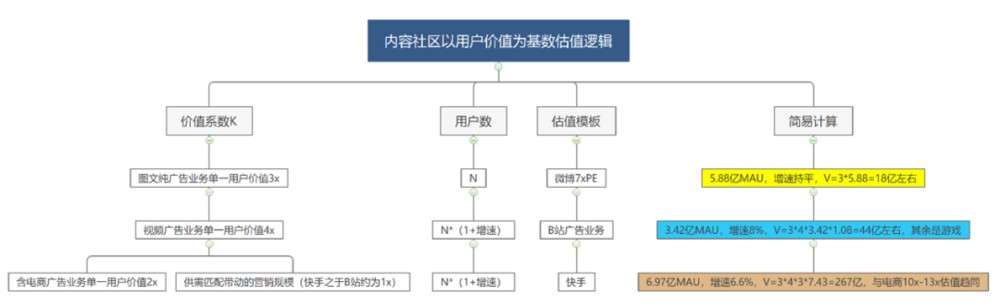
Figure: Valuation logic of content community based on user value, Source: Jin Duan Research Institute
Of course, all valuation models are difficult to be universal.
Most internet companies have subtle differences in their business models, which we refer to as uniqueness x in the valuation model. Some differences can significantly affect the valuation level. For example, the uniqueness shown by Douyin under the advantage of algorithms still far exceeds its overseas performance in the same industry, giving it a much higher valuation performance than its peers.
As for Xiaohongshu, the most typical uniqueness lies in two points. Firstly, the special user structure that the company has always promoted, with a high proportion of high-paying group users. Secondly, the ability to create trends, based on the "grass planting" economy, brands born are far superior to traditional content communities and content e-commerce. These are all manifestations of the uniqueness of valuation Limited by space, in the next report, we will use the above model as a framework to specifically calculate the valuation of Xiaohongshu: combining its unique X factor, we will explore what the reasonable valuation level is
