


Analyzing the unique play of "backdoor listing" from the debut of Ruichang International Holdings on the stock market

Ruichang International Holdings was listed on the main board of the Hong Kong Stock Exchange on July 10th, with its stock price rising by 14.3% to HKD 1.20 on the first day, reaching a market value of HKD 600 million. The company adopted a tactic of "stingy selling" through a callback mechanism, distributing a portion of internationally allocated shares to retail investors. The callback ratio is related to the oversubscription rate, and if the oversubscription rate is high enough, the public offering ratio will increase. The sponsor of Ruichang International can also artificially lower the callback ratio. Overall, Ruichang International Holdings had a strong performance on its first day of listing
Despite the bumpy road to IPO, Ruichang International Holdings (01334) seems to have caught a good time for its IPO.
On July 10th, Ruichang International Holdings officially landed on the main board of the Hong Kong Stock Exchange, with First Shanghai Securities as the sole sponsor. On the market, the stock opened at 1.05 Hong Kong dollars, up 23.81% from the issue price, and then surged, rising by about 48% at one point during the day. By the close of trading, Ruichang International Holdings had risen by approximately 14.3% to 1.20 Hong Kong dollars, with a turnover of 50.953 million Hong Kong dollars and a total market value of 600 million Hong Kong dollars.
According to the Wise Finance APP, in yesterday's grey market trading, Ruichang International Holdings opened at 1.03 Hong Kong dollars, reached a high of 1.35 Hong Kong dollars, and closed at 1.19 Hong Kong dollars, with a gain of 13.33%. Without considering transaction fees, one could profit 350 Hong Kong dollars per lot.
The Play of Backtracking and Reluctant Selling
The strong performance of Ruichang International Holdings on its first day of listing is closely related to its play of backtracking and reluctant selling.
As is well known, the general IPO of Hong Kong stocks is divided into international placement and public offering, with international placement mainly targeting institutional investors, while public offering is for individual investors (retail investors), divided into Class A and Class B. Generally, international placement accounts for 90% of the shares offered, and public offering accounts for 10%. However, if the public offering is too hot, leading to an excessively high oversubscription rate, it will trigger a backtracking mechanism, transferring some of the international placement shares to the public offering side, in other words: institutional investors relinquish some chips to retail investors.
Specifically, the backtracking ratio is closely related to the existence of oversubscription: if the public offering is oversubscribed by at least 15 times up to 50 times, the public offering ratio will increase from 10% to 30%; 50 times up to 100 times will increase to 40%; and oversubscribed by 100 times or more will backtrack to 50%. However, if the placement is undersubscribed while the public offering is oversubscribed, or if both are fully subscribed but the public offering is less than 15 times oversubscribed, the public offering ratio can increase to a maximum of 20%, subject to a lower limit price.
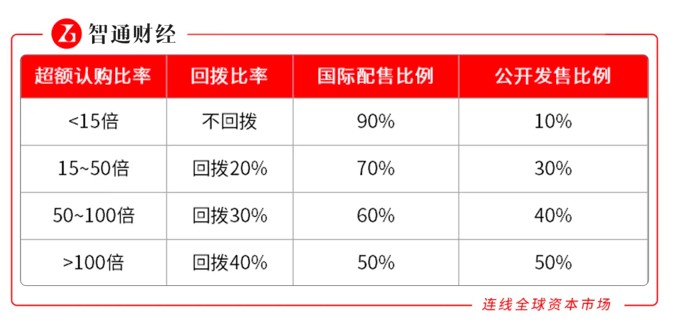
However, these are just normal circumstances. If the international placement itself is undersubscribed, the sponsor has the right not to follow the corresponding rules for backtracking. For example, if the oversubscription ratio is 50 times, but when the international placement itself is undersubscribed, the sponsor can "artificially" lower the backtracking ratio to 20%. However, this comes at the cost of setting a lower limit price range.
Lowering the backtracking ratio indicates that the company does not want to distribute too many chips, while setting a lower limit price is beneficial for the stock price to rise after listing. With these two factors combined, the stock price is likely to rise after listing Returning to RUICHANG INTL, according to the previous distribution results, in terms of global offering, RUICHANG INTL issued a total of 125 million shares globally, accounting for 25% of the total shares after completion of the issuance; 3 cornerstone investors including Huangshan Construction under Huangshan State-owned Assets Supervision and Administration Commission, Huangshan Chenghe Xinye, and Emsdom under Mr. Zhang Xinyu subscribed for a total of 55.045 million shares of the offering, accounting for 44.04% of the offering shares and 11.01% of the total shares of the company after listing. In terms of subscription funds, RUICHANG INTL raised a total of approximately HKD 131 million, with a net amount of approximately HKD 62 million. The three cornerstone investors accounted for approximately HKD 57.692 million, while the remaining international allocations accounted for approximately HKD 56.883 million.
According to analysis from the Zhitong Finance APP, RUICHANG INTL seems to have incorporated all the prerequisites for a callback, such as a nearly 40% difference between the upper and lower limits, a market value of around 500 million, issuing 25% of shares, a P/E ratio of 10 times, and so on.
As expected, the company's Hong Kong public offering was oversubscribed by 19.24 times, with the final number of shares allocated to the public offering being approximately 15.675 million shares, accounting for approximately 12.54% of the total offering shares (after adjustment of the offering size and reallocation), while the international offering was oversubscribed by 0.97 times, with the final number of shares allocated to the public offering being approximately 109 million shares, accounting for approximately 87.46% of the total offering shares (after adjustment of the offering size and reallocation).
As mentioned earlier, under normal circumstances, RUICHANG INTL's public offering subscription would have been oversubscribed by 19.24 times, increasing the public offering proportion to 30%. However, due to insufficient international allocations, the sponsor has the right not to callback according to the corresponding rules. As a result, RUICHANG INTL has adopted a strategy of scarcity, offering only 12.54% of the shares.
With this strategy of scarcity combined with a lower limit pricing, it is highly probable that RUICHANG INTL's stock price will trend upwards after listing.
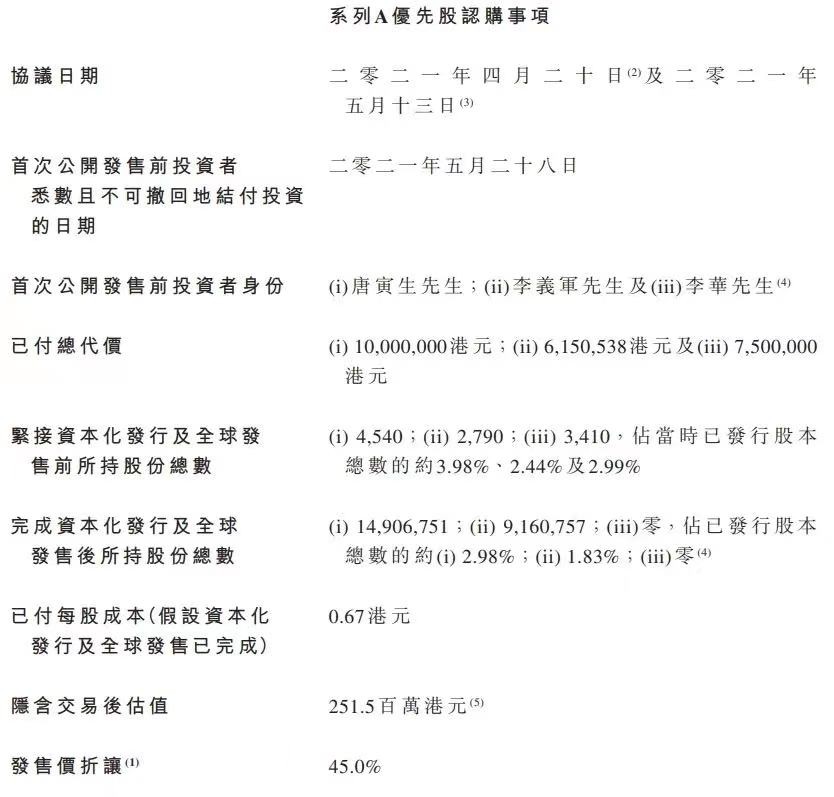
In addition, the company completed a Series A preferred stock subscription before its IPO, with the final completion date in May 2021, at a cost of HKD 0.67 per share, implying a post-transaction valuation of HKD 252 million, a 45% discount to the offering price. Based on the closing price on July 10th, Tang Yinsheng, Li Yijun, and Li Hua have all earned a return of 100%.
It is worth mentioning that after the distribution results were announced, some investors on Xueqiu were not optimistic about RUICHANG INTL's debut on the market. However, the company offered investors a 30% return at the peak of the grey market, and continued to perform strongly on the first day of listing, bringing substantial profits to investors who held on.

Close Cooperation with the "Three Barrels of Oil" with Healthy Cash Flow Worthy of Attention
Highly favored in the secondary market, how is the fundamental of RUICHANG INTL?
Public information shows that in 1994, RUICHANG INTL was established in Luoyang City, mainly engaged in the manufacturing and sales of oil refining and chemical equipment. Its products mainly include four categories of products: catalytic cracking equipment, heat exchangers, process burners, sulfur recovery equipment, and volatile organic compound incineration equipment, belonging to the leading enterprises in the industry's segmented field.
According to a Frost & Sullivan report, based on the earnings in 2023, RUICHANG INTL is the third-largest manufacturer of catalytic cracking equipment in China's oil refining and chemical operations, with a market share of about 7.6%. Additionally, it is also the manufacturer of sulfur recovery equipment and volatile organic compound incineration equipment in China's oil refining and chemical operations, with a market share of about 3.4%.
In terms of performance, RUICHANG INTL's performance is commendable. During the period from 2021 to 2023, RUICHANG INTL's performance has steadily grown. The company's revenue increased from 248 million in 2021 to 544 million in 2023, with a two-year compound growth rate of 48.11%. Correspondingly, its profitability has also significantly increased, with net profit increasing from 13.246 million in 2021 to 55.211 million, more than tripled; the adjusted profit margin also increased from 7.4% to 12.5%.
This is closely related to its long-term close cooperation with the "Three Barrels of Oil". According to the prospectus, RUICHANG INTL has established a solid and stable relationship with the subsidiaries and branches of China's three largest oil refining and petrochemical groups, as well as the largest EPC (Engineering, Procurement, and Construction) contractor in the industry, and business relationships with five major customers ranging from 2 to 28 years.
Based on this, it can be reasonably speculated that these three companies are subsidiaries and branches of China Petroleum, Sinopec, and CNOOC. In fact, RUICHANG INTL's IPO plan also has a certain "state-owned enterprise" color, with two of the company's three cornerstone investors having state-owned backgrounds.
However, the increasing concentration of major customers has led to an increase in the proportion of trade receivables, thereby affecting its healthy cash flow. From 2021 to 2023, the revenue from the top five customers accounted for 46.9%, 75.9%, and 73.6% of the revenue, respectively, which is relatively high. At the same time, the company's trade receivables and accounts receivable have continued to rise, reaching 160 million, 310 million, and 327 million respectively, with an average turnover days of trade receivables and accounts receivable of 198 days, 205 days, and 214 days. The difficulty in turnover has increased, undoubtedly posing a challenge to its cash flow In fact, Ruichang International operates in the oil refining and petrochemical equipment manufacturing industry, which has a significant need for capital. Historically, it has mainly relied on cash generated from operations and external financing (including bank loans and other borrowings) to meet its working capital and capital expenditure needs. Under immense pressure from large remittances and high cost expenditures, Ruichang International had mostly negative net cash flow from operating activities before 2021, only starting to turn around in 2022, with an estimated net cash flow of about 6.4 million yuan in 2023.
Looking ahead, the company's growth prospects are the core foundation for sustained stock price growth.
In terms of industry outlook, with the increasing refining capacity in China and the rapid development of the petrochemical industry, the market size of China's oil refining and petrochemical equipment is forecasted to grow at a compound annual growth rate of approximately 6.5% from 2023 to 2028, reaching 979.2 billion yuan by 2028.
To gain growth dividends in the continuously growing track, the company's primary task is to seize market share through capacity expansion. However, according to the information from Zhitong Caijing APP, the contradiction of insufficient production capacity is prominent for Ruichang International Holdings as its business scales up.
Ruichang International Holdings has two production facility centers in Luoyang City, one responsible for producing sulfur recovery equipment, volatile organic compound incineration equipment, and catalytic cracking equipment, while the other is responsible for producing heat exchangers and process burners. By the end of 2023, the utilization rates of the two production facility centers were 100.9% and 70.1% respectively. In June 2023, Ruichang International Holdings leased a production facility in Jiangsu Province, with a utilization rate exceeding 100%.
Unfortunately, as of the end of 2023, Ruichang International Holdings had cash on hand of only 46 million yuan, which is insufficient to support the construction of capacity expansion projects. Therefore, Ruichang International Holdings plans to invest 99 million yuan to build production facilities on its own land in Luoyang City, responsible for producing sulfur recovery equipment, volatile organic compound incineration equipment, and catalytic cracking equipment.
If able to raise funds through an IPO, increase capacity construction, and improve the company's cash flow health, Ruichang International Holdings will also be considered to have entered a new growth stage.
