"Dong Wang" has not taken the stage, but the MAGA wind has swept through Wall Street! Is this x86 architecture pioneer embarking on a bull market?

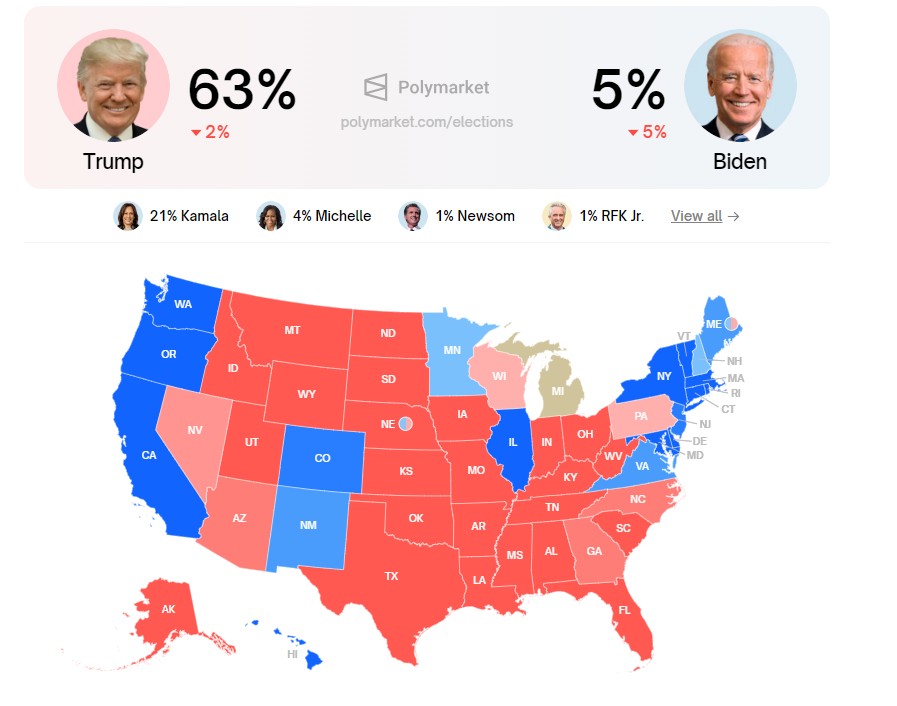
The MAGA trend has swept Wall Street, and the Trump attack incident will be one of the important turning points in the U.S. election, strengthening Trump's political leadership image and positively impacting his return to the White House. Trump's probability of winning in the November election soared to 75%, currently still around 63%, while his competitor Biden's chances of winning plummeted to around 5%. Trump's "Trump trade" is popular in the global market, with Wall Street generally believing that Trump's policies will bring investment opportunities. The veteran chip giant Intel, which pioneered the x86 architecture, is experiencing a unique rebound under the "MAGA trend"
From the moment the bullet grazed Trump, the outcome of the 2024 US presidential election was almost certain. Musk even compared Trump to one of the greatest presidents in US history, Theodore Roosevelt, praising his unwavering spirit as a new generation of American leaders. Following the shooting incident, Trump's lead in the polls had surged significantly, far ahead of the current president, Biden. Trump, known as the "understanding king," has seen a resurgence of the "MAGA wind" in recent days, sweeping across Wall Street. These top institutions are embracing stocks that are expected to benefit long-term from the "understanding king" policies with real money, among them, the veteran chip giant Intel (INTC.US) with an AI label, which stands out with a unique rebound amidst the overall decline in chip stocks.
According to the US 2024 election prediction platform Polymarket, Trump's probability of winning the November election had soared by over 10 percentage points after the shooting incident, reaching an astonishing 75%, currently hovering around 63%. Meanwhile, his competitor Biden's chances of winning have plummeted to around 5%, and the support rate for US Vice President Harris has risen to around 20%, but still cannot be compared to Trump.

Investors in the financial markets generally believe that the attack on Trump will be one of the most important turning points in the US election, strengthening Trump's political leadership image comprehensively, laying the foundation for his return to the White House in November. Especially in the minds of Trump's supporters, he is seen as a historic hero who unites American voters. Even in the eyes of some Republican donors who do not support Trump, Trump's survival from the bullet under "God's protection" means he is the only rightful next president. In contrast, weaknesses in Biden's on-the-spot response, speech logic, and internal party support have become more pronounced.
On Wall Street, since Biden's poor performance in last month's presidential debate boosted Trump's prospects of winning, the "Trump trade" has swept global markets. The coverage of the "Trump trade" is very wide, with traders and strategists generally agreeing that under the MAGA policy tone, Trump's election will stimulate inflation trades benefiting from loose fiscal policies and greater trade protectionism—that is, betting on a stronger US dollar, rising US bond yields, as well as benefiting domestic industrial giants, and seeing rises in banks, healthcare, and energy stocks. Without exception, these assets have recently rebounded against the tide following the "Trump trade" trend. MAGA, short for "Make America Great Again," can be used to refer to the overall tone of the Trump administration's policies, as well as to describe Trump himself and the fervent supporters of Trump by some mainstream media. The term "Trumponomics" created by the media is synonymous with low interest rates and low taxes, aiming to "Make America Great Again" through a loose fiscal plan dominated by low interest rates and tax cuts.
The MAGA Trend Sweeping Wall Street, Intel Known as the Core "King of Understanding" Concept Stock
Intel may be the biggest AI winner in the new wave of "AI investment frenzy." Trump's victory has become a basic consensus among most investors. From the latest news, it seems that Trump, who is known as the "King of Understanding," may have more intense trade protectionist policies compared to when he took office in 2016 and during the Biden administration.
In the view of some analysts, investors can imagine that the "King of Understanding," who pursues trade protection policies and urgently hopes for the reshoring of high-end manufacturing to the United States, will return to the White House successfully in November. In the future, the subsidy support for Intel may continue to escalate, and there is even the possibility of using policy measures to force TSMC to transfer some core chip orders to Intel or TSMC's chip factory in the United States that is about to be built, driving the prosperity and growth of the U.S. chip manufacturing industry.
Trump has frequently emphasized the importance of the trend of "reshoring manufacturing to the United States" in his recent speeches. In his view, TSMC, known as the "King of Chip Foundry," has seized the prosperity that originally belonged to American chip manufacturers. Trump stated that almost all chip manufacturing in the United States has been "snatched by TSMC" without any benefits. From his remarks, we can see that Trump is striving to launch stricter trade protectionist policies after taking office, especially hoping that Intel and GlobalFoundries, the two major American chip giants, can seize a large number of chip orders from TSMC.
After Trump's remarks on the upgrade of chip manufacturing and trade protection, U.S. chip stocks plummeted across the board, as most chip giants rely on TSMC's production capacity. Trump's remarks undoubtedly dealt a heavy blow to TSMC's prospects, making it difficult for TSMC to boost its sluggish stock price even if its performance exceeds expectations. NVIDIA and AMD, among other chip giants that rely on TSMC, also face uncertain production capacity prospects.
Although ASML's Q3 performance outlook fell short of expectations and the market's expectation of interest rate cuts driving a shift in U.S. stock styles also contributed to the sharp decline in chip stocks, from the market pricing since Wednesday, it is clear that the market believes that Trump's remarks are more impactful, and Wall Street has begun to price in that Intel may become one of the biggest winners after the "King of Understanding" takes office. Looking at the trend of chip stocks since Wednesday, the Philadelphia Semiconductor Index (.SOX), known as the "global chip stock barometer," plummeted by 7% in two days, while Intel's stock price, which has been lackluster this year, has rebounded against the trend, surging nearly 15% since July, while the Philadelphia Semiconductor Index has fallen by over 2%. Intel and Gexin (GFS.US) are both American domestic chip manufacturers, but unlike Intel focusing on 10nm and below high-end processes, Gexin focuses on mature processes. However, Gexin's stock price has recently seen a counter-trend growth, especially on Wednesday when US chip stocks plummeted across the board, Gexin rose by nearly 7%.
Intel's recent strong rebound trend has attracted more and more attention from investment institutions. In the eyes of these institutions, Intel's stock price has quietly embarked on the "bull market road" since the moment Trump was shot, making it one of the most promising "understanding king concept stocks". Northland Securities recently released a research report stating that they maintain a "buy" rating on Intel with a target price of $68 within 12 months (Intel closed at $34.870 on Thursday).
Global Equities Research is more aggressive, bullish on Intel rising to $100 in the long term. Global Equities stated that high subsidies from the US government will fully support Intel in achieving its ambition to become a leader in high-end chip manufacturing, thereby helping Intel become the global leader in the manufacturing of "next-generation AI chips" in the future. Global Equities mentioned that Intel's possession of the most advanced chip process technology routes such as 18A, 14A, and 10A is crucial for the future mass production plans of higher performance AI chips for chip giants like Nvidia and AMD.
Intel's Ambition: AI PC and Chip Manufacturing Dream
From the perspective of performance expectations, dominating the core position in the AI PC field that is expected to lead a new wave of consumer electronics replacement, as well as Intel's "chip manufacturing dream" in the high-end chip process field, may be important catalysts for promoting Intel's long-term performance expansion trend and stock price bull run.
Well-known Wall Street investment firm Melius Research recently released a report stating that the stock price trends of "latecomers" in the AI field, such as Intel, AMD, IBM, and even Apple, may start catching up with absolute leaders in the artificial intelligence field such as Nvidia, Microsoft, and Google in the second half of this year, leading a new wave of "AI investment frenzy".
Here, "latecomers" do not mean that they are lagging behind in AI underlying technology, but rather that their efforts in a specific field started relatively late, with market share far behind industry leaders, or their stock price trends lagging behind the leaders. For example, although Intel seems to have no share in the data center AI chip market, it may boost Intel's valuation by leveraging its x86 ecosystem advantage to participate in the AI PC layout and entering the chip manufacturing field.
Melius pointed out in the report that AMD and Intel are expected to benefit comprehensively from the AI PC wave. These two major x86 architecture chip giants integrating CPU+NPU+GPU processor hardware will be used in new AI PC terminal devices running Microsoft Windows operating system. Meanwhile, Microsoft is about to launch the "Recall" feature in its "Copilot+ PC", which Melius believes could be the upgrade reason closest to a killer application In Melius' view, AI PC may be an important catalyst for Intel's continued stock price increase. Intel has been deeply involved in the x86 architecture CPU field on the PC side for decades, with a strong ecosystem of software and hardware developers, supply chain partnerships, and a large loyal user base in the PC domain.
This year, both AMD and Intel, the two x86 architecture CPU giants, have been intensifying their efforts in the AI PC field. Qualcomm, on the other hand, has made a strong entry into the AI PC field by launching high-performance central processors based on ARM architecture. At this year's Computex conference, AMD CEO Lisa Su invited a series of partners on stage - from HP CEO Enrique Lores to ASUS Chairman Jonney Shih - to discuss the use of AMD's new Ryzen AI 300 series processors in their upcoming AI PC models. These PC manufacturers have also indicated that they will be equipping their devices with Intel's latest processors tailored for AI.
Intel's new Core Ultra processor integrates an AI-specific Neural Processing Unit (NPU) and Arc GPU into the CPU. The NPU is dedicated to accelerating AI inference tasks, making this integrated CPU+NPU+GPU processor the company's "most efficient processor," marking the official arrival of the AI PC era. Intel's Lunar Lake processor for laptops is set to be launched in the second half of 2024, featuring a "brand-new low-power architecture and significant IPC improvements," with AI data processing performance from the GPU and NPU modules three times higher than that of Meteor Lake.
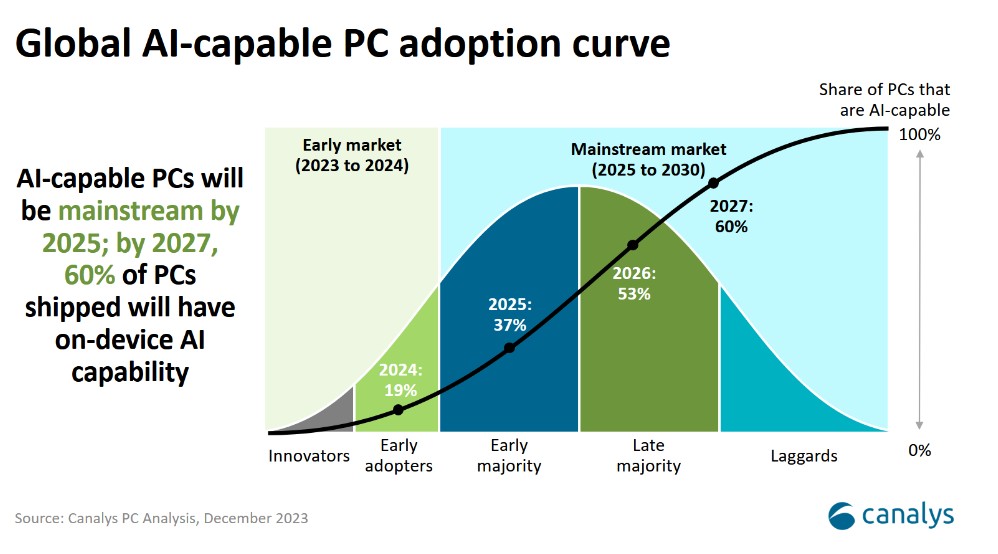
According to the latest forecast data from research firm Canalys, 2024 is expected to be the "year of AI PC," with global AI PC shipments reaching 51 million units, accounting for 19% of total personal computer (PC) shipments. However, this is just the beginning of market transformation. It is projected that by 2028, AI PC shipments will reach 208 million units, with an expected market share of over 70% of total PC shipments. The compound annual growth rate (CAGR) from 2024 to 2028 is expected to reach an astonishing 42%.
For Intel's advanced foundry business transformation towards becoming a "global chip foundry," the company expects that the overall operating loss of its foundry business will peak in 2024. Intel plans to achieve up to 40% Non-GAAP gross margin and up to 30% Non-GAAP operating margin by some time between now and 2030.
Intel CEO Gelsinger recently stated that the company is willing to manufacture chips for any company, including long-term competitors Nvidia and AMD. Gelsinger predicts that by 2030, Intel will primarily achieve the second largest scale in the global chip manufacturing business by meeting the huge demand for AI chips, with its scale possibly slightly behind the chip manufacturing leader TSMC.
Gelsinger also mentioned that the company's business transformation is progressing smoothly, **taking a "leading step" ahead of competitors in the chip manufacturing field to achieve a more advanced 18A process node, where the 18A advanced process will allow Intel to be cost-competitive with its competitors again. The "18A" chip manufacturing category refers to Intel's planned 1.8nm level chips and the 3D chiplet advanced packaging technology roadmap planned by Intel.
Intel's chip manufacturing business with room for imagination is also a core logic for investment firm Global Equities Research to be bullish on Intel reaching $100. "The $8.5 billion in free government funding is a very optimistic start. But in addition, Intel has also planned to establish a chip manufacturing company capable of producing 'next-generation' AI chips based on 18A, 14A, and 10A process technologies, with Intel's high-end chip manufacturing and 3D advanced packaging being essential technologies for accelerating the development of AI technology," Global Equities wrote in a report.
In addition to Intel's 1.8nm level chip manufacturing potentially leading competitors, Intel's lead in Foveros advanced packaging technology over TSMC and Samsung is also a core logic for Global Equities to be optimistic about Intel winning more orders in the AI chip manufacturing field. **From a technical standpoint, Foveros is ahead of TSMC's 2.5D CoWoS technology. The 3D advanced packaging technology named Foveros is an innovative chip stacking solution, with AI chips expected to be the largest-scale application of this technology; Intel's technology allows the vertical stacking of processor compute blocks, rather than side-by-side stacking. Intel stated that by 2025, the capacity of its planned 3D Foveros packaging will be four times the current level.
The current demand for AI chips is incredibly strong, and is likely to remain so for a long time to come. TSMC management stated at an earnings conference on Thursday that the demand for CoWoS advanced packaging required for AI chips is expected to continue to outstrip supply until 2025, with a slight easing possible in 2026. At the "Advancing AI" event, Nvidia's strongest competitor AMD raised its global AI chip market size expectations up to 2027 from the previous $150 billion to a staggering $400 billion, with the AI market size expected to be only around $30 billion in 2023. Well-known investment firm I/O Fund expects the total potential market size of the global AI data center market to reach $400 billion by 2027, and a staggering $1 trillion by 2030
The economic cycle is still ongoing! Chip stocks are on a frenzy, maybe not over yet
Although the financial market is starting to see Intel as the concept stock with the greatest potential for growth, focusing on PC chips, Intel is still fundamentally a very pure chip stock. The expectation of a long bull market in its stock price is also inseparable from the strong support provided by the upturn in the chip industry's business cycle.
The trend of the chip industry's recovery led by AI chips is becoming more and more clear, as recent data from the Semiconductor Industry Association (SIA) in the United States shows that global semiconductor sales totaled $49.1 billion in May 2024, a significant increase of 19.3% from the same period last year, with a month-on-month growth of 4.1%. Regarding the expected semiconductor industry sales in 2024, SIA President and CEO John Neuffer predicts in the data report that the overall sales in 2024 will achieve a double-digit increase compared to 2023.

When the deployment scale of server AI chips processing massive parallel computing reaches the basic computational power requirements and basic performance support, according to technological trends, in applications terminals such as smartphones, humanoid robots, consumer electronics, electric vehicle software systems, industrial production, etc., AI large models will eventually be integrated into these terminals, known as edge AI. TSMC management emphasized on Thursday that almost all of TSMC's chip customers want to incorporate AI large models at the edge.
Compared to cloud AI, edge AI, which combines high efficiency, fast response, and personalization, is more in line with actual consumer needs. According to the technological roadmap of chip manufacturers, in applications terminals such as PCs, smartphones, and smartwatches, AI chips will be centered around CPUs, integrating NPU and GPU technologies. This means that the demand for consumer electronics chips will soon take over the demand for data center server chips, ushering in an explosive demand. Allied Market Research predicts that in terms of chip types, CPU-centric application terminal AI chips will occupy the majority share in the global AI chip market.
Therefore, as edge AI large models are integrated into everything, it means that not only will the demand for AI infrastructure—data center AI chips increase, but also the demand for CPU-centric central processors, storage chips, MCU covering electric vehicles, and analog chips covering the industrial sector, among others, is expected to experience a wave of surge since 2024. Global top financial institution Nomura recently released a report stating that as the cyclical technical recovery expands to other consumer electronics markets, it will support the entire chip industry to enter the next upturn cycle, which is expected to continue comprehensively from the second half of this year until 2025. Nomura predicts that global chip sales will show strong growth trends in the coming months, with the cyclical recovery in the terminal chip market driven by AI chip demand expanding from artificial intelligence servers to traditional servers, PCs, core CPU chips in smartphones, and other major computing areas such as electric vehicle MCUs.
Wall Street major bank Bank of America released a research report stating that the current chip industry recovery cycle began in late 2023 and is currently only in the third quarter, indicating that the strong recovery momentum may continue until mid-2026. Analysts at Bank of America pointed out that after experiencing an extremely sluggish downturn cycle, the chip industry typically enters an upturn cycle lasting for up to 10 quarters, and this pattern is just beginning.
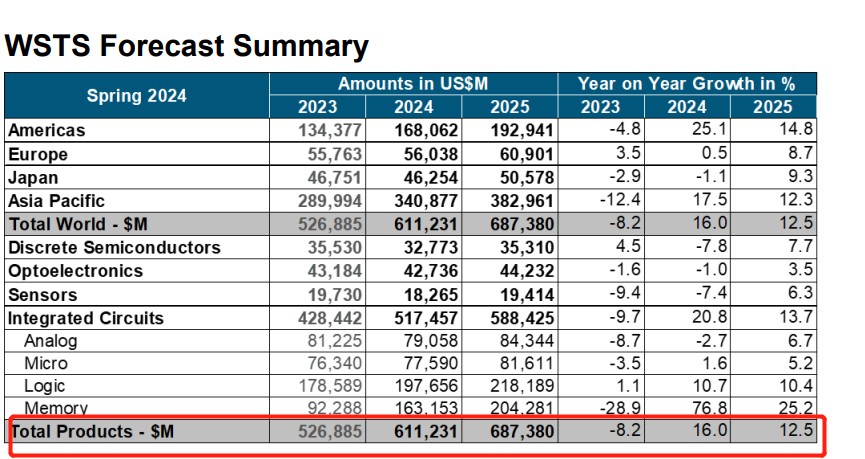
The latest semiconductor industry outlook data released by the World Semiconductor Trade Statistics (WSTS) organization recently shows that the global semiconductor market is expected to experience a very strong recovery trend in 2024, with WSTS significantly raising its sales forecast for the global semiconductor market in 2024 compared to the end of 2023. For 2024, WSTS predicts a market size of $611 billion, which means a significant increase of 16% compared to the previous year, and this is a substantial upward revision from the end of 2023 forecast.

WSTS stated that the expected revision for 2024 reflects strong performance in the past two quarters, especially in the computing terminal market. After a significant market contraction in 2023, WSTS expects that in 2024, two core chip product categories will drive double-digit sales growth, with total sales of logic chips including CPUs and GPUs expected to increase by 10.7%, and the storage chip category dominated by DRAM and NAND, which best reflects the chip cycle, is expected to surge by 76.8% in 2024.
Looking ahead to 2025, WSTS predicts that the global semiconductor market's sales are expected to reach $687 billion, indicating a further growth of approximately 12.5% on top of the already strong recovery trend in 2024. WSTS still expects this growth to be mainly driven by the categories of memory chips and logic chips, with the overall size of these two categories expected to soar to over $200 billion in 2025, fueled by the AI boom