


After the $900 billion tech stock crash, the US stock market will face a critical week!

The technology stock bubble bursts, causing a heavy blow to the US stock market, with a shift in style between large and small cap stocks. The market value of the technology sector shrinks by $900 billion. Stocks of Amazon, Google, Meta, Microsoft, Tesla, and Apple all decline. Chip stocks are particularly impacted, with the semiconductor index falling by 9%. Next week, several large technology companies will release their earnings reports, with Tesla and Google being the first to announce their performance. Analysts will focus on Tesla's ride-hailing plans and electric vehicle demand, as well as delve into the details of Google's revenue generated through AI. If the performance of technology stocks is strong and combined with weak inflation, it may reverse the market's soft trend and trigger a new round of gains. Inflation data solidifies expectations of a rate cut in September, prompting a shift in the market sentiment
Recently, the overall trend of the US stock market has been weak, with discussions in the market about the bursting of the technology stock bubble and the style switch between large and small cap stocks.
Chip Stocks Suffer Heavy Losses
This week, the Nasdaq and S&P 500 indices have both experienced their largest weekly declines since April.

Technology stocks were sold off, with the technology sector of the S&P 500 index falling nearly 6% in a week, resulting in a market capitalization reduction of approximately $900 billion.
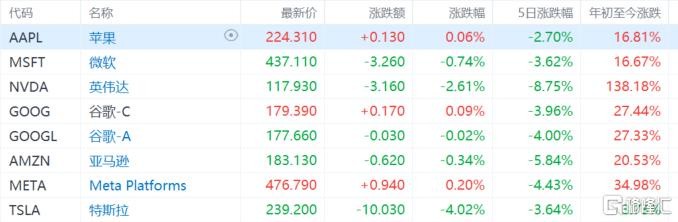
The "Big Seven" tech giants saw significant declines, with Amazon dropping over 5%, Google A and Meta dropping over 4%, Microsoft and Tesla dropping over 3%, and Apple dropping over 2%.
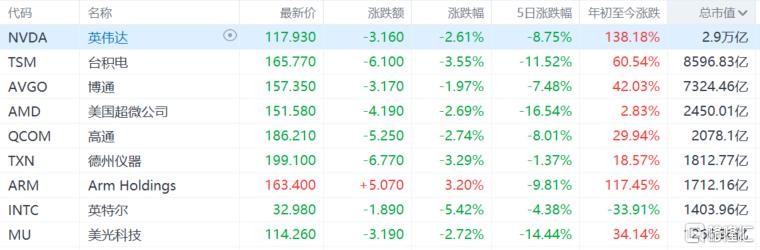
The "bleeding" in chip stocks was particularly evident, with the semiconductor index falling nearly 9% during the week.
Among individual stocks, AMD fell over 16%, Micron Technology fell over 14%, TSMC fell over 11%, ARM fell over 9%, Qualcomm and NVIDIA fell over 8%, Broadcom fell over 7%, and Intel fell over 4%.
Meanwhile, despite the downturn in small cap stocks, the Russell 2000 index still rose by over 1.68% this week.
A Crucial Week Ahead
Next week is crucial for the future trend of the US stock market, as several large tech companies will be releasing their last quarter earnings reports.
Tesla and Google will be the first of the "Big Seven" to announce their performance, scheduled for after the US market closes on Tuesday next week.
Analysts may focus on the progress of Tesla's autonomous driving taxi plan, issues regarding the demand for electric vehicles, and delve into the details of Google's revenue through AI.
The well-known US investment research firm Zacks predicts that Tesla's earnings per share for the last quarter will be $0.62, down 31.9% year-on-year; with revenue of $25.13 billion, up 0.8% year-on-year. Google Cloud service revenue is expected to be $10.08 billion, up 25.5% year-on-year.
In the following week, Microsoft, Meta, Amazon, and Apple will also release their earnings reports. NVIDIA, on the other hand, will not announce its performance until the end of August.
Glen Smith from GDS Wealth Management stated, "If we see strong tech earnings combined with weak inflation, this could reverse the recent weak market sentiment and trigger a new round of gains."
Anthony Saglimbene, Chief Market Strategist at Ameriprise Financial, believes that earlier inflation data this month caught many investors off guard, almost solidifying expectations for a rate cut in September, leading to a market shift Saglimbene suggests that investors take advantage of the partial pullback in tech stocks as an opportunity for long-term allocation.
He believes that the upcoming earnings releases may alleviate the selling pressure on large tech companies.
Wall Street Optimism
While a pullback in the US stock market is widely anticipated on Wall Street, long-term outlook remains positive.
Goldman Sachs strategists indicate a risk of market pullback this summer. The second half of the year is more likely to see a pullback rather than a bear market.
Goldman Sachs analysis suggests that this could be a result of "weakening economic data, a more dovish Federal Reserve, and rising policy uncertainty ahead of the US election."
Bank of America strategists state that as investors become increasingly convinced of a Fed rate cut in September and a Trump victory in the election, they are pouring into the US stock market.
Citing EPFR Global data, Bank of America notes that in the week ending Wednesday, US stock funds attracted around $45 billion, marking the fourth largest inflow in history. Small-cap funds saw an inflow of $9.9 billion, the second largest ever, while large-cap funds attracted $27.4 billion.
Bank of America also suggests that the stock market may decline after a Fed rate cut, calling it an opportunity to "buy the rumor, sell the fact."
The bank also remains bullish on bonds, expecting that any new tariffs implemented by Trump in the next year will "lead to deflation rather than inflation."
UBS has raised its S&P 500 index target price for the fourth time this year, now forecasting the index to close at 5,900 points by the end of the year, with a bull market target of 6,500 points, implying a further increase of 7%-18%.
UBS believes that the market backdrop remains favorable due to the following factors: 1) robust and expanding profit growth, 2) slowing inflation, 3) Fed's shift towards rate cuts, and 4) a surge in investment in artificial intelligence infrastructure and applications
