


Cui Dongshu: The number of public charging piles increased by 72,300 month-on-month, with a significant increase in public and private charging piles

In June 2024, the number of public charging piles in China increased by 72,300 on a month-on-month basis, with a year-on-year growth rate of 12%. The number of private charging piles increased by 247,000 on a month-on-month basis, with a year-on-year growth rate of 7%. The annual increase in public charging piles was 400,000, with a year-on-year growth rate of 13%. The annual increase in private charging piles was 1.25 million, with a year-on-year growth rate of 15%. China's charging infrastructure is developing rapidly, with the world's largest and most extensive charging infrastructure system already in place. However, there are still issues such as incomplete layout, outdated technology, and uneven service. The rate of electric vehicle buyers changing their minds has increased in some regions. With the expansion of scale, the electric vehicle market has tremendous development potential
According to the Zhitong Finance and Economics APP, on July 20th, Cui Dongshu, the Secretary-General of the China Passenger Car Association, stated in a post that based on the data analysis of the China Charging Alliance compiled by the China Passenger Car Association, the number of public charging piles in June 2024 increased by 72,300 compared to the previous month, exceeding the growth rate of the same period last year by 12%; the cumulative increase in public charging piles was 400,000, with a year-on-year growth rate of 13% compared to the same period last year. The number of private charging piles with vehicles increased by 247,000 compared to the previous month, with a growth rate of 7% faster than in June 2023; the cumulative increase in private charging piles was 1.25 million, with a year-on-year growth rate of 15% compared to the same period last year. The charging volume of public charging piles was 456,000 kWh, showing a good growth compared to the same period, with an average monthly charging of 1461 kWh per pile, a 6% increase from June last year.
In recent years, China's charging infrastructure has developed rapidly, establishing the world's largest, most extensive, and most diverse charging infrastructure system. Currently, according to the calculation of 1 public charging pile = 3 private charging piles, the ratio of pure electric vehicle charging piles in the incremental market in China in 2024 has reached 1:1, leading other countries in the world by several times.
However, the current charging infrastructure still faces challenges such as incomplete layout, unreasonable structure, outdated charging pile technology, uneven service, and lack of standardized operation, which urgently need improvement. The rate of regret for electric vehicle purchases in some lower-tier areas has increased. It is believed that with the continuous increase in scale, minor adjustments and great potential for improvement in electric vehicles.
The moderate advance development of charging piles results in underutilization, leading to overall losses in charging facility operations. Currently, the ratio of the incremental number of pure electric passenger cars to public charging piles is 1.4:1. If one public charging pile serves at least 3 vehicles, the charging system for pure electric passenger cars is basically a 1:1 relationship, which is a relatively good ratio.
In terms of charging enterprise operations, leading operators have shown strong performance. GAC Energy's charging piles averaged 5671 kWh in June, performing well; Nio's charging piles reached around 6500 kWh; Tesla reached 3634 kWh last month. However, some old charging piles only average over 100 kWh per month. Considering the rapid growth trend of future new energy vehicles, especially electric vehicles, it is necessary to further build a high-quality charging infrastructure system, upgrade old low-power AC piles, increase the upgrade of high-power DC fast charging, better meet the needs of the people to purchase and use new energy vehicles, and help promote the green and low-carbon transformation of transportation and the construction of a modern infrastructure system.
1. Overall Status of Charging Piles
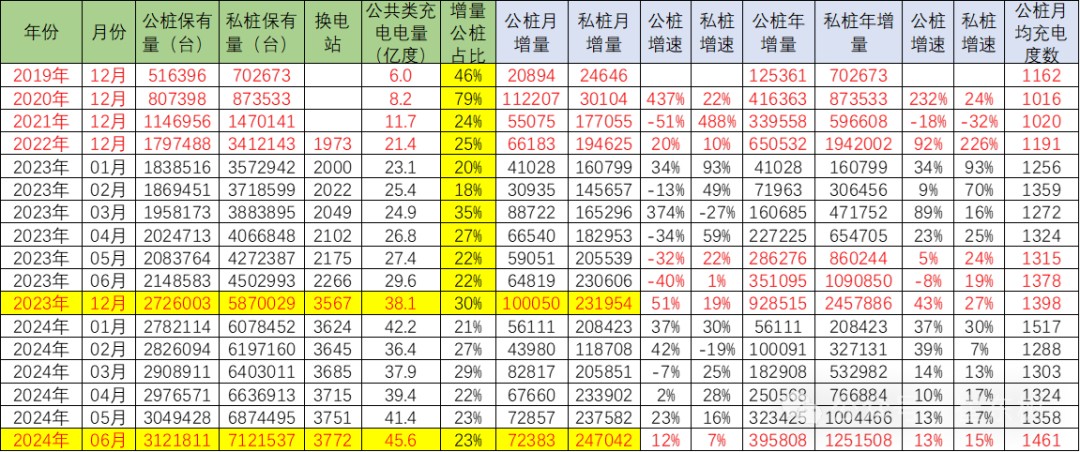
Charging infrastructure provides charging and swapping services for electric vehicles and is an important infrastructure for integrating transportation energy In 2021, the number of public charging piles increased by 340,000, while the number of private charging piles with vehicles increased by 600,000. The year-on-year growth rate of public charging piles decreased by 18% compared to 2020, and the growth rate of private charging piles decreased by 32% compared to 2020.
In 2022, the number of public charging piles increased by 650,000, and the number of private charging piles with vehicles increased by 1.94 million. The year-on-year growth rate of public charging piles increased by 92% compared to 2021, and the growth rate of private charging piles increased by 226% compared to 2021.
In 2023, the number of public charging piles increased by 930,000, with a year-on-year growth rate of 43% compared to 2022. The number of private charging piles with vehicles increased by 2.457 million compared to the end of 2022, with a growth rate of 27% compared to 2022.
In June 2024, the number of public charging piles increased by 72,300 compared to the previous month, with a growth rate of 12% faster than the same period last year. The cumulative increase in public charging piles in the year reached 400,000, with a growth rate of 13% compared to the same period last year. The number of private charging piles with vehicles increased by 247,000 compared to the previous month, with a growth rate of 7% faster than June 2023. The cumulative increase in private charging piles in the year reached 1.25 million, with a growth rate of 15% compared to the same period last year. The charging volume of public charging piles reached 456,000 kWh, showing good growth compared to the same period, with an average monthly charging of 1,461 kWh per pile, a 6% increase from June last year.
According to surveys, charging is mainly done through private charging piles, shared charging piles, and public charging piles in residential areas or companies, with each accounting for between 22% and 26%, totaling around 75%. Some respondents who lack access to these options charge at public charging piles outside residential areas, while others charge at public charging piles in places like shopping malls and cinemas.
2. Analysis of Public Charging Pile Characteristics in Various Regions
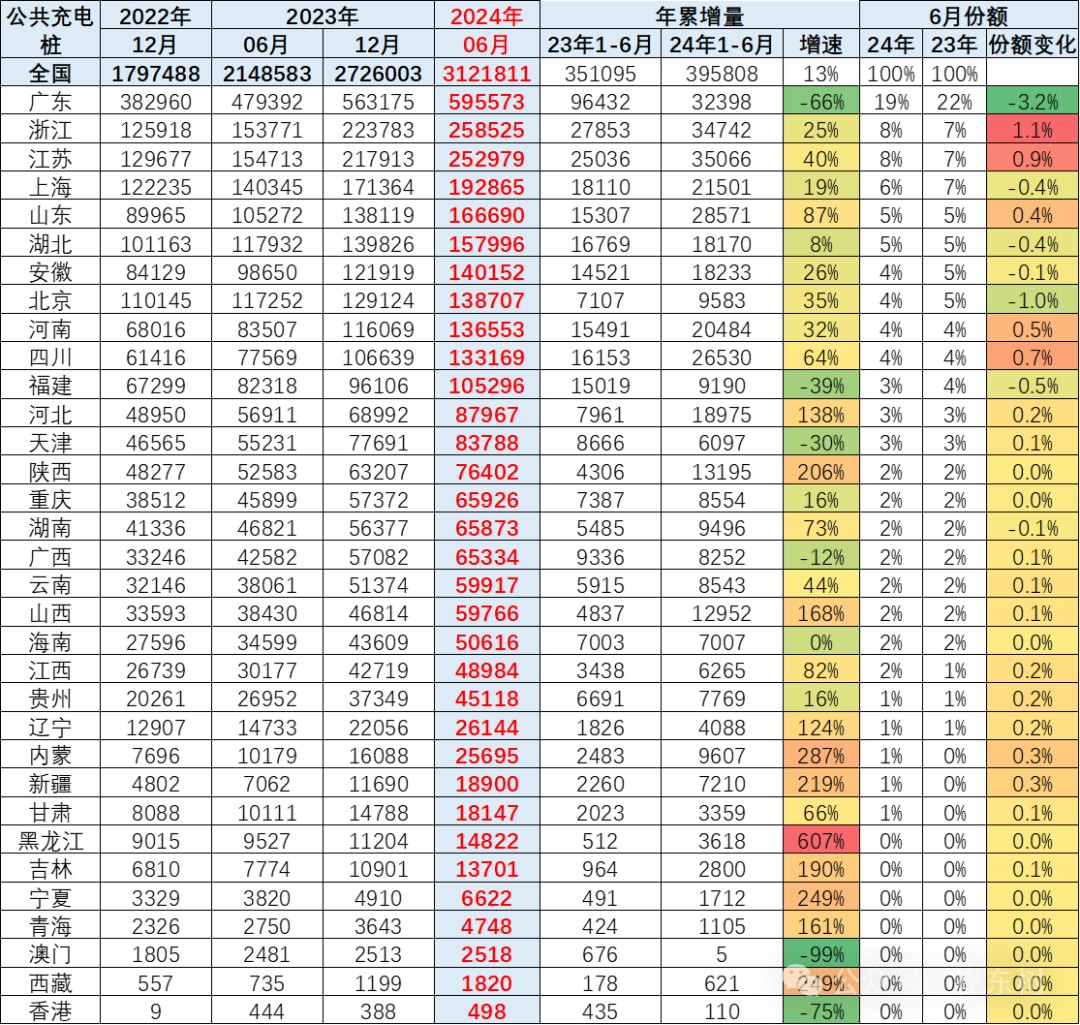
From January to June 2024, the number of public charging piles increased by 396,000 compared to the end of 2023, with a growth rate of 13%, showing rapid growth.
In the first half of 2024, Guangdong saw an increase of 32,300 public charging piles, with a market share of 19%. Last year, the increase was 96,000 with a market share of 22%, indicating a slight decrease in market share this year.
There are significant differences in the situation of public charging stations in various regions, with developed cities having larger-scale charging stations. Guangdong, Jiangsu, Zhejiang, Shanghai, and Beijing have well-developed charging station infrastructure.
In the first half of 2024, Shandong and Henan each saw an increase of around 20,000 charging piles, with a rapid increase in market share.
Beijing has 139,000 public charging piles, with nearly 10,000 added this year, indicating a large and steadily growing infrastructure. Shanghai shows a similar situation The current ratio of public charging piles to electric vehicles in China is much better than in Europe and the United States, but there is a problem of underutilization, with some public charging piles suffering heavy losses.
3. Analysis of Charging Station Characteristics
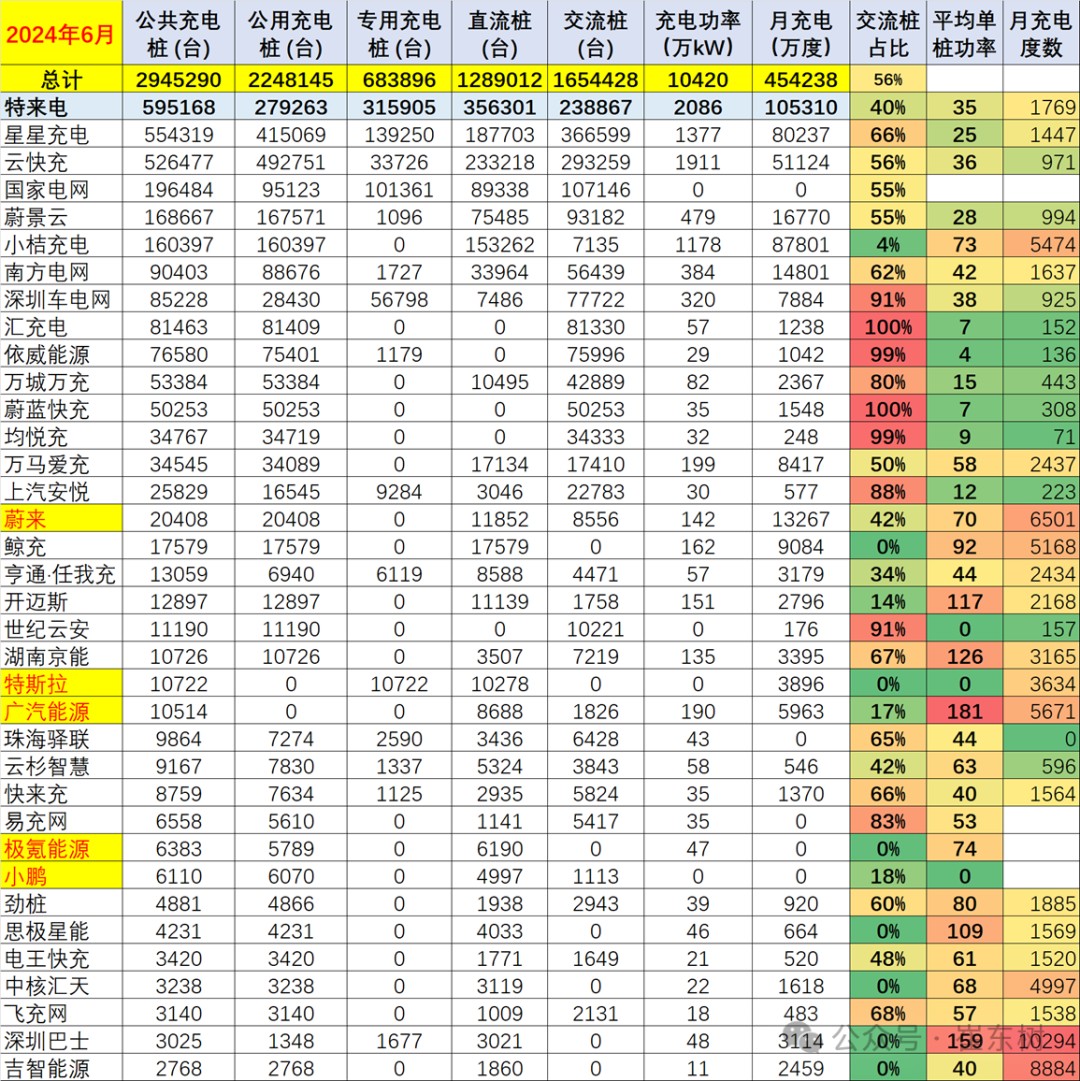
There is a significant head effect among operators. Currently, the scale of development of DC charging piles is large, and the performance of leading operators is strong. GAC Energy's charging piles reached an average of 5671 kWh in June, performing very well. Nio's charging piles reached around 6500 kWh, Tesla reached 3634 kWh, while some old charging piles only average over 100 kWh per month. The monthly charging of major charging companies is at the level of thousands of kWh, with a huge difference in charging volume ranging from several times to tens of times. Tesla's monthly data remains stable and very good.
Charging piles are divided into two categories: DC piles (fast charging) and AC piles (slow charging). DC charging piles: large in size, with high voltage, high power, and fast charging characteristics, requiring higher grid requirements, usually built at highway service areas, bus stations, etc., hence the quantity is relatively small, accounting for about 20%. AC charging piles: relatively lower unit price, easier installation, usually privately owned, hence more in quantity and widely distributed, accounting for over 80%. In terms of technological development trends, DC piles are gradually moving towards high-power development.
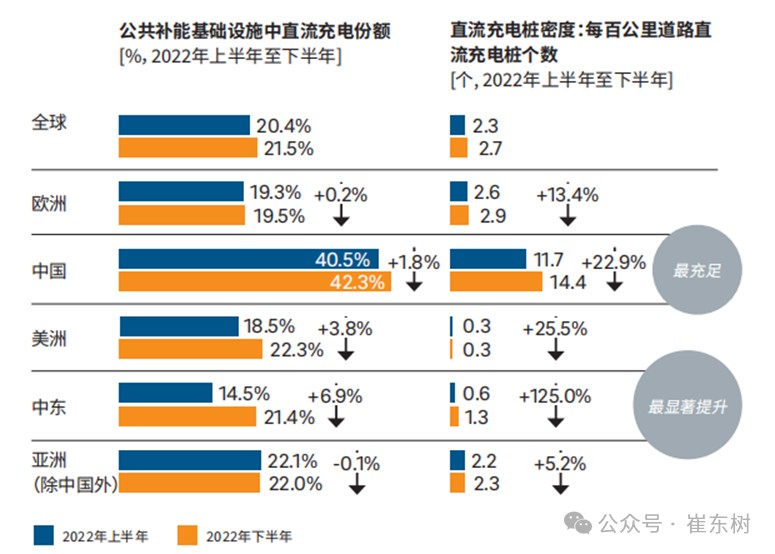
Internationally, the best efficiency is seen in public dedicated charging piles, with orderly charging for fixed charging needs such as public transportation. The number and density of public DC charging piles are increasing globally. China is in a leading position in the promotion of DC charging piles: for example, by 2024, China's share of DC charging piles in the public network will exceed 42%. Meanwhile, the Middle East has become a rising "new star" in DC charging piles: the share of DC charging piles increased by over 7% in 2022, reaching over 21%; the density of DC charging piles increased by 125%, reaching 1.3 DC charging piles per 100 kilometers of road. Both of these data points will continue to grow rapidly.
4. Analysis of Charging Pile Capacity to Meet Demand
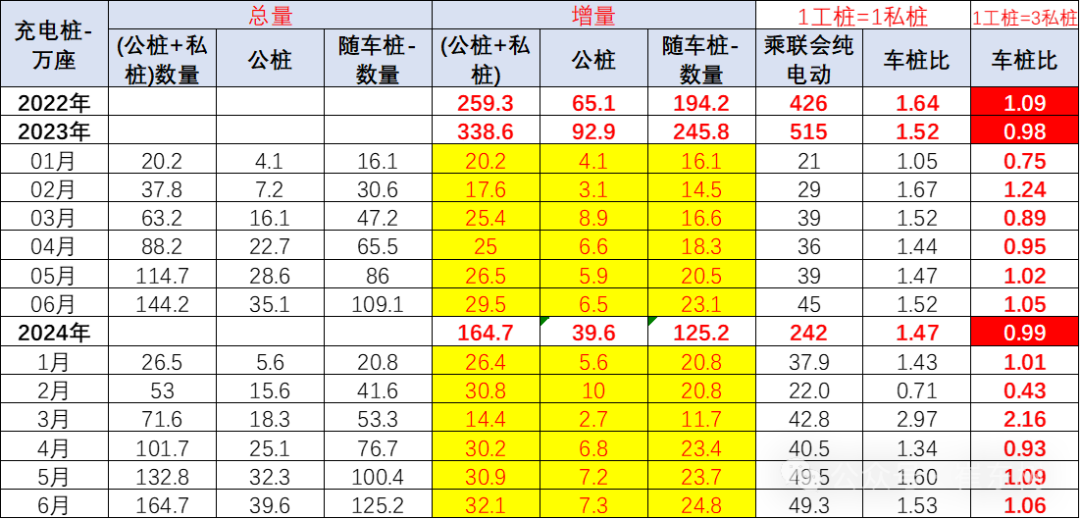
The national new energy development plan clearly states that private slow charging is the development trend and should account for over 90%. Currently, the development of private chargers is slightly slow, seriously affecting the popularization of electric vehicles.
According to surveys, users of private charging piles have higher satisfaction in various aspects (such as the adequacy of charging piles, reasonable layout, charging prices, accurate settlement, etc.) compared to other respondents.
Private chargers are privately owned by vehicle owners to meet their home charging needs, usually built with the vehicle. With a large customer base, they are the absolute mainstay of basic charging facilities.
In the first half of 2024, the domestic retail sales of pure electric passenger vehicles reached 2.42 million units, with 396,000 new public chargers and 1.25 million private chargers installed. In terms of the ratio of public chargers to private chargers being considered as 1:1 in terms of user service quantity, the ratio of vehicles to chargers is 1.5:1, indicating relatively sufficient charging facilities. It is important to note the special nature of plug-in hybrid vehicles with less charging demand. This refers to the demand characteristic of only burning fuel without charging, as seen in the Shanghai model.
However, if we look at the specific functions, the utilization rate of public chargers is three times that of private chargers, in a 3:1 relationship. This means that the ratio of charging facilities to the sales volume of pure electric vehicles reaches 0.99, which is basically a 1:1 relationship. Due to the sharp increase in the installation of public chargers, the overall ratio of vehicles to chargers has reached a relatively reasonable level of 1:1 incrementally
