


Jumia stock price is overbought and overvalued: Aug 6 will be key

Jumia stock price has surged by over 280% this year, but there are concerns about its overvaluation. The company faces challenges such as currency devaluation, competition from other e-commerce platforms, and its own loss-making status. Analysts question the company's high market cap of over $1.2 billion and its ability to generate profits. The stock price analysis suggests a bearish pattern and overbought levels. The upcoming August 6th will be a key date to watch.

Jumia (JMIA) stock price has gone parabolic in the past few months. It jumped to a high of $14.38 earlier this month after receiving an upgrade by a Benchmark analyst. It has soared by over 280% this year, beating popular Wall Street names like Google, Amazon, AMD, and even Nvidia.
Jumia’s rally has helped to push its market cap to over $1.2 billion, solidifying its position as the biggest e-commerce company in Africa. It has also become one of the top e-commerce companies globally.
Jumia is growing amid challenges
Jumia is an e-commerce company that is often said to be Africa’s answer to Amazon. It operates an e-commerce platform that is available in some African countries like Nigeria, Morocco, and Kenya.
The company makes its money from third party sellers who list their products on the website. In this, it takes a cut whenever someone buys these products.
Over time, Jumia has added other products and services in its platform. It launched a logistics platform where it helps sellers do their deliveries easily. It recently launched modern warehouses in Nigeria and Morocco.
Jumia has also entered the payment industry through JumiaPay, a solution that lets users pay on its website and pay for subscriptions.
The company has gone through huge challenges in the past few years. First, the Covid-19 pandemic led to supply chain issues that affected its business. As a result, its annual revenue dropped from over $179.5 million in 2019 to $159.4 million in 2020.
Second, it is going through a significant currency devaluation in some countries. For example, the Nigerian naira has plunged to 1,500 against the US dollar from last year’s low of less than 800.
Other African currencies have also retreated, leading to inflation and weak consumer spending. It has also made it difficult for the company to move money from Africa to Berlin, where it is headquartered.
Competition is rising
The other big challenge that Jumia is facing is the robust competition in Africa. Most big supermarket brands like Shoprite, Carrefour, Quickmart, and Naivas have embraced e-commerce and are more convenient.
In Kenya, people can use Glovo to shop at any supermarket and receive the products within a few minutes. In contrast, Jumia deliveries tend to take at least a day. Therefore, this competition will likely hit its profit margins.
More competition is coming from social media platforms like Facebook and Instagram, where many sellers are focusing on. As such, people are more likely buying from these sellers instead of Jumia.
This trend was seen in Jumia’s most recent financial results, which showed that its active customers dropped to 1.9 million from 2 million a year earlier. The drop in users was offset by a 1.9% increase in the number of orders. Jumia’s quarterly revenue rose from $41.3 million in Q1’23 to $48.9 million in Q1’24.
Jumia is a cash incinerator
Meanwhile, Jumia is a loss-making company that has never turned a profit. Its loss before income tax rose by 35.5% to $39.6 million. In 2023, its annual loss stood at over $104 million. In its annual report, Jumia noted:
“Since we were founded in 2012, we have not been profitable on a consolidated basis. We incurred a loss for the year of $226.9 million in 2021 and a loss for the year of $238.3 million in 2022 and a loss for the year of $104.2 million in 2023. As of December 31, 2023, we had accumulated losses of $2.1 billion.”
On a positive sign, the company’s levered free cash flow improved from minus $152.6 in 2022 to minus $43 million in 2023. In the last quarter, the free cash outflow was $20 million, a big increase from $6.1 million a year earlier.
The key concern about Jumia is its valuation. The company now has a market cap of over $1.2 billion against annual revenues of $186 million. Analysts expect that its annual revenues will be flat at $186 million this year. Its loss-making trend is expected to go on for a few years. As such, it is hard to justify this valuation.
Jumia stock price analysis
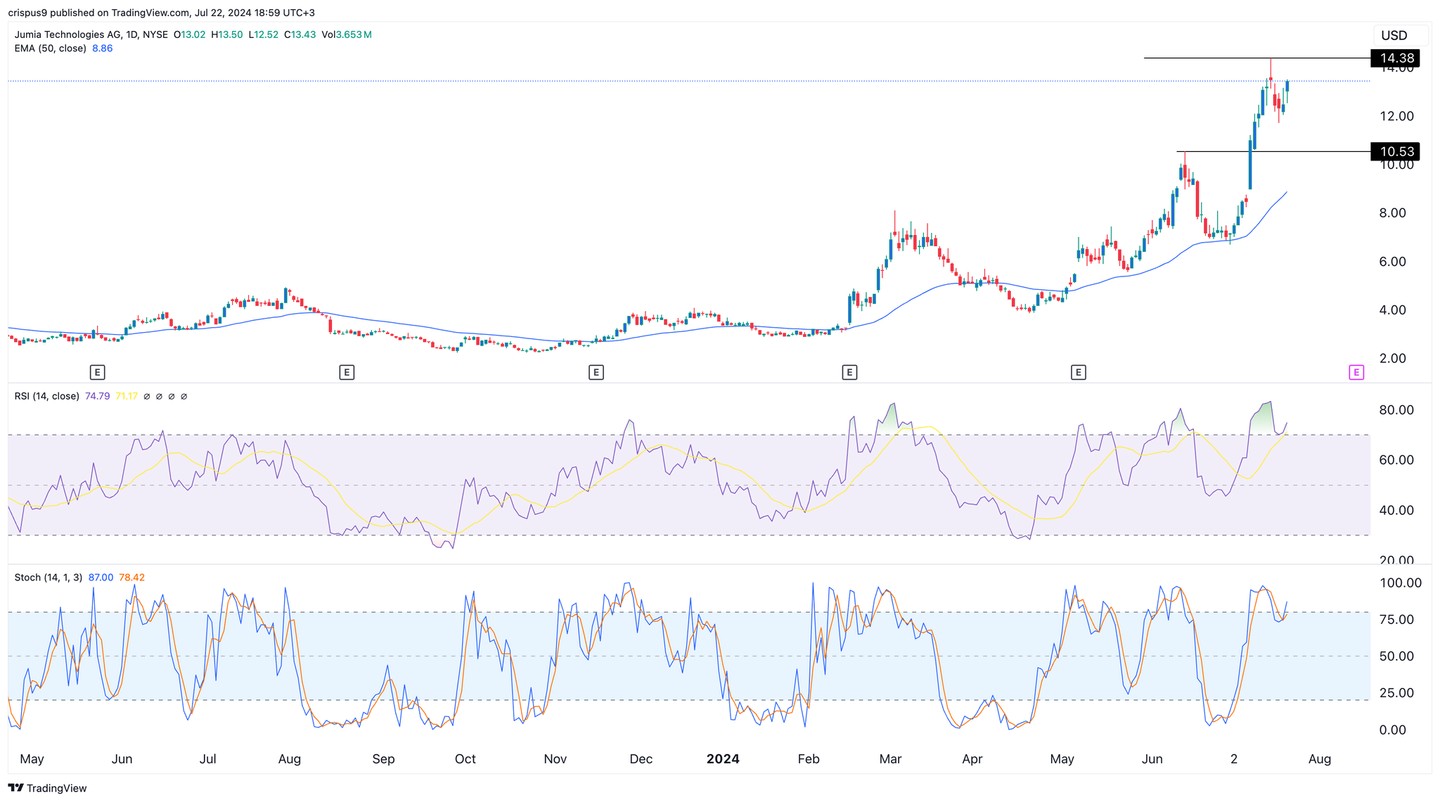
Turning to the daily chart, we see that the Jumia share price formed a doji pattern on July 16th. In most cases, this is one of the most bearish chart patterns in the market. Also, the Relative Strength Index (RSI) and the Stochastic Oscillator have moved above the overbought level.
Jumia has remained significantly above the 50-day and 100-day moving averages. Therefore, I suspect that the stock will retreat in the coming days. A key catalyst to watch will be its earnings report that is scheduled for August 9th.
A retreat will likely see the stock drop to the key support level at $10.43, its highest point on June 13th.
The post Jumia stock price is overbought and overvalued: Aug 6 will be key appeared first on Invezz
