New Stock Analysis | Riding the wave of autonomous driving, BLACK SESAME becomes the "first stock of autonomous driving AI chips"

BLACK SESAME is a major player in the domestic autonomous driving AI chip field, and has initiated the final step of its Hong Kong IPO, with a subscription period from July 31 to August 8. It is expected to become the "first stock of autonomous driving AI chips". Foundational investors such as GAC Group and Jusheng Electronics will subscribe to BLACK SESAME shares
As the popularity of Luobo Kuai Pao in Wuhan has driven the heat of unmanned driving, the Wuhan unmanned driving industry has once again received major news.
According to the Zhitong Finance and Economics APP, Black Sesame Intelligence (02533), headquartered in Wuhan, launched its IPO on July 31st, marking the final step towards a listing on the Hong Kong Stock Exchange. Black Sesame Intelligence is a major player in the domestic autonomous driving AI chip field, with two series of chips: the Huashan series high-performance SoC and the Wudang series cross-domain SoC.
Frost Sullivan stated that based on the shipment volume of high-performance SoCs for automotive-grade in 2023, Black Sesame Intelligence is the third largest supplier globally. This means that Black Sesame Intelligence has entered the top tier of the global autonomous driving AI chip field.
According to the prospectus, the IPO period for Black Sesame Intelligence is from July 31st to August 8th. The company plans to sell 37 million shares in this IPO, with 1.85 million shares for public offering and 35.15 million shares for international placement. The offering price is HKD 28.00-30.30 per share, with a board lot of 100 shares. The shares are expected to start trading on the HKEX on August 8th. At that time, Black Sesame Intelligence will become the "first stock of autonomous driving AI chips".
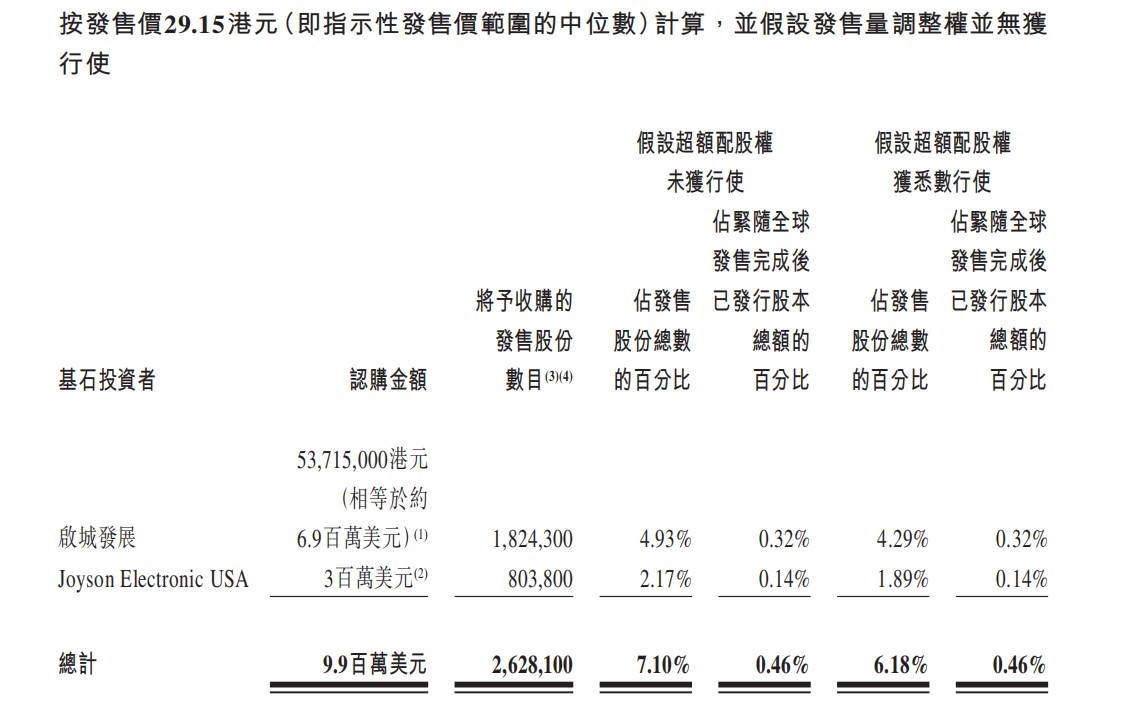
Furthermore, based on the positive outlook for the future development of Black Sesame Intelligence, two cornerstone investors will subscribe to shares worth USD 9.9 million in this IPO. Guangzhou Automobile Group (02238)'s indirectly wholly-owned subsidiary Qicheng Development will invest USD 6.9 million, and Alwin Technologies' wholly-owned subsidiary will invest USD 3 million. At the median issue price, the two cornerstone investors can subscribe to 2.6281 million shares (unexercised over-allotment option), accounting for 7.1% of the total shares offered.
In fact, Black Sesame Intelligence, which successfully made it to the "2023 Hurun Global Unicorn List", has been well received by capital in the primary market. Well-known companies such as Xiaomi, Tencent, Nio, Geely, and SAIC are among its shareholders, so it is not surprising that heavyweight cornerstone investors are once again introduced in this IPO.
With the rise of Luobo Kuai Pao and Tesla's Robotaxi set to enter China within the year, 2024 may be the "first year of large-scale application of unmanned driving", becoming a market consensus. This means that the unmanned driving industry may experience accelerated growth. In this industry trend, how to evaluate the valuation of Black Sesame Intelligence, the "first stock of autonomous driving AI chips" that "empowers the future of travel with chips", is worth further consideration by the market.
Autonomous driving AI chips are the "golden track", but the localization rate urgently needs to be improved
Autonomous driving can be divided into levels L0-L5 based on the degree of human intervention and driving scenarios. Among them, the highly automated L4 level and fully automated L5 level are considered unmanned driving, while levels L1-L3 require driver intervention and are referred to as intelligent assisted driving It is worth noting that systems that achieve automation from Level 1 to Level 2 (including Level 2+) are usually referred to as Advanced Driver Assistance Systems (ADAS), while systems that support automation from Level 3 to Level 5 are referred to as Autonomous Driving Systems (ADS). Currently, autonomous driving technology is advancing towards Level 2+ functionality, where features like NOA (Navigation on Autopilot) can provide a similar experience to Level 3 autonomous driving. Although RoboTaxi has popularized autonomous driving and its operating vehicles have unmanned driver cabins, it still requires intervention from backend safety personnel.
Whether it is advanced autonomous driving or intelligent assisted driving, both require AI computing chips to process signals collected from various sensors and send driving signals to the corresponding control modules, thereby realizing the decision-making function in autonomous driving.
MCUs and SoCs are two typical types of AI computing chips. However, with the continuous improvement in the level of automotive intelligence, traditional MCUs have struggled to effectively cope with electronic and electrical architectures and massive data processing. SoCs, on the other hand, with advantages such as improved computing power, increased data transmission efficiency, reduced chip usage, and more flexible software upgrades, have become the mainstream trend in automotive chip design and application.
It is worth noting that ASIC chips have excelled in the era of mining, with advantages such as low cost, high performance, and low power consumption in mass production. Therefore, the adoption of SoCs with ASIC architecture is gradually becoming popular. In the long run, as chip solutions develop and the demand for processing power increases, SoCs with ASIC architecture are expected to become the mainstream choice for future autonomous driving solutions based on SoCs.
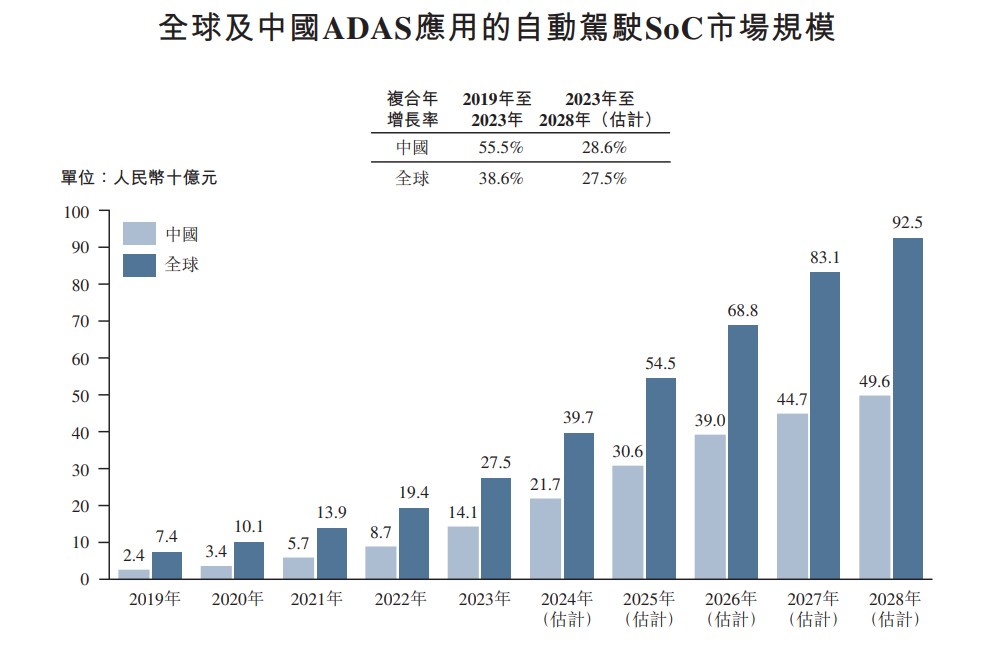
Due to technological advancements and rapid cost reductions, by 2023, the global penetration rate of passenger cars with autonomous driving capabilities had reached 69.8%, with China reaching as high as 74.7%. This has driven rapid development in the autonomous driving SoC market. According to Frost Sullivan data, from 2019 to 2023, the market size of autonomous driving SoCs for ADAS applications in China increased from 2.4 billion RMB to 14.1 billion RMB, with a high compound annual growth rate of 55.5%, 17 percentage points higher than the global market growth rate of 38.6%.

Frost Sullivan stated that thanks to policy support, continuous cost reductions, and the increasing market acceptance of autonomous driving, the market for autonomous driving SoCs in ADAS applications will continue to grow rapidly. From 2023 to 2028, the market size in China will increase from 14.1 billion to 49.6 billion RMB, with a compound annual growth rate of 28.6%, slightly higher than the global growth rate of 27.5% during the same period. By 2028, the global market size will approach nearly 100 billion RMB.
On the other hand, vehicles with more advanced ADS applications than ADAS are currently still in the testing phase and gradually undergoing pilot projects worldwide. Therefore, whether domestically or internationally, ADS is currently in its early stages. As ADS SoCs are typically more valuable than ADAS SoCs, the ADS SoC market is expected to have more explosive potential Frost Sullivan predicts that by 2026, the global ADS SoC market will reach 8.1 billion RMB, and by 2030, it will reach 45.4 billion RMB, with China expected to become the largest market. During the same period, the scale is expected to increase from 3.9 billion to 25.7 billion RMB, with a compound annual growth rate of up to 60%.
Undoubtedly, autonomous driving AI chips are a rapidly developing "golden track" with broad prospects. However, China's autonomous driving AI chip industry heavily relies on overseas suppliers. According to Frost Sullivan data, by 2023, the top three suppliers of autonomous driving AI chips and solutions in China were Intel's subsidiary Mobileye (MBLY.US), NVIDIA (NVDA.US), and Tesla (TSLA.US), with market shares of 27.5%, 23.7%, and 4.8% respectively, totaling over 56%.
Whether for supply chain security or for the high-quality development of China's autonomous driving industry, there is a need for autonomous driving AI chip companies to lead the localization efforts. BLACK SESAME is at the forefront, with a mission to empower future travel with chips and lead global intelligent travel.
High-performance chip shipment industry leader, revenue continues to double
Established in 2016, BLACK SESAME has been deeply involved in the autonomous driving AI chip field, aligning its development with the automotive industry, starting from developing products from L2 to L3. In 2020, BLACK SESAME launched the Huashan series chips, including the A1000 and A1000L, and began mass production in 2022.
Among them, the A1000 can provide 58 TOPS computing power at INT8 precision, making it the first high-performance autonomous driving SoC with proprietary IP cores in China. It is also the first in China to obtain ASIL-B and AEC-Q100 Level 2 certification for L2+ and L3 SoC, making BLACK SESAME the first enterprise to initiate mass production of high-performance autonomous driving SoC.
By April 2021, BLACK SESAME's Huashan series chips introduced the A1000 Pro, which is used for L3 autonomous driving and can provide over 106 TOPS computing power at INT8 precision. This is the first domestically developed and launched autonomous driving SoC with over 100 TOPS computing power. At INT8 precision, the computing power provided by this chip is the highest among domestic peers, making BLACK SESAME the first domestic enterprise to launch a 100+ TOPs autonomous driving SoC, demonstrating the company's strong research and development capabilities.
Furthermore, BLACK SESAME continues to enrich its product line. Currently, the automotive electronic and electrical architecture is evolving from a distributed architecture to a domain-centralized architecture supported by SoC. Automotive functions are thus divided into 5 specific domains: autonomous driving domain, cockpit domain, power domain, chassis domain, and body domain. Among them, autonomous driving SoC and cockpit SoC are in a rapid development stage, while other domains are still in the early stage of large-scale deployment. To seize this development opportunity and open up company growth space, BLACK SESAME is expanding from autonomous driving SoC to cross-domain SoC In April 2023, BLACK SESAME launched the Wudang series chip C1200, which is a cross-domain SoC integrating functions such as autonomous driving, intelligent cockpit, vehicle control, and other computing functions, providing innovative and cost-effective computing solutions for smart cars. This is the industry's first product to integrate multiple domains. As of now, BLACK SESAME has a total of 4 chips in the Huashan series and Wudang series.
At the same time, BLACK SESAME also values the establishment of a software ecosystem. To better adapt to customer ecosystems, BLACK SESAME provides customers with automatic driving supporting software including operating system support, Hanhai-ADSP software middleware, perception algorithms, etc., to support customized deployment of applications by customers, thereby enhancing the market competitiveness of the company's chip products.
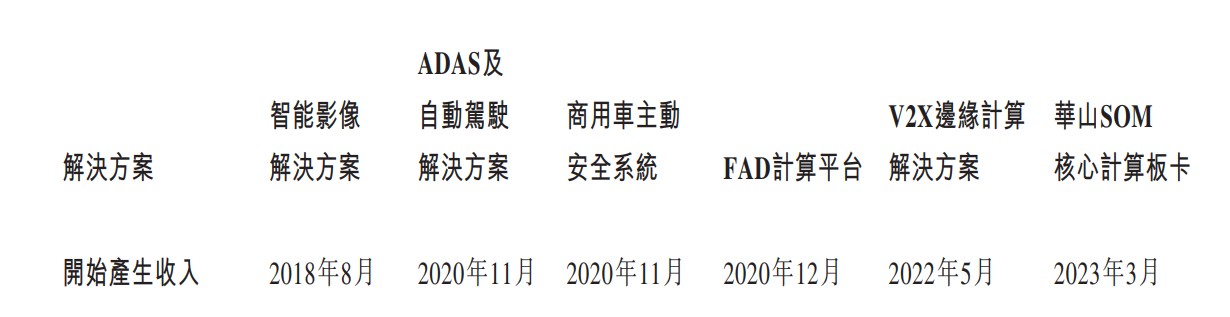
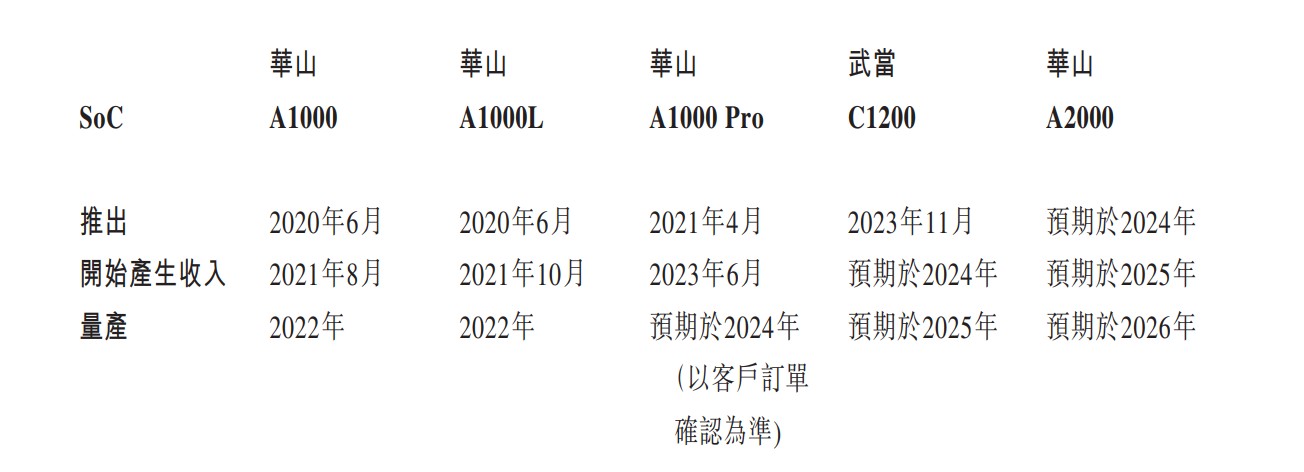
In addition to continuously enriching its product line through intensive R&D, BLACK SESAME is actively promoting commercialization and monetization. As early as 2018, leveraging its accumulated intelligent image technology capabilities in autonomous driving, BLACK SESAME provided high-quality intelligent image solutions for high-end consumer electronics manufacturers and smart electronics manufacturers. With the launch of the Huashan series chips, BLACK SESAME began to provide autonomous driving solutions, including closed-loop autonomous driving solution sets, commercial vehicle active safety systems, V2X edge computing solutions, etc., making BLACK SESAME one of the earliest domestic enterprises to generate substantial revenue by selling autonomous driving solutions.

Figure: Time when BLACK SESAME's various solutions generate revenue
With high computing power performance of its chips, software ecosystem, and rich solutions, BLACK SESAME's commercialization has rapidly progressed and is concretely reflected in the following three aspects:
First, the rapid increase in the number of company customers.
As of 2023, BLACK SESAME had 85 customers, nearly double the number from 2022, which was 45. As of June 4, BLACK SESAME had received intention orders for 23 vehicle models from 16 automotive OEMs and tier-one suppliers, and collaborated with over 49 automotive OEMs and tier-one suppliers, including FAW Group, Dongfeng Group, Jiangling Motors, Hechuang, Yikatong Technology, Baidu, Bosch, ZF Friedrichshafen, and Marelli.
Second, leading industry shipment volume.
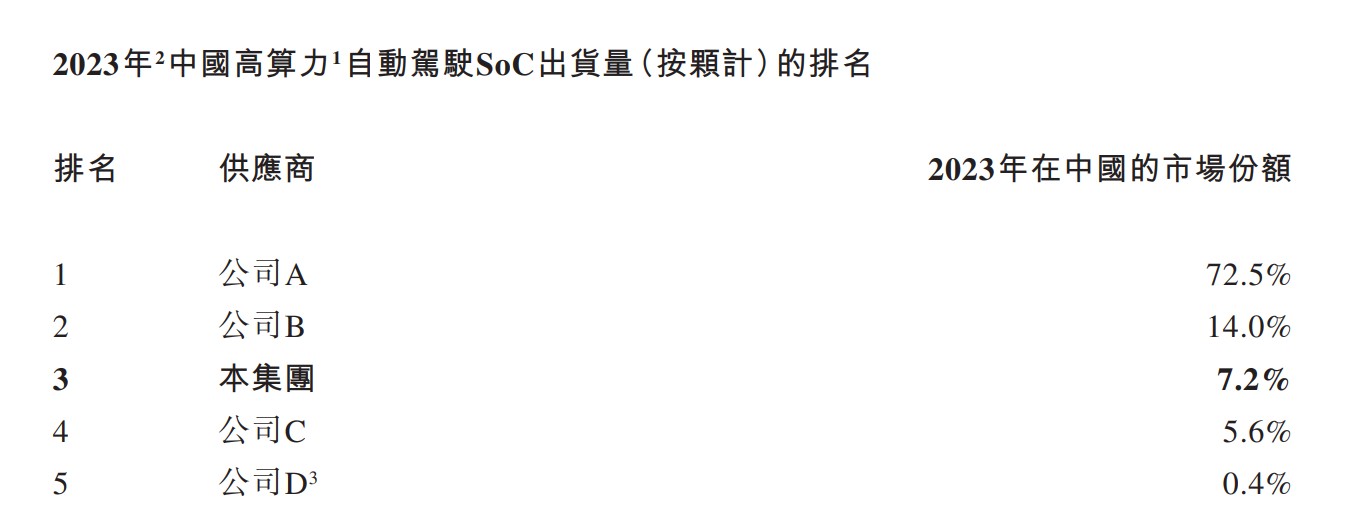
As of December 31, 2023, the total shipment volume of BLACK SESAME's flagship A1000 series SoC exceeded 152,000 units. According to Frost Sullivan's data, in terms of shipment volume of high computing power (50+ TOPs) autonomous driving SoCs, BLACK SESAME ranks third domestically with a market share of 7.2%. Excluding the top-ranked NVIDIA among local companies, BLACK SESAME is the second largest supplier in China

Thirdly, there is a continuous rapid growth in revenue.
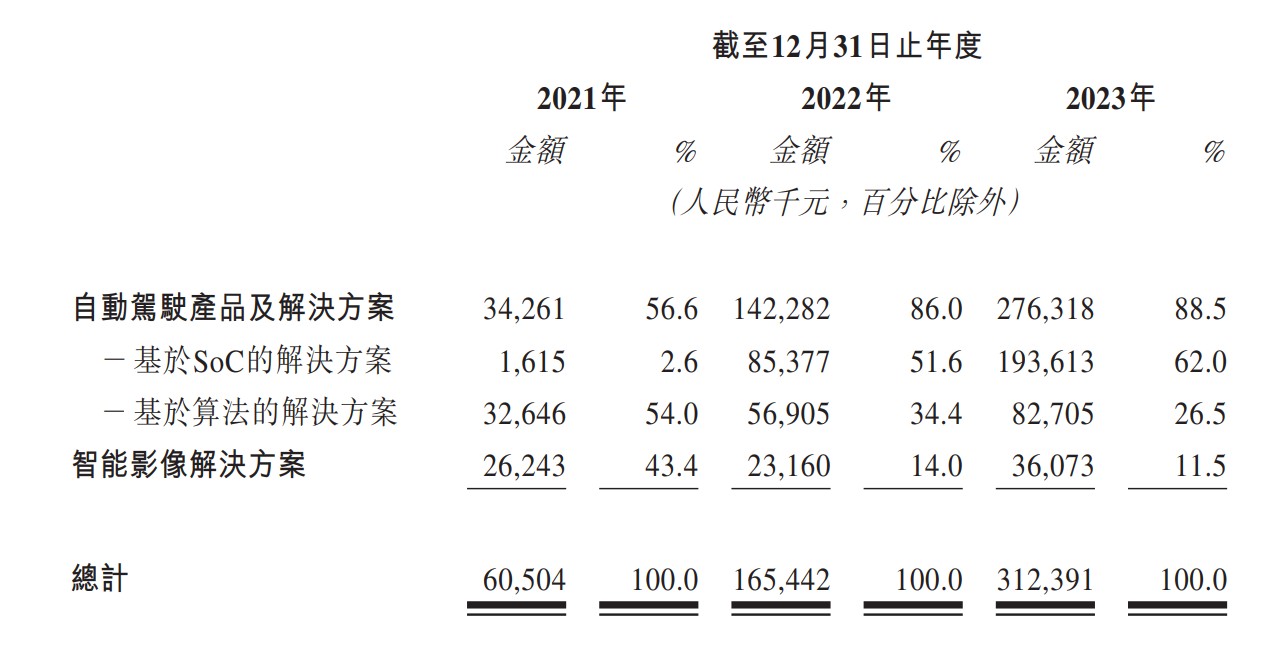
It is well known that from 2020 to 2022, due to the impact of the epidemic, the automotive industry's supply chain was disrupted, and the normal operation of the industry was affected by external factors. During this period, the performance of market players was generally affected. However, Black Sesame Intelligence has shown very strong performance since 2021. Thanks to the rapid increase in the volume of autonomous driving products and solutions, Black Sesame Intelligence's revenue has increased significantly from 60.504 million yuan in 2021 to 312 million yuan in 2023, with a compound annual growth rate as high as 127%. The revenue share of autonomous driving products and solutions has also rapidly increased from 56.6% in 2021 to 88.5% in 2023.

Future revenue continues to grow with strong certainty
Facing the rapid growth of the autonomous driving AI chip market, in order to further seize industrial opportunities and strengthen itself, Black Sesame Intelligence has detailed its future development in the prospectus. The company will adhere to the mission of empowering travel with chips, continue to focus on the high-performance chip market, and continuously research and develop new products and iterative solutions to accelerate the commercialization speed of the company.
The cross-domain competitive Wudang C1200 is expected to generate revenue in 2025 and is expected to be mass-produced in 2026. In addition, A2000 will be launched within 2024, generating revenue next year.

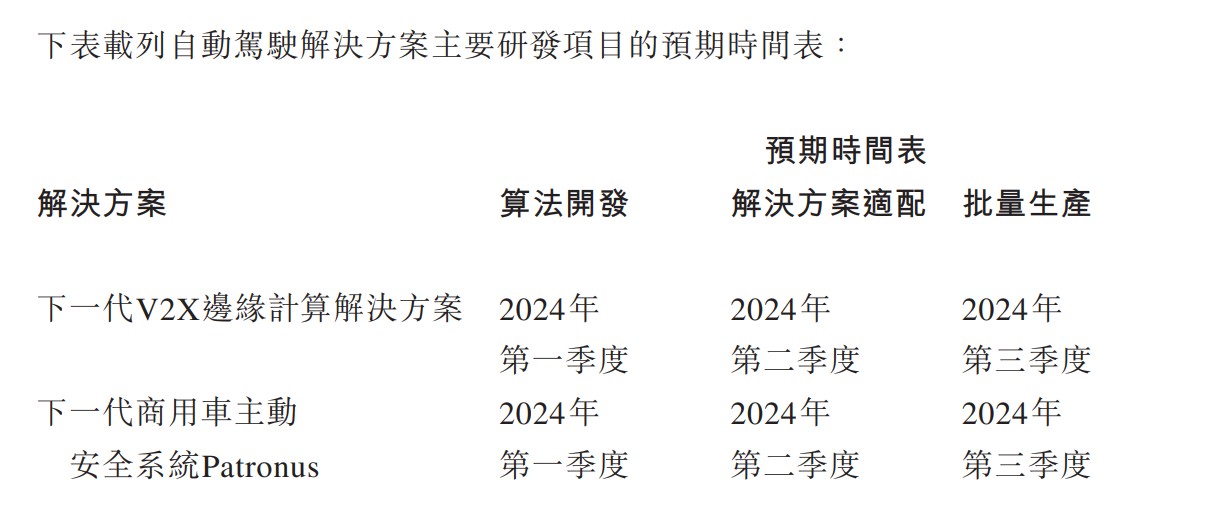
At the same time, the next-generation V2X edge computing solution and the next-generation commercial vehicle active safety system will begin mass production in the third quarter of this year, which is expected to tap into the needs of various customers in different application scenarios, further expanding the customer base. In addition, by providing various hardware and software products, the company will expand its business scope beyond autonomous driving to address other market demands such as smart cars and robots.
It can be foreseen that with the mass production of Wudang C1200 and the update of autonomous driving solutions, the commercialization of BLACK SESAME will further accelerate. Its performance in 2024 and 2025 is expected to continue to maintain high growth with strong certainty.
Overall, BLACK SESAME has already established technological advantages, customer advantages, and commercial advantages in the high-growth "golden track" of autonomous driving AI chips. This has been reflected in its revenue, making it a leading company in the industry. It has taken on the important task of domesticating high-performance chips for autonomous driving and is expected to enjoy a high valuation premium.
Moreover, the recent high enthusiasm for autonomous driving in the capital market has led to the emergence of many "hot stocks" in the A-share market with short-term doubling of stock prices. In such a market environment, as the first stock of pure autonomous driving AI chips, BLACK SESAME is likely to attract a large amount of funding during its IPO