Fit, Accord, and Civic, Honda's three flagship models are also not selling well

Honda's sales in the Chinese market have dropped by 39.04%, with plans to close two fuel vehicle factories, facing competition pressure in the electric vehicle market. Honda has launched a new pure electric brand "Ye" and multiple electric vehicle models, demonstrating its determination for electrification transformation. Honda's production capacity in China will be reduced to 1.2 million vehicles, and it is already confirmed that it is impossible to match last year's sales this year. Honda sold approximately 410,000 vehicles in the first half of the year, and to achieve the same sales volume as last year in the second half, it would need to sell at least 800,000 vehicles, which is clearly out of reach

NewGeek (ID: XinguiNewgeek), Author: Xu Shanshan, Editor: Zhang Zeyi, Cover Image: Visual China
This article reports on Honda's declining sales in the Chinese market, as well as its production reduction plan and the challenges of electrification transformation.
• 💥 Honda's sales in the Chinese market dropped by 39.04%, planning to close two fuel vehicle factories
• 🚗 Honda's vehicle sales fell below expectations, facing competition pressure in the electric vehicle market
• ⚡ Honda's electrification transformation plan is determined, launching a new pure electric brand "Ye" and multiple electric vehicle models
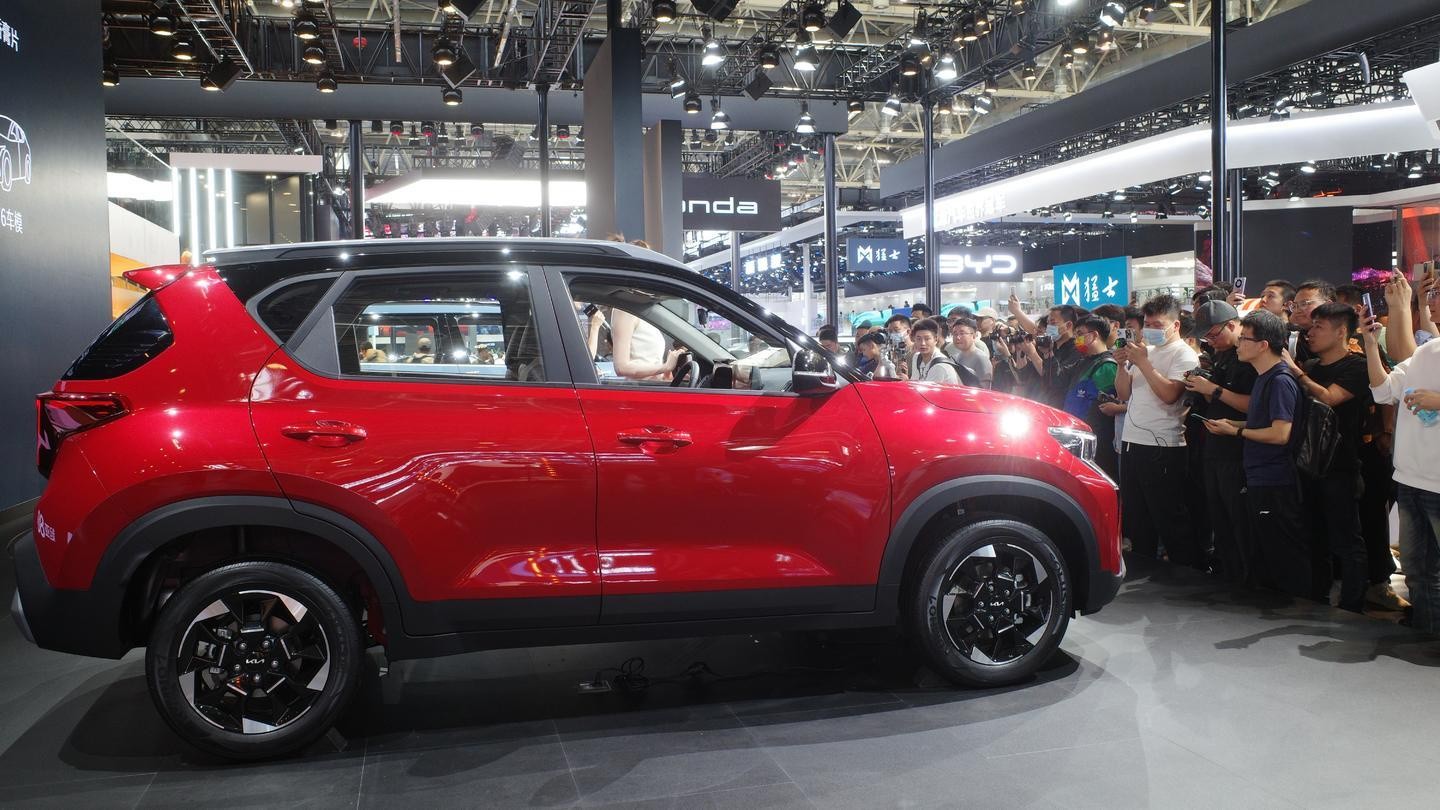
At this year's Beijing Auto Show, most of the discussions were focused on Lei Jun, who was followed all the way, and the red-clad car model sitting on the roof of the car.
On the other side, Honda's booth had a slogan:
Guangben cars that can't be broken.
I don't know if it's because the quality is really too good, Honda has gained a reputation of "people leave but the car stays", to the point that no one is buying new cars anymore. For example, in June, Honda sold 68,966 cars in China, a year-on-year decrease of 39.04%.
Recently, there have been reports that Honda plans to close two fuel vehicle factories, reducing China's total vehicle production capacity by 490,000 vehicles, which accounts for one-third of Honda's production capacity in China.
The media hype claims that this sets a record for the largest production cut by a Japanese carmaker.
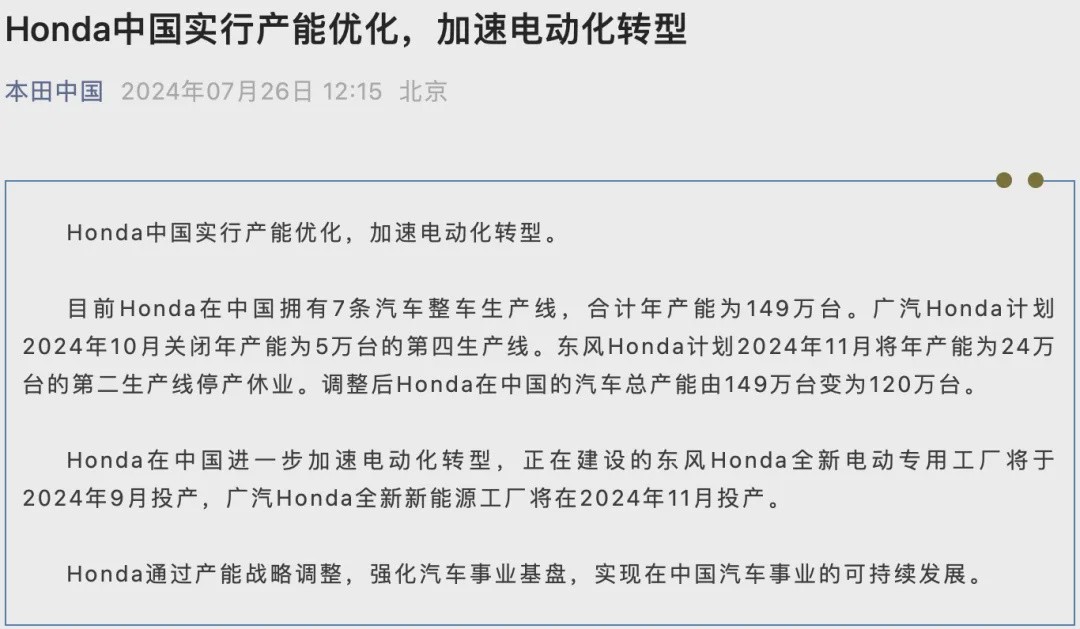
Honda quickly responded, saying that they have seven complete vehicle production lines in China. The one closed in October was the fourth production line of GAC Honda with an annual capacity of 50,000 vehicles, and the one shut down in November was the second production line of Dongfeng Honda with an annual capacity of 240,000 vehicles.
After all calculations, the production cut is 290,000 vehicles, which is equivalent to the sales volume of Nio and XPeng last year, far from being considered the largest production cut record.
As for the 200,000 vehicle production capacity gap between media reports and official announcements:
Whether another factory in Guangzhou will be shut down is still under discussion.

After this adjustment, Honda's production capacity in China will be reduced to only 1.2 million vehicles. Although Honda's sales in China have been declining every year, it still achieved sales of 1.234 million vehicles last year.
In other words, Honda is already very certain:
It is impossible to match last year's performance this year.
In the first half of the year, Honda sold a total of about 410,000 vehicles, compared to 529,700 vehicles in the same period last year. To achieve the same results as last year, at least 800,000 vehicles would need to be sold in the second half of the year, which is clearly out of reach Taking June as an example, among Honda's 24 models, only two models sold over 10,000 units per month, which are Accord and CR-V. During the same period, BYD's retail sales of passenger cars reached 280,000 units, with the Qin family alone selling over 60,000 units.
Honda's best-selling year in China was 2020, with approximately 1.63 million cars sold, a record that may be difficult to achieve again.
Nevertheless, this time Honda is cutting into itself, as Honda is also taking a gamble. In 2022, Honda announced the electric vehicle factory projects for Dongfeng Honda and GAC Honda, with an initial annual production capacity of 120,000 units each. Behind the full-speed development of electric vehicle projects is the collective slowdown of Honda's fuel vehicle system.
Looking back at Honda's past popular models, CR-V, Civic, Accord, and Fit are all well-known.
In the hearts of Chinese people, Fit can be considered a legendary Honda model. It is small and easy to park, suitable for commuting and grocery shopping. More importantly, it has the characteristics of durability and high resale value typical of Japanese cars. So far, Fit has over 8 million owners worldwide, with over 1.3 million in the Chinese market alone.
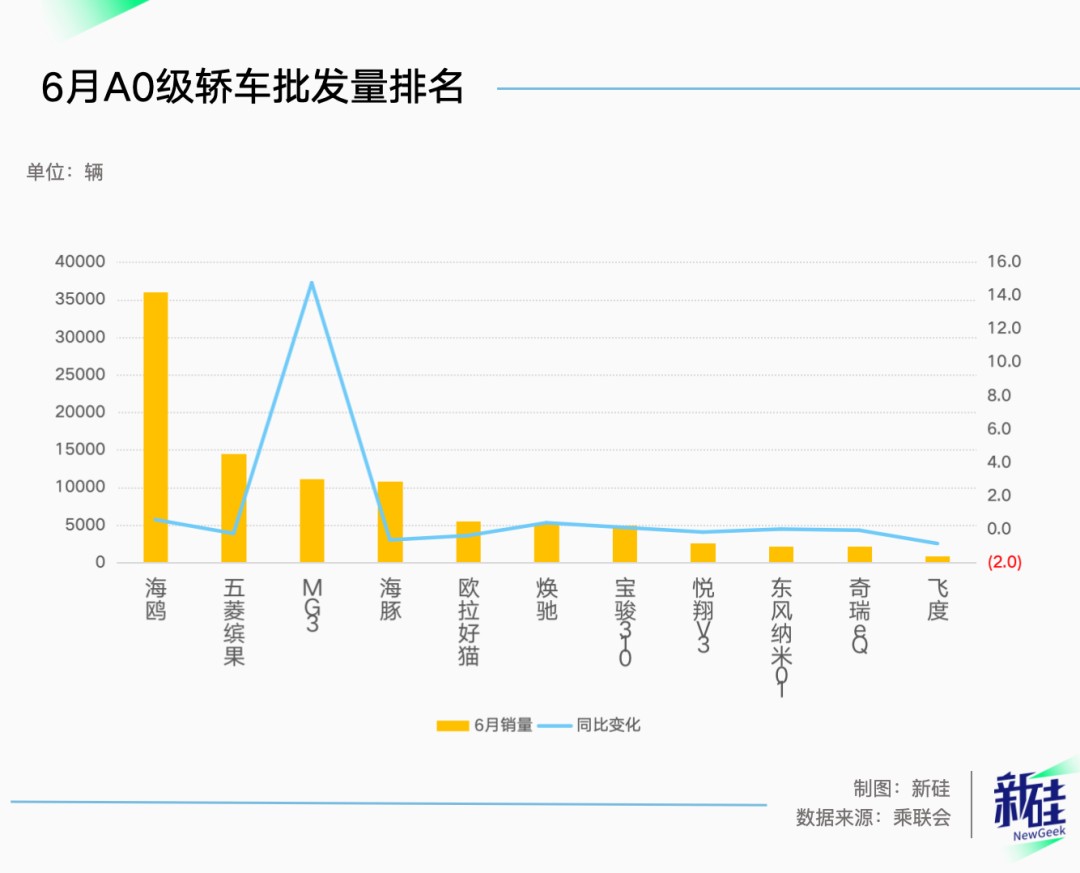
However, in June this year, Fit only sold 961 units, which is over 30,000 units less than the A0 segment sales champion BYD Song. As a highly upvoted comment on Zhihu puts it:
"In 2017, only fools wouldn't buy Fit at this price point, in 2024, only fools would buy Fit at this price point."

2017 Fit (left) and 2024 Fit (right)
Seven years ago, Fit's competitors were Volkswagen Polo, Toyota Vios, Hyundai Reina, and Kia K2. Nowadays, the choices in the small car market are overwhelming, with models like Wuling Binyue, Dolphin, Ora Cat, Dongfeng Nano, Chery eQ, and other electric vehicles ahead of Fit.
Not to mention that in the past 20 years since Fit entered China, its appearance has changed slightly. The 2024 Fit has even increased its price by 10,000 yuan, with a price of 97,800 yuan without a central control screen, still featuring a simple interior and only supporting self-installed rearview camera.
Even in terms of fuel efficiency, how can Fit's operating costs compare to pure electric vehicles? In terms of price, the high-end version of Song and the low-end version of Fit are comparable. It's not that Chinese people don't understand cars, it's just that Fit hasn't changed while the Chinese market has changed.

Moreover, in the 100,000-yuan market, there is an absolute god that joint venture cars cannot surpass:
BYD Qin.
The once-called "civilian supercar" Fit is actually more suitable for Civic.
As a best-selling model with global sales exceeding 25 million units, Civic once captured the hearts of many Chinese consumers with its Earth Dreams engine. In the minds of many young people, this car fulfilled their various fantasies about a 150,000-yuan car Powerful, fast acceleration, good-looking, resembling a sports car. Due to some car owners' racing behavior, the Civic is jokingly referred to by netizens as "FalaYuan".
A few years ago, 150,000 could definitely be spent without hesitation.
At the launch of the Xiaomi SU7, a netizen asked Xiao Ai, "If you have 215,900 yuan, what car would you buy?" The answer was "Honda Civic", ignoring the crying SU7, which also reflects the important position of the Civic in the hearts of Chinese netizens.
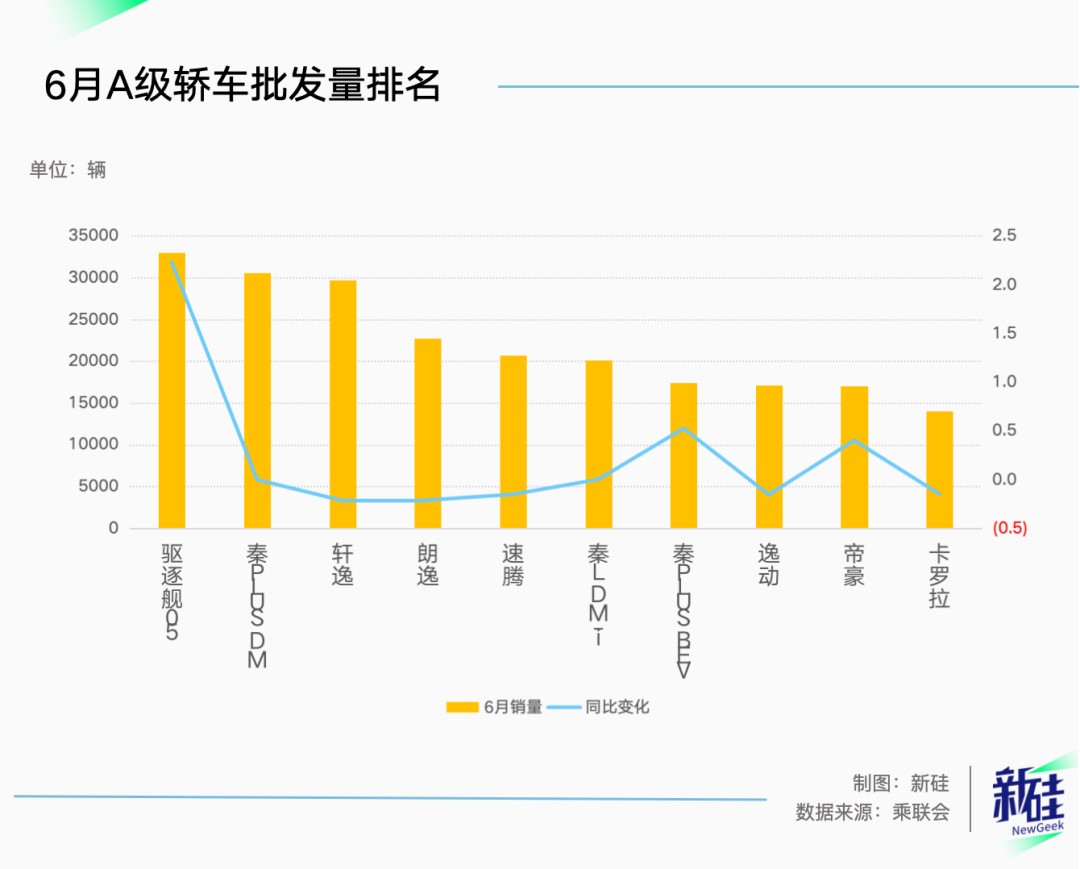
But now, the Civic is also facing a significant impact. In June, the domestic sales of the Civic were only 6,486 units, ranking 22nd in the A-class sedan market.
Last year, the Civic once achieved a monthly sales record of 26,000 units, surpassing the Volkswagen Lavida. However, the real reason was the large terminal discounts. The car that had to be priced higher before can now be purchased for less than 100,000. This year, the Civic's sales have returned to mediocrity, with the A-class market sales crown still belonging to the BYD family - the Destroyer 05.
In this main market, Volkswagen and Toyota are also sandwiched between domestic cars.
It is worth noting that the Volkswagen Lavida is also a well-deserved legendary car in the sedan market, consistently winning the sales crown of fuel sedans since its release. Now, there is a gap of 10,000 units from the BYD Destroyer.
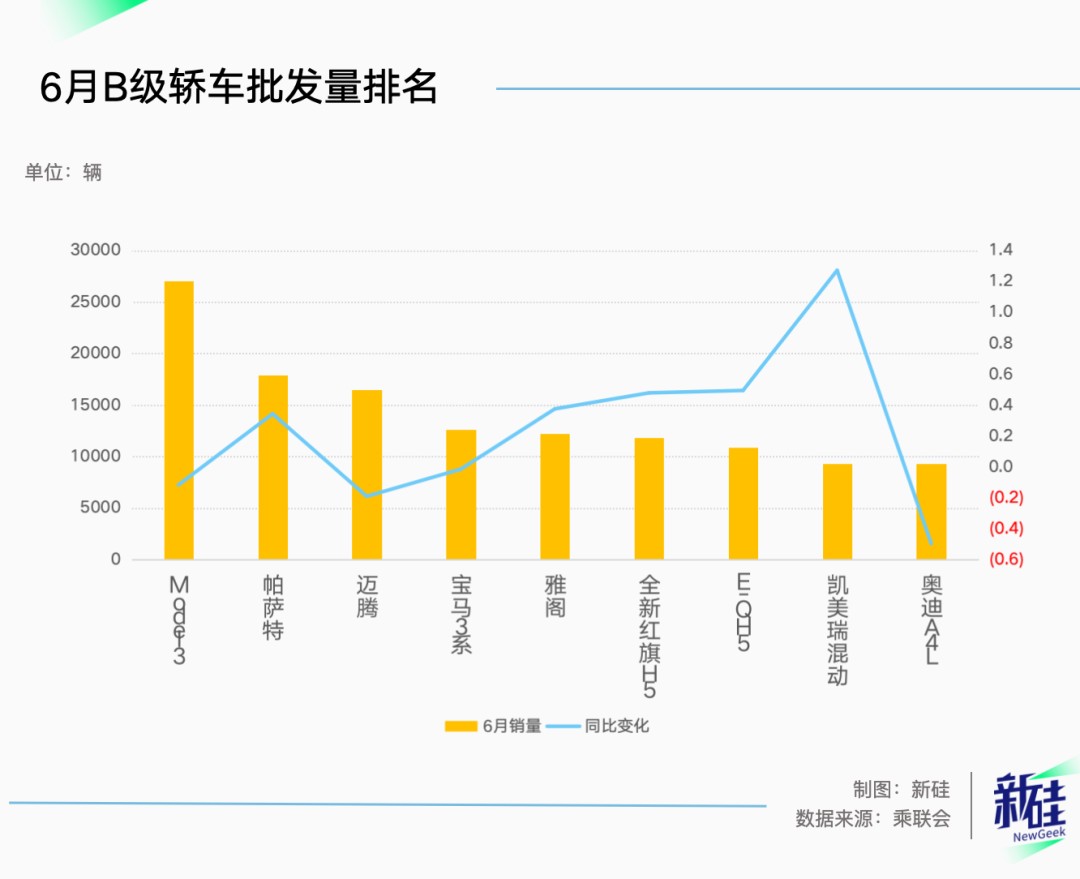
As a former undefeated general in the B-class car segment, the Accord can be regarded as the pioneer of price-increasing sales in the Chinese car market.
In June, the Accord ranked fifth with 12,197 units sold, but the PHEV version only sold 650 units. In the B-class car market, Tesla Model 3's leading advantage is more obvious, with Volkswagen Passat and Magotan following closely.
Back in 1999, the first domestically produced Accord rolled off the line in Guangzhou. At that time, this was China's first model synchronized with global technology, and the slogan was "Starting in sync with the world". With a price of 298,000 yuan, more than 10,000 units could be sold in a year.
Up to last year, the Accord has sold over 3.3 million units in the Chinese market. However, the fate of the "legendary car" is similar to the Passat and Camry, from leading to suddenly being overtaken by the Model 3, as if it was already destined.
Even Honda, the favorite SUV of the Chinese people, could not escape the law of "legendary car not being legendary".
Honda's popular SUV, the CR-V, is undoubtedly the most popular. When it comes to this car, most people will first think of the Toyota RAV4. The latter is recognized as the pioneer of urban SUVs. When the first generation RAV4 was released, Musk was still in college, and the CR-V was considered the biggest competitor to the RAV4.
In the 2023 global best-selling SUV models, the Model Y ranks first, RAV4 second, and CR-V third, with global sales close to 850,000 units However, back to the Chinese market, the performance of the CR-V can only be considered average.
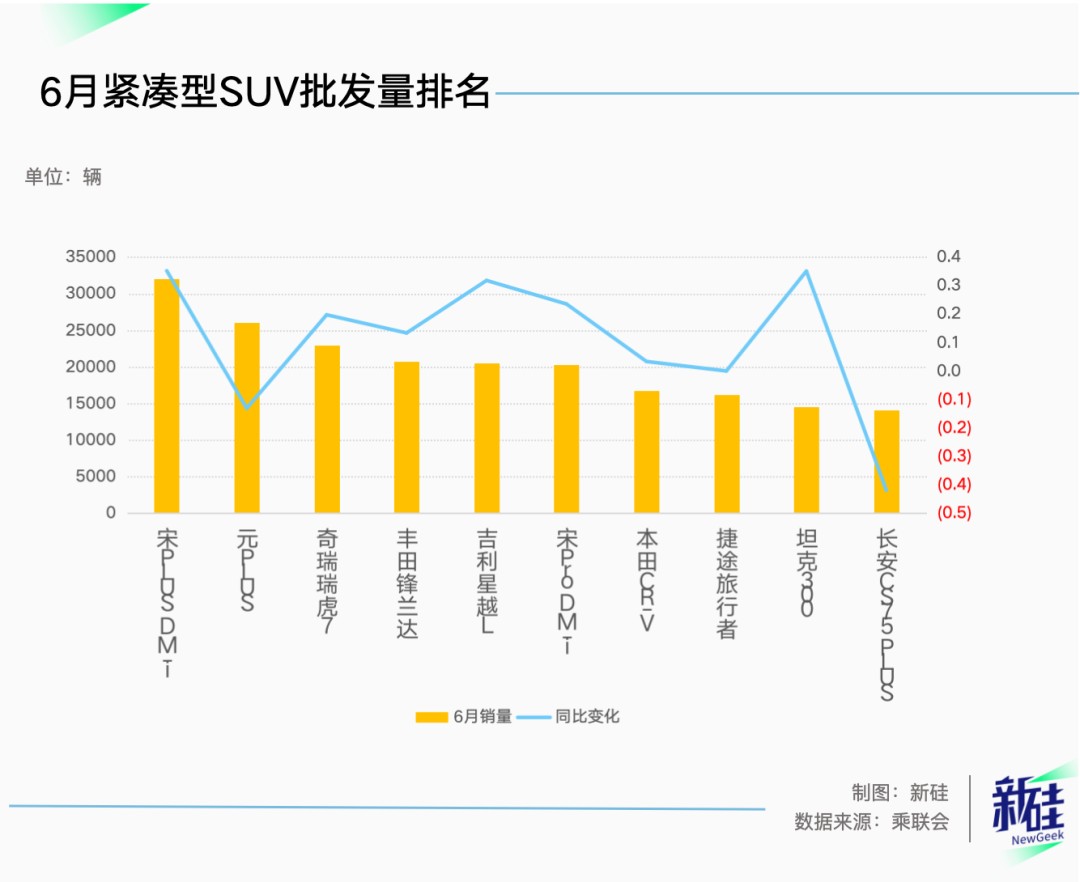
In June, the CR-V sold more than 16,000 units, ranking behind the BYD Song Pro DM-i. Here we are talking about the compact SUV market. If we ignore size, the Model Y, which sold over 40,000 units per month, is truly deserving of the first place.
In May, the CR-V's sister model, the XR-V, also achieved sales of over 10,000 units. However, in June, it dropped to 8,841 units. Currently, Honda's models in China with monthly sales of over 10,000 units are only the Accord and CR-V.

The biggest dilemma facing Honda is the sluggish growth of gasoline vehicles and the slow sales of electric vehicles.
In terms of pure electric vehicle sales, Honda's e:N series only sold around a hundred units per month. Compared to Toyota's bZ4X, which sold close to zero units, Honda is leading by a wide margin.
Three years ago, Honda China launched the pure electric vehicle brand "e:N". "e" stands for energize, electric, and "N" stands for New, Next, indicating Honda's determination towards electrification. For this, Honda also developed a brand-new pure electric architecture.
However, the sales of the first model, e:NS1 (JiPai 1), can't even be described as dismal. Undeterred, Honda released the second model under the e:N brand in November last year: GAC Honda e:NP2 (JiPai 2) and Dongfeng Honda e:NS2 (LieGuang), with the former officially launched at the end of April and the latter just recently.
I also don't understand why Honda and Toyota have to name their electric vehicles in a way that resembles verification codes.
Not long ago, Honda released the pure electric brand "Ye," developed specifically for the Chinese market, meaning "bright and shining," full of Chinese style. The two models under the Ye brand, Ye S7 and P7, are expected to be officially launched and available for sale by the end of the year.
According to Honda's plan, by 2027, they will introduce 10 pure electric vehicle models in the Chinese market, and achieve 100% electrification by 2035.
Japanese brands are most criticized by Chinese consumers for their lack of innovation, slow response to changes in the domestic market, and lack of creativity. But at least Honda is serious about the electrification transformation.
Speaking of seriousness, let's take a look at big brother Toyota.
Back in 2020, Toyota said they would introduce at least 10 pure electric vehicles by 2025. However, last year, Toyota changed its tune and postponed the timeline to 2026. Over the years, Toyota's attitude towards electrification has been back and forth, to the point where Toyota's President once famously said:
Electric vehicles have been excessively hyped.