


Betting on the big model, what lies ahead for China Literature?

China Literature Group has launched a large-scale model "Yuewen Wonderful Pen" for online literature and plans to grant beta testing qualifications to creators. The CEO of China Literature Group stated that Yuewen Wonderful Pen is the most knowledgeable large-scale model in online literature and will become the "golden finger" for authors, making it the most important feature in the IP industry in the next five years. China Literature Group will comprehensively explore AI applications in the development chain of audio, comics, animation, derivatives, and more. This move represents a substantial advancement for China Literature Group in the field of AIGC. While China Literature Group's total revenue has recently declined, whether it can drive the implementation of large-scale models in industry scenarios remains uncertain

Editor | Yang Yong
Caption | IC Photo
The battle of large models is escalating, and Tencent's online literature brand China Literature Group has also joined the fray.
On July 19, China Literature Group launched the large model "China Literature Magic Pen" for online literature, as well as the application product "Writer Assistant Magic Pen Edition" based on this large model. It is reported that China Literature Magic Pen mainly serves creators, providing services including assisting in character design, world-building, power system construction, etc. China Literature Group plans to grant beta testing qualifications to 400 creators by the end of July and will develop various new functions in the second half of the year based on the capabilities of the large model.
Hou Xiaonan, CEO and President of China Literature Group, stated, "China Literature Magic Pen is the large model that understands online literature the most, and will comprehensively empower the AIGC for creative and IP ecosystems. AI will not replace creators, but will become the 'golden finger' of authors. AI is the most important function for the IP industry in the next five years."
China Literature Group has high hopes for AIGC. The launch of China Literature Magic Pen is a specific action taken by China Literature Group after announcing organizational upgrades in June to lay out AIGC, and is a key measure to enhance the efficiency and quality of its IP ecosystem.
On June 19, Hou Xiaonan issued an internal memo to all employees, announcing the start of a new round of organizational upgrades, the establishment of four major business divisions, and stating that the company's medium to long-term business blueprint is to upgrade AIGC to empower original content on a multi-modal, multi-category content platform, and build a new integrated ecosystem for IP upstream and downstream.
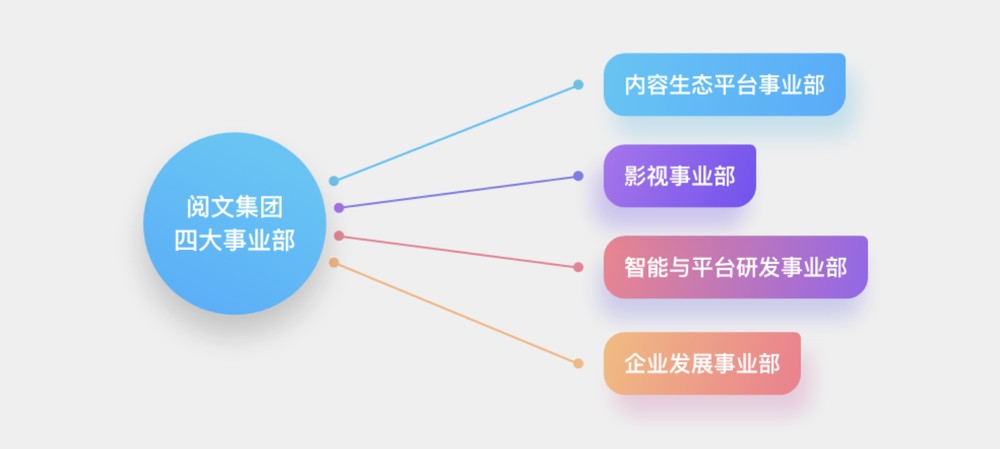
The landing of China Literature Magic Pen signifies substantial progress in China Literature Group's exploration in the AIGC field. Regarding China Literature Magic Pen, Hou Xiaonan revealed that in the future, China Literature Group will continue to upgrade towards open, multi-modal large models to comprehensively empower the creative and IP ecosystems with AIGC. China Literature Group will fully explore AI applications in the development chain of audio, comics, animation, derivatives, etc.
It is worth noting that online literature creation is one of the clearest application scenarios for large models at present, but whether China Literature Group can promote the landing of large models in industry scenarios and change commercialization dilemmas remains an unknown variable.
I. Weak Growth in Performance
As the largest Chinese online literature platform, China Literature Group has experienced a total revenue decline for the first time in its five years since going public.
According to the financial report, in 2022, China Literature Group's total revenue was 7.63 billion yuan, a year-on-year decrease of 12%; net profit was 608 million yuan, a year-on-year decrease of 67.1%; non-IFRS net profit attributable to equity holders was 1.35 billion yuan, a year-on-year increase of 9.6%.
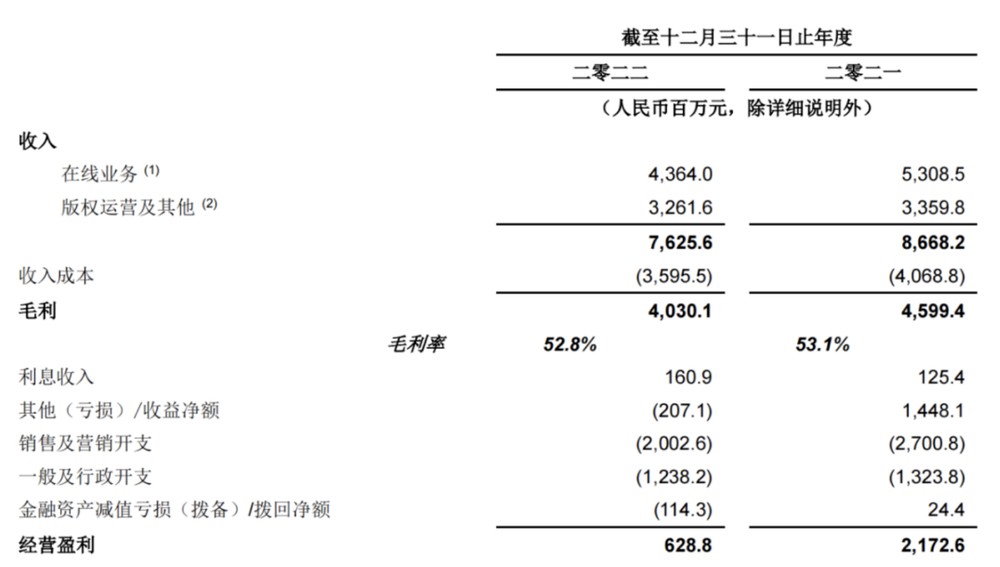 Source: CHINA LIT Financial Report
According to the business composition, CHINA LIT mainly has two major businesses: online business and copyright operation and other businesses. The former mainly includes revenue from online reading, online advertising, and distributing third-party online games on the platform, while the latter mainly includes revenue from producing and distributing TV dramas, web dramas, animations, movies, selling copyrights, operating self-owned online games, and selling physical books.
According to the financial report, the online business revenue in 2022 was 4.364 billion RMB, a year-on-year decrease of 17.8%; the revenue from copyright operation and other businesses was 3.261 billion RMB, a year-on-year decrease of 2.9%. CHINA LIT explained in the financial report that this was mainly due to cost reduction measures, reduction in marketing expenses related to user acquisition, and a decrease in revenue from self-owned online games in 2022.
If we extend the timeline further back, it seems that CHINA LIT's performance has bid farewell to the high-growth period. Since its listing in 2017, CHINA LIT's total revenue has experienced a decline for the first time, and there have been continuous fluctuations and even sharp declines in net profit.
From 2017 to 2021, CHINA LIT's total revenue was 4.095 billion RMB, 5.038 billion RMB, 8.348 billion RMB, 8.526 billion RMB, and 8.668 billion RMB, with corresponding net profits of 0.563 billion RMB, 0.912 billion RMB, 1.112 billion RMB, -4.5 billion RMB, and 1.843 billion RMB.
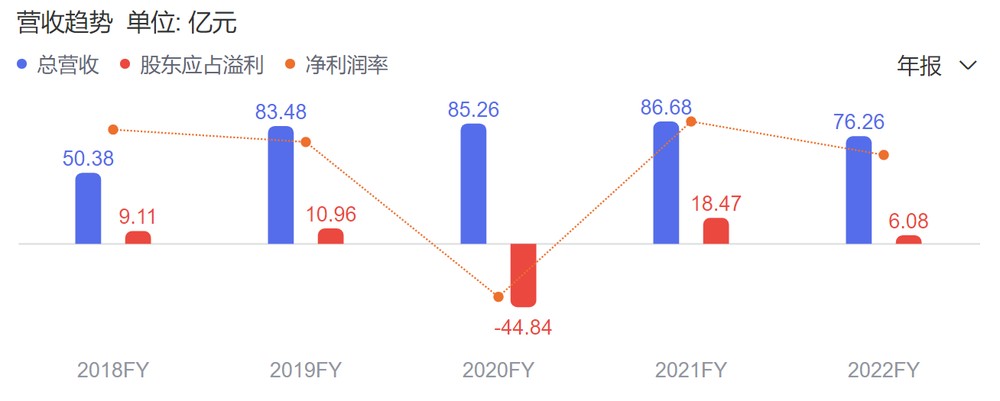
Source: Baidu CHINA LIT Financial Report
On the other side of bidding farewell to the high-growth period in performance, various indicators of CHINA LIT are difficult to describe.
Firstly, the average monthly paid users for paid reading and ARPU (average revenue per user) are facing weak growth. In 2022, these two indicators were 7.9 million and 37.8 RMB respectively, with year-on-year decreases of 9.2% and 4.8%. From 2017 to 2021, the average monthly paid users for paid reading of CHINA LIT were 11.5 million, 10.7 million, 9.8 million, 10.2 million, and 8.7 million, with ARPU of 20.5 RMB, 24.4 RMB, 25.3 RMB, 34.7 RMB, and 39.7 RMB respectively.
Secondly, the comprehensive gross profit margin performance is unsatisfactory. In 2022, CHINA LIT's comprehensive gross profit margin was 52.8%, a decrease of 0.3 percentage points from 2021. From 2017 to 2021, its comprehensive gross profit margin was 50.7%, 50.8%, 44.2%, 49.7%, and 53.1% respectively.
With the ceiling looming, CHINA LIT has to find a "secret weapon" to break through.
AIGC is considered the "secret weapon" for CHINA LIT to change its commercial dilemma. In the conference call after the release of the 2022 financial report, Hou Xiaonan stated that although AIGC's current technological level is not yet at its best, the internal team of CHINA LIT will closely follow the development of AIGC He believes that AIGC can quickly transform text into audio, images, and videos, which can improve the efficiency of content production under China Literature and reduce costs.
In an internal letter to all employees, Hou Xiaonan also mentioned that China Literature Group will establish a key project team to focus on tackling AIGC technology and its application scenarios. He believes that AIGC is not only crucial to China Literature's foundation, but will also lead China Literature towards sustainable growth in the next three, five, or even longer periods.
However, at present, the large-scale model products are still far from being truly implemented. How China Literature Group combines China Literature's writing skills with industry scenarios is still something that needs continuous exploration.
2. Can large-scale models subvert the online literature industry?
Is it feasible to help creators with the idea of AIGC?
Hou Xiaonan likened the significance of AIGC to authors as "upgrading from manual driving to assisted driving." He stated that China Literature's writing skills will assist authors in saving a lot of redundant and tedious work through content inspiration, scene creation, knowledge services, and other creative aids.
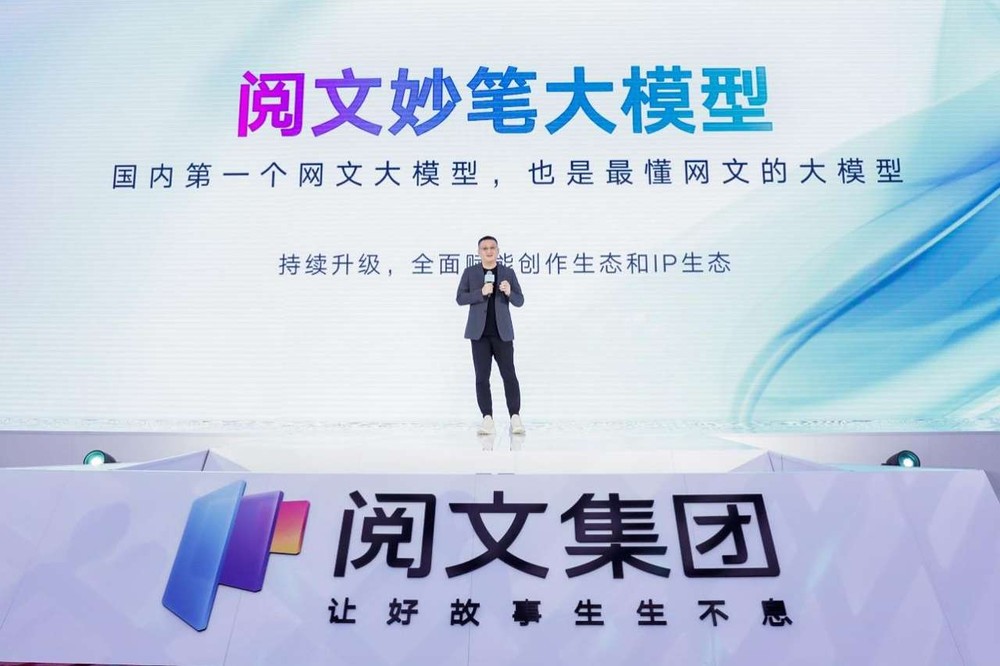
Image Source: China Literature Group Official Website
Regarding the application product Writer's Assistant MiaoBi Version based on China Literature's writing skills, Huang Yan, Vice President of China Literature Group, stated that the Writer's Assistant MiaoBi Version has four main functions, including world setting, character setting, scene description, and combat description. Among them, world setting is one of the important contents for the pre-production preparation of online literature creation. The Writer's Assistant MiaoBi Version can enrich the world setting, generate large amounts of content supplements, and improve details. However, the spiritual core and evolutionary direction of the world setting still need to be grasped by the authors themselves.
From practical experience, the Writer's Assistant MiaoBi Version can analyze the details such as the type of work, gender, and tags input by the author, combined with a rough idea of the characters, to obtain AI-generated character titles, appearances, personalities, experiences, and other information. Taking urban novels as an example, AI can generate character names, relationships, personality traits, etc., according to the author's rough idea, and for some scenes, it can also generate detailed descriptions of hundreds of words.
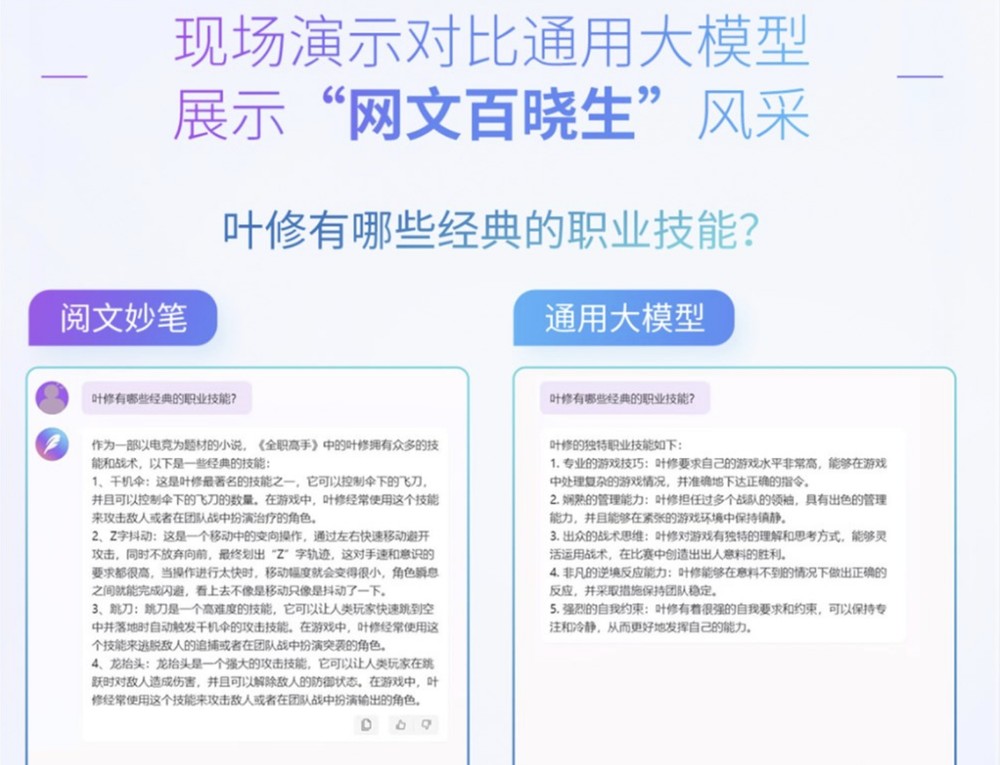
Image Source: China Literature Group Official
However, although the Writer's Assistant MiaoBi Version can generate story outlines to help authors effectively organize their thoughts, it still cannot achieve a satisfactory reading effect.
"Salted Fish Army Leader," a China Literature author who has tried the Writer's Assistant MiaoBi Version, believes: "AI has a larger vocabulary and rich scene descriptions, but it cannot control the rhythm of online literature or the readers' high points. I believe that as long as you find the right way to use it, it can greatly improve the writing efficiency of authors."
However, China Literature Group's expectations for AIGC clearly go beyond this. Hou Xiaonan stated, "Previously, it took about 1 year for a comic adaptation. After testing with AI, our efficiency in comic adaptations has increased by about 20%. With AI assistance in the future, it is entirely possible for one person to serialize, achieving a semi-automated creative ecosystem "Currently, China Literature Group has been experimenting with AI comic adaptation and AI machine translation.
"AI machine translation can reduce translation costs to 1%. Our long-term goal is to enable domestic writers to go global with just one click, and even achieve global simultaneous updates of online literature in the future, which will help us build a global IP. AI will reshape the business model of the entire IP industry chain," said Hou Xiaonan.
Overall, although the Writer's Assistant MiaoBi version can already be applied in the actual creative process, its help to creators is still extremely limited. However, with the continuous upgrading of large models and products based on large models, China Literature Group does have the opportunity to reshape the online literature industry.
III. Large Models Are Currently Not a Lifesaver
In the long run, large models will help China Literature Group build a new integrated ecosystem for IP upstream and downstream, but at the current stage, large models are not a lifesaver for China Literature Group.
Running large models is still very costly. Hardware is a huge investment. According to the US market research firm TrendForce, processing the training data for ChatGPT requires 20,000 GPU chips, and as OpenAI further expands the commercial applications of ChatGPT and other GPT models, the demand for GPUs will exceed 30,000 (this report is mainly based on A100 chips).
In addition, the cost of training large models is also significant. According to a report by Guosheng Securities on "How Much Computing Power ChatGPT Needs," the cost of training GPT-3 once is about $1.4 million, and for some larger LLMs (large language models), the training costs range from $2 million to $12 million. Based on the average number of independent visitors to ChatGPT in January at 13 million, the corresponding chip demand is over 30,000 NVIDIA A100 GPUs, with an initial investment cost of about $800 million and a daily electricity cost of around $50,000.
According to the financial report, as of the end of 2022, China Literature Group had cash and cash equivalents of 7.09 billion RMB on its books. In its current situation, how to deal with the capital consumption of large models and whether China Literature's MiaoBi can reach the commercialization stage are still unknown.
In summary, at the current stage, betting on large models is unlikely to change China Literature Group's situation: on the one hand, there are multiple challenges in the process of promoting the industrialization of large models, such as constraints on computing power, varying data quality, and difficulties in high integration with the industry; on the other hand, large model products also face the issue of homogenized content. Currently, the homogenization of online literature content is quite serious, and under AI-assisted creation, similar themes may lead to similar worldviews and character settings, exacerbating the problem of homogenization.
It is crucial to consider how to better serve creators and reshape the IP industry with large models, and how to use large models to make online literature diverse rather than uniform, are long-term issues that China Literature Group needs to think about
