


Struggling to sustain profitability, Lalamove has become enamored with internet credit

Lalamove is a local freight platform that has recently sparked controversy due to being accused of condoning overloading. When drivers refuse to overload, the platform will deduct points from their behavior, affecting their ability to pick up orders and withdraw cash. Previously, Lalamove has been warned multiple times for adjusting pricing rules, engaging in malicious price competition, and other issues. As a leading player in the industry, Lalamove's brand reputation has been called into question. In addition, Lalamove submitted an IPO application in April 2024, facing a critical period of impact from the capital market. Currently, the fate of Lalamove remains uncertain
Editor | Yang Yong
Caption | IC Photo
Local freight platform Lalamove has once again been embroiled in a huge controversy.
Recently, Lalamove has been accused of tolerating overloading. Once a driver discovers that the customer's goods are overloaded and refuses to transport them after accepting the order, the platform will deduct the driver's behavior points for this. This may affect subsequent order grabbing for minor offenses, and may even affect withdrawals for major offenses. The outside world has questioned whether Lalamove is shifting the risk of overloading to the drivers.
In response, Lalamove stated that after verifying each case of overloading, they will correct the overloading orders that were wrongly blamed and restore the behavior points for the drivers.
In fact, tolerating overloading has always been a chronic issue for Lalamove. Complaints on consumer complaint platform Black Cat Complaints can be traced back to as early as 2022, with over 600 related complaints. Many drivers have reported that after refusing to overload, Lalamove would deduct their behavior points.
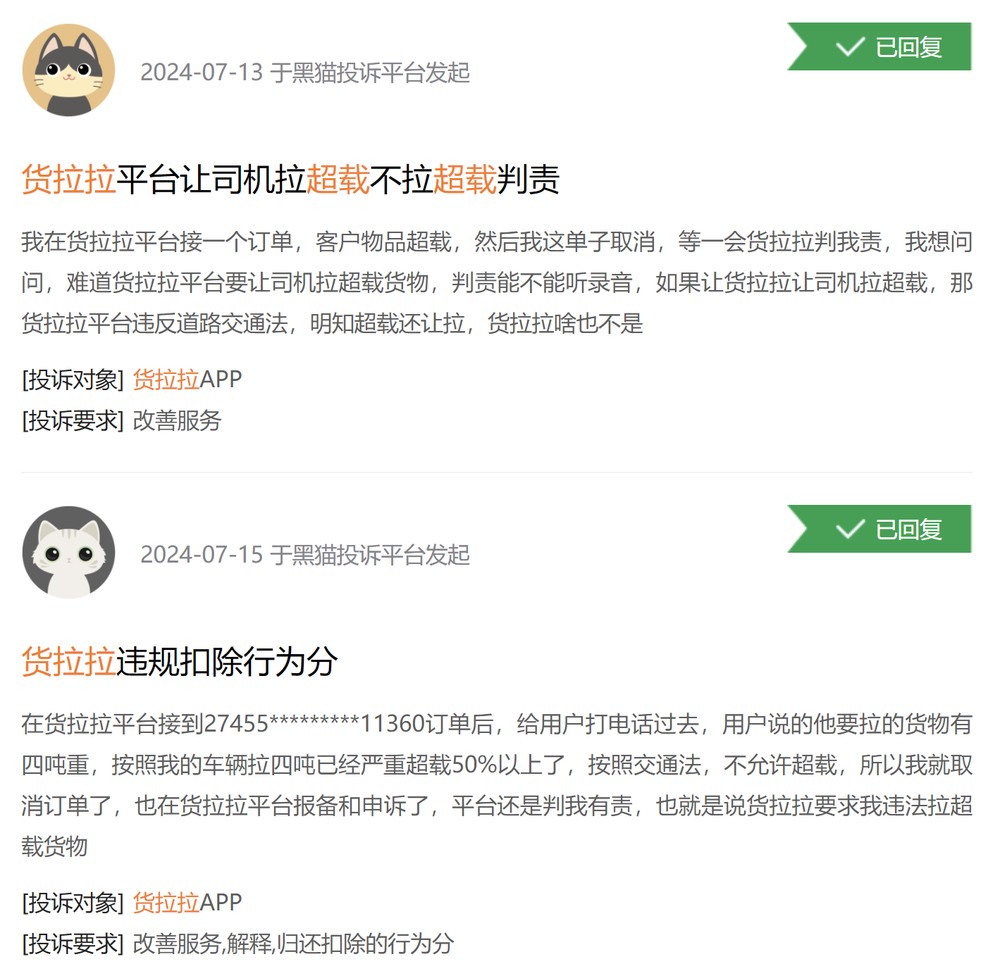
Image Source: Black Cat Complaints
A Lalamove driver told DoNews that he had also canceled orders due to severe overloading, only to have the platform deduct his behavior points in the end. "Overloading poses great risks, including impacts on braking distance, vehicle condition, and other aspects. The more overloaded, the greater the danger. As a platform, it should not tolerate overloading and make the drivers pay for the platform's mistakes."
In April 2024, Lalamove updated its prospectus and submitted its listing application to the Hong Kong Stock Exchange for the third time. During this critical period of challenging the capital market, brand reputation is often crucial. However, Lalamove's troubles go far beyond tolerating overloading. Prior to this, Lalamove had been repeatedly summoned by regulatory authorities, mainly due to arbitrary adjustments to pricing rules, malicious price competition, multiple charges, and excessively high commission rates.
As a giant in the local freight platform industry, Lalamove not only lacks a long-term vision but also seeks short-term benefits through such shortsighted means. Standing at the doorstep of the Hong Kong Stock Exchange, Lalamove has reached a crossroads in its fate.
I. Heavily Dependent on Drivers for "Blood Transfusion"
In the domestic local freight market, Lalamove is undoubtedly the industry leader. Established in 2013, it mainly engages in local/cross-city freight, enterprise logistics services, moving, less-than-truckload freight (multiple batches of goods sharing transportation tools), car rental/sales, and post-market services. From 2015 to the present, Lalamove has completed 8 rounds of financing, with a total financing amount of $2.495 billion, and a valuation of billions of dollars. Its investor lineup includes big names like Sequoia Capital and Hillhouse Capital.
Lalamove's business model mainly connects and serves merchants and drivers through a platform model, realizing a closed-loop transaction from online ordering to intelligent order matching, automatic dispatching, and after-sales service. The prices are mainly set by the platform, and due to adopting a light-asset business model, Lalamove does not own vehicles used by drivers to provide digital freight services According to the prospectus, in 2020 and 2021, Lalamove's total revenue was $529 million and $845 million respectively, with adjusted net losses of -$155 million and -$631 million. The accumulated loss over the two years was $786 million.
In 2022 and 2023, Lalamove's total revenue is projected to be $1.036 billion and $1.334 billion respectively. After adjustments, the net profit turned from loss to profit, reaching $53 million and $391 million respectively, completely shedding the "loss" label.
Based on its business composition, Lalamove's revenue mainly comes from three parts: freight platform services, diversified logistics services, and value-added services. Among them, the freight platform service is the largest revenue-generating business, accounting for nearly 60% in 2023. This business revenue can be further divided into membership fees paid by drivers and commissions earned after completing freight orders.
The main reasons for Lalamove's turnaround from loss to profit are twofold.
Firstly, the increase in gross profit margin. The prospectus shows that from 2021 to 2023, Lalamove's gross profit margin was approximately 39.41%, 53.66%, and 61.23% respectively, showing a continuous upward trend. The gross profit margin of the largest revenue-generating business, the freight platform service, also increased to 28.8%, 74.3%, and 80.6% respectively, mainly due to Lalamove streamlining its employee structure and optimizing operational efficiency. Additionally, the gross profit margins of diversified logistics services and value-added services also increased.
Secondly, the contribution of commissions earned from drivers after completing freight orders is significant for Lalamove. In the prospectus, Lalamove stated, "By combining driver membership fees and commissions, we effectively convert GTV growth into revenue growth."
According to the prospectus, commission income is increasing year by year, accounting for 5.7%, 28%, and 33.3% of total revenue from 2021 to 2023 respectively. If membership fees are included, over half of Lalamove's revenue is contributed by the driver community, with the proportion continuing to rise. With a monopolistic advantage, millions of drivers have propelled Lalamove onto the Hong Kong Stock Exchange.
It is worth mentioning that Lalamove's high commission rates have caused dissatisfaction among many drivers. How to balance profitability and driver interests directly affects the sustainability of Lalamove's profitability. A report from China Merchants Securities pointed out that over the past two years, Lalamove's monthly active user count has experienced a significant decline. In this scenario, whether Lalamove can maintain sustainable profitability in the future remains uncertain.
II. Credit Does Not Bring Incremental Volume
The top 10 market share in China's urban freight market is only 3.5%, meaning that 96.5% of the market is still untapped. This has attracted numerous players and cross-border explorers. Currently, the urban freight market is transitioning from a "blue ocean" to a "red ocean," with the race becoming increasingly crowded. Apart from Lalamove, Didi Freight, Manbang Group, Kuai Gou Taxi, and SF Same City, there are even players like JD, Hellobike, and Meituan. In the future, Lalamove may find it difficult to grab a larger share of the market. For Lalamove, which heavily relies on drivers for sustenance, exploring new growth curves is becoming urgent So Lalamove set its sights on the internet credit business.
In May 2024, Lalamove launched its borrowing product "Round Easy Borrowing" with a maximum limit of 200,000 RMB, starting at an annual interest rate of 10.8%, and partnered with licensed financial institutions such as Instant Consumption.
However, the good times didn't last long. Less than half a month after the launch of Round Easy Borrowing, Lalamove removed the borrowing entrance from its app. In response, Lalamove explained that "the system is undergoing maintenance and upgrades, and the specific online time is awaiting notification."
Interestingly, also in May, Himalaya, which was making its fourth attempt to list on the Hong Kong Stock Exchange, received inquiries from the China Securities Regulatory Commission, requesting explanations on issues related to assisted lending business. After facing regulatory inquiries, Himalaya promptly removed the borrowing entrance from its app.
Although it is not yet clear whether the reason for Lalamove's removal of the borrowing entrance from the app is related to regulation, in September 2023, Lalamove was once questioned by the China Securities Regulatory Commission about its financial business. At that time, the CSRC requested Lalamove to supplement information on the compliance of its financial business during the process of listing on the Hong Kong Stock Exchange, especially regarding the operation of its main domestic entities in financing leasing, commercial factoring, small loans, private fund management, and the proportion of relevant data in the issuer's financial statements, as well as the regulatory opinions obtained from the financial regulatory department.
Due to the disorderly expansion of the internet credit industry in the past few years, regulatory authorities are gradually tightening supervision over related businesses. For example, in June 2024, the China Banking and Insurance Regulatory Commission stated that it would strengthen supervision over three types of banks that have received strong feedback from the public in the areas of internet loans, credit cards, deposits, and other businesses. Against this backdrop, the CSRC's vigilance towards internet companies engaging in internet credit business is inevitable.
It can be seen that in order to smoothly land on the capital market, the quiet removal of credit business by Lalamove and Himalaya is a wise move. However, at the same time, this also means that internet credit business is difficult to become a lever for Lalamove's upward development.
III. Hindered Diversified Development
Lalamove is not only involved in internet credit business. In order to achieve diversified development and seek new growth curves, it has also ventured into many areas.
In March 2023, Lalamove announced the official launch of its errand service, covering diverse delivery categories such as documents, 3C electronics, clothing accessories, flowers and plants, gifts and cakes, electronic components, and fresh food.
The errand industry is a high-quality industry. Research data from iMedia Consulting shows that users aged 26-30 and 31-40 have a high frequency of using errand services, mainly ranging from 1-4 times and 5-10 times per month, accounting for over 70% in total; a small percentage of users in each age group use the service more than 10 times a month. With the increasing pace of work and life, as well as the rising demand for instant needs, the penetration rate of errand services is expected to further increase.
As a same-city freight platform, in order to achieve growth, Lalamove is bound to evolve into a comprehensive logistics service platform. In the process of exploring diversified businesses, the errand service can provide strong support for Lalamove to build a logistics ecosystem. However, although the errand service can provide Lalamove with high-frequency traffic entry points and help it further build a commercial closed loop, at present, Lalamove does not have a significant advantage in the errand business, especially with a group of same-city instant delivery platforms such as UU Errands, Flash Express, Dada Group, and SF Same City showing their strengths Accelerating the division of the "cake", Lalamove's development will be filled with uncertainties.
In addition, car manufacturing is also a new growth curve that Lalamove wants to explore. In its prospectus, Lalamove mentioned that the company is leveraging its experience in existing vehicle leasing and sales services to explore new business opportunities, such as the development of electric commercial vehicles.
Tianyancha shows that Xiamen Dora New Energy Automobile Technology Co., Ltd. was registered and established in October 2023, with Lalamove Car Service Co., Ltd. holding 100% of the shares.
In fact, as early as May 2021, news about Lalamove's initiation of a car manufacturing project was widely spread. At that time, Lalamove began recruiting talents in the field of new energy truck manufacturing, posting positions such as experts in new energy truck whole vehicle products on recruitment platforms; in July 2022, Lalamove planned to invest 10.5 billion yuan to establish the Automobile China Headquarters in the direct management park of Chongqing High-tech Zone, laying out the construction of facilities including the whole vehicle research institute, intelligent connected center, supply chain, and large-scale manufacturing collaborative center; in April 2023, Tianyancha shows that Shenzhen Lalamove Technology Co., Ltd. underwent industrial and commercial changes, with the business scope expanded to include manufacturing of intelligent in-car devices, sales of intelligent in-car devices, sales of whole new energy vehicles, manufacturing of automobile parts and accessories, and sales of new energy vehicle electrical accessories.
It should be noted that car manufacturing is a comprehensive competition involving technology, craftsmanship, funds, supply chain, and more. For Lalamove, which has just achieved profitability, the aspect of funds alone is like a huge mountain, and venturing into car manufacturing across industries is far from easy as imagined.
It is evident that how Lalamove can sustain profitability, as well as efficiently explore new growth curves, are important issues that must be considered. It can be foreseen that the road ahead for Lalamove is not easy
