


Automotive chip giant Infineon in crisis! Net profit plummeted by 52% year-on-year, global layoffs of 1400 people, stock price dropped by 18%

German automotive chip giant Infineon announced its financial report for the third quarter of the 2024 fiscal year ending on June 30. The report shows that Infineon's net profit decreased by 52% year-on-year, and revenue also fell below expectations. Due to the sluggish demand in the electric vehicle and Internet of Things markets, the company announced the layoff of 1,400 employees and will relocate some positions to countries with lower labor costs. Infineon expects the total revenue for the entire 2024 fiscal year to reach around 15 billion euros. As a result, Infineon's stock price fell by 18%
German veteran automotive chip giant Infineon Technologies has made a major announcement.
On August 5th local time, Infineon Technologies AG (FWB: IFX, OTCQX: IFNNY) released its financial report for the third quarter of the 2024 fiscal year ending June 30th (the second quarter of the 2024 calendar year).
According to the report, Infineon's revenue for the third quarter was 3.702 billion euros, up 2% quarter-on-quarter but down 9% year-on-year, falling below the expected 3.8 billion euros; the gross margin was 40.2%, compared to 38.6% in the previous quarter; the adjusted gross margin increased to 42.2%, up from 41.1% in the second quarter; the departmental operating profit reached 734 million euros, down 31% year-on-year; the departmental performance profit margin was 19.8%, a decrease of 6.6 percentage points from the same period last year's 26.1%; the net profit was 403 million euros, a 52% decrease year-on-year, lower than the expected 447 million euros.
Infineon CEO Jochen Hanebeck stated at the financial report meeting that the recovery of the electric vehicle market has been delayed, and there are currently no signs of a full recovery. However, he also mentioned, "Chinese consumer demand is strong, which is very helpful for us, especially considering our position in China, the largest automotive market."
Due to the continued low demand in the electric vehicle and IoT markets, Infineon's revenue and profit for the quarter fell short of expectations. The company announced the layoff of 1,400 employees and the relocation of an additional 1,400 positions to countries with lower labor costs, accounting for around 5% of the total workforce of 58,600.
Based on the current performance, Infineon expects the revenue for the entire 2024 fiscal year to reach around 15 billion euros, with a profit margin of approximately 20%, significantly lower than the 16.3 billion euros in revenue for the 2023 fiscal year (ending September 30).
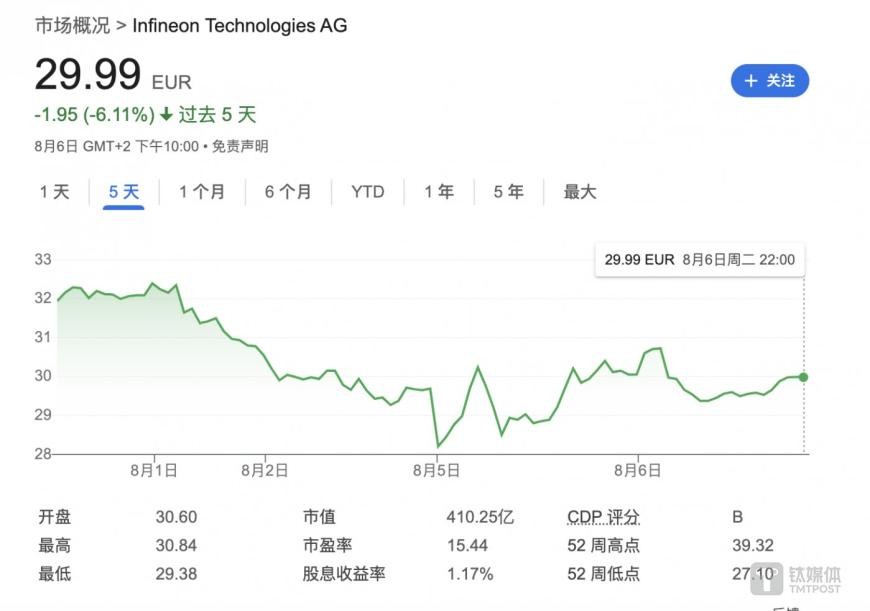
Affected by the above news, Infineon's stock price has been fluctuating over the past three trading days, falling by more than 5% at one point. As of midday on the 7th, Infineon's European stock was at 29.99 euros per share, down 0.22%. Over the past 5 days, Infineon's stock price has fallen by 6.11%. Year-to-date, the stock has dropped by 17.72% in Europe and 18.43% in the US.
Infineon is a global powerhouse in power systems and IoT chip semiconductors, as well as the world's largest automotive chip company, headquartered in Neubiberg, Bavaria, Germany, providing semiconductor and system solutions. According to official data, Infineon's business spans the globe, with 56 research institutions and 20 production facilities worldwide.
The latest data released by research firm IDC on August 7th shows that in 2023, the top 5 companies in the global automotive semiconductor market held over 50% market share. Among them, Infineon ranked first with a market share of 13.9%; followed by NXP and STMicroelectronics with market shares of 10.8% and 10.4% respectively; Texas Instruments and Renesas Electronics ranked fourth and fifth, with market shares of 8.6% and 6.8% respectively.
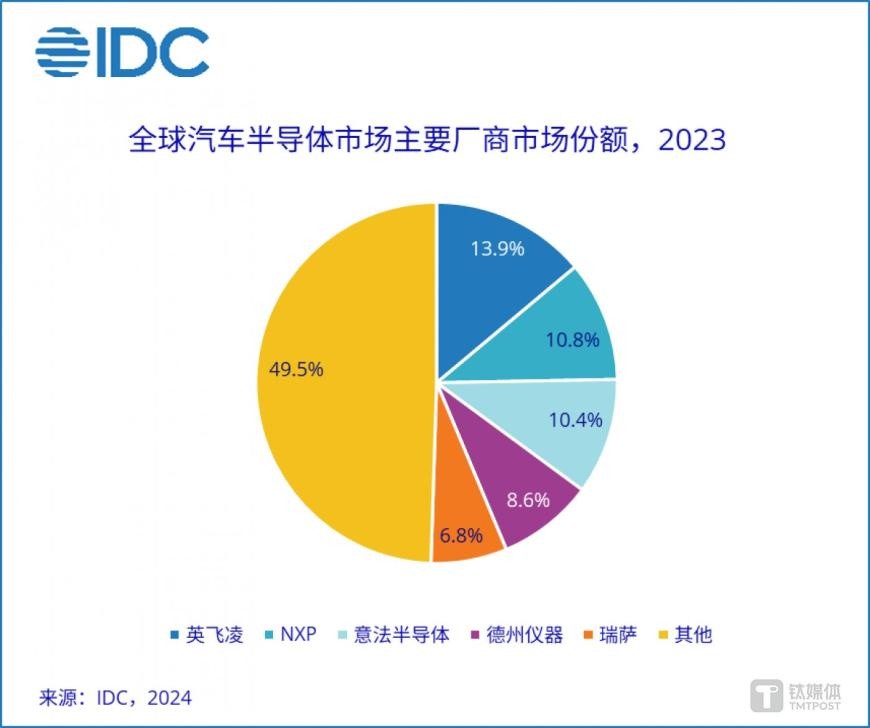
Therefore, Infineon plays a crucial role in the global automotive chip market, and its financial report is a key indicator for the global automotive chip industry.
The financial report shows that Infineon's revenue comes from five business segments: Automotive, Green Industrial Power (GIP), Power and Sensor Systems, Connected Secure Systems (CSS), and other operating segments.
In the third quarter, Infineon's revenue increased by 2% compared to the previous quarter, with the main contributors being the Automotive (ATV) and Power and Sensor Systems (PSS) divisions. In terms of the Automotive business, revenue for this quarter was 2.112 billion euros, up 2% from the previous quarter but down 1% year-on-year, with a profit margin of 25.4%; Power and Sensor Systems business revenue was 749 million euros, down 18% year-on-year but up 5% from the previous quarter.
Additionally, Green Industrial Power business revenue was 475 million euros, down 16% year-on-year but up 1% from the previous quarter; the profit margin decreased from 30.3% in the same period last year to 18.5%; Connected Secure Systems business revenue was 366 million euros, down 23% year-on-year and 1% from the previous quarter.
Hanebeck stated that the market environment remains challenging, with slow progress in the recovery of target markets. The long-term economic weakness has led to semiconductor inventory levels in many areas exceeding end-user demand. "In addition to managing the current demand cycle, we are committed to enhancing the company's competitiveness through the 'Step Up' structural optimization and enhancement plan."
For the outlook of the fourth quarter of the 2024 fiscal year, assuming a euro to dollar exchange rate of 1:1.10, Infineon expects revenue for this quarter to be around 4 billion euros, slightly higher than analysts' expectations of 3.94 billion euros. On this basis, the departmental profit margin is expected to reach around 20%, lower than analysts' expectations of 22%. Based on business, Infineon continues to lower its expectations for the 2024 fiscal year to around 15 billion euros, with a profit margin of around 20%. The adjusted gross margin is expected to be between 40% and 45%. The expected investment amount will be around 2.8 billion euros. Taking into account investments in large front-end factories and the acquisition of Gallium Nitride Systems company (GaN Systems), the adjusted free cash flow is expected to be around 1.5 billion euros, while the reported free cash flow is around -200 million euros.
"The long-term economic weakness has led to inventory levels in many regions exceeding end-user demand." Hanebeck pointed out that Infineon will implement a "gradual cost reduction" plan, including the elimination of 1400 employees, including several hundred positions that were previously canceled at the Regensburg factory in southern Germany During the financial report meeting, Infineon stated that the "gradual cost reduction" plan is expected to slowly take effect starting from the 2025 fiscal year, with the goal of achieving a revenue target of 30 billion euros by 2027.
Infineon emphasized that in such an environment, the company needs to establish a diversified business portfolio—the common point being that inventory levels overall remain relatively high, but there are some differences between different product categories, customers, and distributors. In other words, the worst inventory adjustments in the supply chain are already behind. To further reduce inventory, the company will continue to meet the demand in most regions to help alleviate overall inventory pressure.
"Looking at the current transitional phase, we see that Infineon's structural growth opportunities are increasing rather than decreasing, mainly coming from our five broad key applications: electric vehicles, ADAS, renewable energy, AI data centers, and the Internet of Things." Infineon will continue to focus on advanced manufacturing industries, from 65nm to 40nm, and may venture into 28nm in the future.
It is worth noting that recent financial reports from automotive chip companies such as NXP, ON Semiconductor, STMicroelectronics, and Texas Instruments have shown signs of decline.
In the second quarter of the 2024 calendar year, NXP's revenue declined by 5% year-on-year to $3.13 billion, with automotive chip revenue down by 7%, mainly due to continued soft demand from automotive customers; STMicroelectronics' Q2 revenue was $3.23 billion, down 25% year-on-year, with net profit down 64%, mainly due to lower-than-expected revenue from the automotive business; Texas Instruments saw a 16% year-on-year decline to $3.82 billion.
Overall, the automotive chip market is transitioning from chip shortage, chip replenishment, to the current situation of high inventory and weakening market demand.
IDC predicts that by 2027, the global automotive semiconductor market will exceed $88 billion
