


With overseas risks escalating, how will AAC TECH make a stunning turnaround?

AAC TECH is transforming into a scenario solution integrator under the pressure of overseas risks and industry competition, focusing on the development of AI smart hardware. The company's investors indicate that the market demand for related components will increase, but high product prices and user feedback issues are affecting sales. In the future, AAC TECH will expand into areas such as automotive LiDAR. However, intense industry competition and changes in metaverse demand still make its future prospects uncertain

Editor | Yang Bocheng
Caption | IC Photo
At the Wu Sheng Business Method Conference, it was pointed out that AAC TECH's perceptual technology often "hides" in terminal products such as smartphones, PCs, and cars, and achieves self-transcendence through experience details x scene algorithms, new terminals x scene proposals, and industry standards x scene planning at three levels.
Taking the example of new terminal x scene proposals, from smartphones to AI phones, from PCs to AI PCs, as well as enhancing smart cars, XR smart devices, etc. AAC TECH's perceptual experience solution continues to embrace new terminals of digital life.
In other words, AI smart hardware has become the key breakthrough direction for AAC TECH in the future. Fu Yuliang, Director of Investor Relations at AAC TECH, and Liang Jiayu, the contact person of the Investor Relations Department, both stated in media interviews that AI phones are the future trend, and the market demand for microphone and heat-related components will increase.
Furthermore, AAC TECH hopes to transform from a component supplier to a scene solution integrator. With the Honor Magic V3 and Magic Vs3 series, Honor and AAC TECH jointly developed the "ultra-thin" perceptual system solution, including Ruben architecture hinges, custom middle frame components, ultra-thin high-performance speakers, ultra-thin high-performance X-axis motors, and small-sized high-performance digital microphones.
However, on the JD platform, whether it is the relatively few comments after the launch of the Honor Magic V3 and Magic Vs3 series, it indirectly indicates poor sales due to high product prices, which limits the shipment boost for AAC TECH. Some users also mentioned that the hinge of the Magic V3 phone is loose and makes noise, indicating that AAC TECH's overall technical capabilities may still need improvement.

Image Source: JD
In addition, the intense competition in the new energy vehicle industry has brought transformation pressure, poor sales of AI hardware have forced hardware manufacturers to upgrade the supply chain, and Apple's declining sales in China followed by overseas pressure brought by Apple's overseas expansion, all make it difficult for AAC TECH.
I. Metaverse Cooling Down, Insufficient High-endization of New Energy Vehicle Audio Systems
Fu Yuliang pointed out that based on AAC TECH's advantages in sensory experience, besides the smartphone business, AAC TECH will extend to areas such as car-mounted LiDAR in the future. In the metaverse world, there is a huge demand for AR/VR in the fields of acoustics, optics, touch, etc.
Even with technological advantages, whether AAC TECH can succeed in the red ocean remains to be seen. In the LiDAR field, driven by factors such as advanced intelligent driving, cost reduction through technology, and scale cost reduction, the turning point for LiDAR is emerging. For example, a person related to Hesai Technology stated that profitability is expected to be achieved in 2024, and TuSimple also plans to achieve a balance between profit and loss in 2025 after the release of the first-quarter financial report The entire lidar market competition has stabilized, with Speedtech Juchuang, Huawei Technologies, Hesai Technology, and Tudatong holding over 90% of the market share. How much room for imagination does AAC TECH have left? More importantly, can AAC TECH accept the high short-term investment and losses in the lidar business?

Image Source: Gasgoo
The same issue also arises in the metaverse field, as there is no clear profit model for the metaverse, leading global giants to scale back their businesses, with very few investors paying attention to the metaverse.
In the AR/VR/MR field, whether it's ByteDance's massive layoffs at PICO or Vision Pro facing high refunds in overseas markets, or the lack of speculation in the domestic market after listing, all indicate that it is difficult for AR/VR/MR to achieve explosive growth in the terminal market in the short term, forcing manufacturers to adjust their product layouts.
Bloomberg reported that Apple has temporarily halted work on Vision Pro2, with multiple suppliers receiving notifications. The future core of Vision Pro2, with the internal code name N109, will focus on being lighter and more comfortable to wear, and it is expected to be pushed to the market no earlier than 2026.
At present, the business that can best support AAC TECH's transformation is the new energy vehicle acoustic business. With the accelerated integration of acoustics and intelligent cabins, more speakers being installed by OEMs is becoming a trend. The Xiaopeng MONA M03, the 2024 Li Auto L9 Ultra version, and the Xiaomi SU7 have 18, 21, and 25 speakers respectively. The 2024 ZEEKR 009 Executive Edition even reaches 30 speakers.
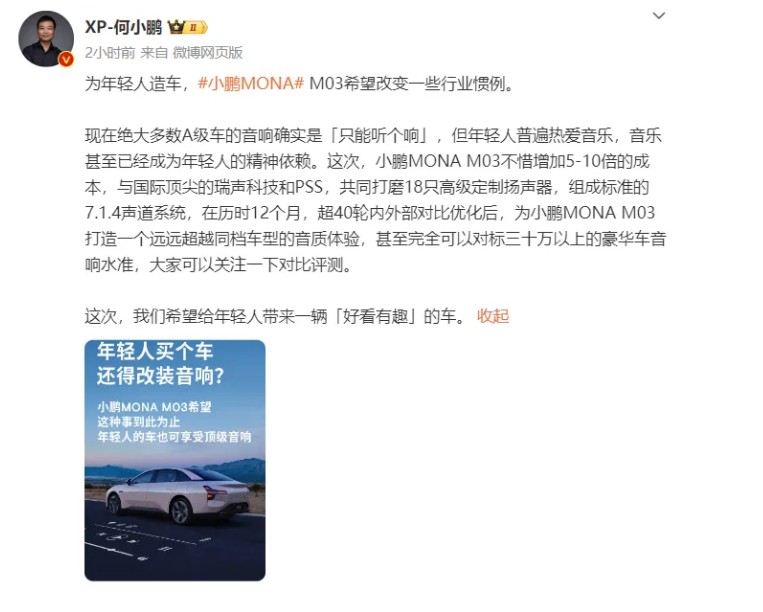
Image Source: He Xiaopeng Weibo
Installing more speakers by OEMs can help speaker manufacturers increase revenue and clear inventory. Based on an estimated price of 125 yuan per speaker in 2023, the AAC TECH SU7 with 21 speakers corresponds to a single vehicle price of 2625 yuan. If, as stated by Xiaomi, they are expected to achieve the target of delivering 100,000 vehicles ahead of schedule in November this year, this will significantly boost AAC TECH's revenue.
However, replicating the myth of shipping more SU7 units like Xiaomi may not be an easy task for AAC TECH.
Firstly, by installing high-end brand audio systems, OEMs can enhance the high-end attributes and selling points. Under this choice by OEMs, high-end models in the market still dominate with brand audio systems. The 2024 ZEEKR 009 Executive Edition is equipped with Yamaha audio brand, the 2024 Taycan4 Cross Turismo is equipped with BOSE and Berliner sound, and the 2024 Voyah Dreamer Custom Edition is equipped with a Danish audio brand. However, the PSS acquired by AAC TECH is not a high-end brand, and the lack of high-end features has become a challenge for AAC TECH to install more high-end models

Image Source: Donews
Secondly, the development model of using white-label audio processing + software tuning by companies like Aisin Electronics representing car speakers and host factories is gradually maturing. This is also the reason why Aisin Electronics has seen revenue growth for 5 consecutive quarters. The audio development model for XPeng G6 is designed by XPeng, with GuoDian Electric handling production. Meanwhile, Li Auto and Nio have self-developed solutions, with equipment provided by Aisin Electronics and tuning handled by Dirac. Li Auto's tuning part is self-developed.

Image Source: Baidu
However, due to the lack of bargaining power for white-label audio systems, the commercial exploration around in-car audio business by host factories remains unclear. As the aftermarket business for new energy vehicle audio systems matures and competition intensifies in the mid-to-low-end vehicle market, industry price wars continue, leading host factories for mid-to-low-end models to strictly focus on cost.
Based on this, although Aisin Electronics' net profit margin in Q1 2024 increased by 47.96% compared to the same period last year, it was only 9.78%. Looking at the existing models equipped with AAC TECH's products, the issues currently faced by Aisin Electronics may also appear in AAC TECH in the future.
Thirdly, He Xiaopeng once stated that after more than 40 rounds of internal and external comparisons and optimizations over 12 months, a sound quality experience far beyond the same-class models was created for XPeng's MONA M03, even comparable to luxury car audio systems priced over three hundred thousand.
Considering the process from entering the supplier list of host factories to proposal bidding, continuous optimization of solutions, subsequent shipments, after-sales tracking, etc., it may take more than a year for speaker suppliers to potentially secure a model from a host factory through a manpower-intensive approach. However, with delivery volumes of models like Nezha S and Li Auto MEGA falling short of market expectations, this not only severely impacts AAC TECH's shipment volume but may even result in net profits not covering AAC TECH's long-term personnel investment costs.
Furthermore, not only do different manufacturers have varying in-car audio requirements, but even within the same manufacturer, different models have different demands for in-car acoustics, making differentiation a key focus for host factories. AAC TECH's brand awareness lags behind Huawei, making it difficult to exert high influence over host factories like Huawei's Car BU, which poses high demands on AAC TECH's comprehensive technical capabilities.
Compared to companies like Desay SV, GoerTek, etc., AAC TECH entered the field of in-car acoustics relatively late. How to quickly make up for this shortfall undoubtedly becomes a major challenge for AAC TECH.
II. Slow Infiltration of AI Hardware, Manufacturers' Cost Game
AAC TECH may also realize that the short-term performance boost from the in-car business is limited, with the core focus still on the smartphone business.
In 2024, AAC TECH has successively supplied Samsung Galaxy S24 with large-volume high-performance X-axis linear motors, as well as ultra-thin speakers for Galaxy Z Fold6 and Galaxy Z Flip6 The Vivo xFold 3 is the first in the world to feature the NLC algorithm created by True Wireless for the 12Pro series, along with AAC Whisper speakers and AeroEngine.
Among the models collaborating with many manufacturers, the Samsung Galaxy S24 may be the model most capable of driving revenue growth for AAC Tech. Samsung officials stated that the quarterly sales of the Galaxy S24 series in Q1 and Q2 this year were higher than those of the Galaxy S23. According to reports from Hanwha Financial Securities, if the sales of the Galaxy S24 series continue to exceed those of the Galaxy S23 series, it is expected that the sales volume in early next year may reach 35 million.
According to Counterpoint Research data, the global sales distribution of the S24, S24 Plus, and S24 Ultra is 21%, 21%, and 52% respectively. The sales volume of the Galaxy S24 in early next year may reach 7.35 million units. Trend Force's consulting report shows that Samsung's production capacity in Q1 2024 is 59.5 million units, with the S24 series accounting for 22.5% of that quarter's production capacity. In other words, Samsung may continue to add orders for the Galaxy S24 series, and AAC Tech will directly benefit from this.
However, not all hardware products from manufacturers can achieve the sales volume of the Samsung Galaxy S24. Taking the upcoming iPhone16 as an example, concerns within the supply chain about the market performance of the "iPhone 16" are "continuously increasing".
Apart from Apple being criticized for incremental innovation, the continuous and unpredictable impact of geopolitical risks persists. The AI features carried by the iPhone16 only support the English version, directly affecting the sales of the iPhone 16 in non-English-speaking countries.
Furthermore, although high-end flagship models are increasingly incorporating AI large models, the cost of mobile chips is gradually increasing as processors enter the 3-nanometer process. With the current trend of lengthening the replacement cycle for high-end smartphones, it may not be realistic to pass on the cost to consumers.
The current reality facing various AI products such as AI PCs, AI learning machines, and AI smartphones is that the cost of AI components is relatively high, coupled with the need for manufacturers to share the R&D costs of AI large models, leading to high prices of AI products. However, when non-AI hardware products can also support the operation of large models, the cost-effectiveness of AI hardware products is significantly insufficient, resulting in a lack of consumer demand in the end market.
If the prices of AI hardware products are completely lowered, it will lead to a poor user experience, thereby affecting brand image and consumer loyalty. However, the upgrade of AI hardware will increase consumer wait-and-see sentiment, ultimately resulting in slow growth in short-term sales of AI hardware products.
Taking the AI PC market as an example, according to the supply chain, there will be no surge in demand for AI PCs during the 618 period, but rather a gradual development. At the same time, mainstream X86 architecture AI PCs in the PC market will not appear in the end market until the second half of the year, undoubtedly further increasing consumer wait-and-see sentiment During the 618 period this year, the supply chain has felt a strong chill. Intel CEO Pat Gelsinger also revealed that currently, AI PCs account for less than 10% of the overall PC market.
To address this issue, hardware manufacturers are not only promoting the automation and streamlining of manufacturing processes, seeking more cost-effective upstream suppliers, increasing bargaining power with component suppliers, and diversifying sources of component supply, but also some component manufacturers are simplifying designs, reducing some components, and replacing them with more cost-effective components.
This poses a greater challenge for AAC TECH as well. On the one hand, when manufacturers prioritize cost and profit, it may lead to increased price competition among upstream suppliers. For example, according to recent supply chain rumors, Sunny Optical is expected to supply camera modules to Apple starting from 2025. If Sunny Optical enters Apple's supply chain, the performance of many manufacturers may be directly affected.
On the other hand, in order to avoid being cut off by Apple and other smartphone manufacturers, AAC TECH can only accelerate the research and development progress of components. This poses higher requirements for AAC TECH in terms of research and development, production capacity planning, and utilization. Especially for AI PCs and AI smartphones, considering the continuously lengthening consumer replacement cycle, research and development and production capacity planning need to prioritize market demand for at least 3 years.
However, in the short term, investments in AI hardware products may have an impact on AAC TECH's profitability. Taking Intel as an example, its investment in AI PCs is currently lowering its short-term profits. According to Intel's Q2 2024 financial report, the gross profit margin in that quarter decreased by 0.4% to 35.4%. The operating profit margin expanded from -7.8 in the same period last year to -15.3%, and it is expected that the gross profit margin will continue to decline to 34.5% in Q3.
III. Vietnamese Factory: Shortage of Labor, Lengthy Customs Procedures
Since 2024, Apple's sales in the Chinese market have been continuously declining. According to Apple's Q2 2024 financial report, under the siege of brands such as Huawei, OPPO, Xiaomi, and Honor, revenue in the Greater China region has decreased by around 6.5% compared to the same period last year.
IDC data shows that in that quarter, the shipment volume of smartphones in the Chinese market was 71.6 million units. Although Apple traded price for volume during the 618 period, its market share has fallen out of the top 5. In addition, Huawei's plan to launch a three-fold screen phone in the second half of the year will bring considerable pressure to iPhone16, which will have a negative impact on AAC TECH's revenue.
However, compared to the sea tactics of Android manufacturers, bundling with Apple is still the practice of the fruit chain due to the relatively fewer iPhone models. Facing declining sales in China, risks of a diversified supply chain, and the advantage of cheap labor in Vietnam, the fruit chain is following Apple's footsteps and accelerating its relocation to Vietnam.
Image Source: Vietnam Statistics Office
According to a brief report from Vietnam, in 2024, Apple has added 8 new "fruit chain" companies in Vietnam, bringing the total to 35 "fruit chain" companies in Vietnam. Supply chain manufacturers such as GoerTek, Luxshare Precision, AAC TECH, Samsung, LG, and others with close business ties to Apple are mainly located in the northern part of Vietnam
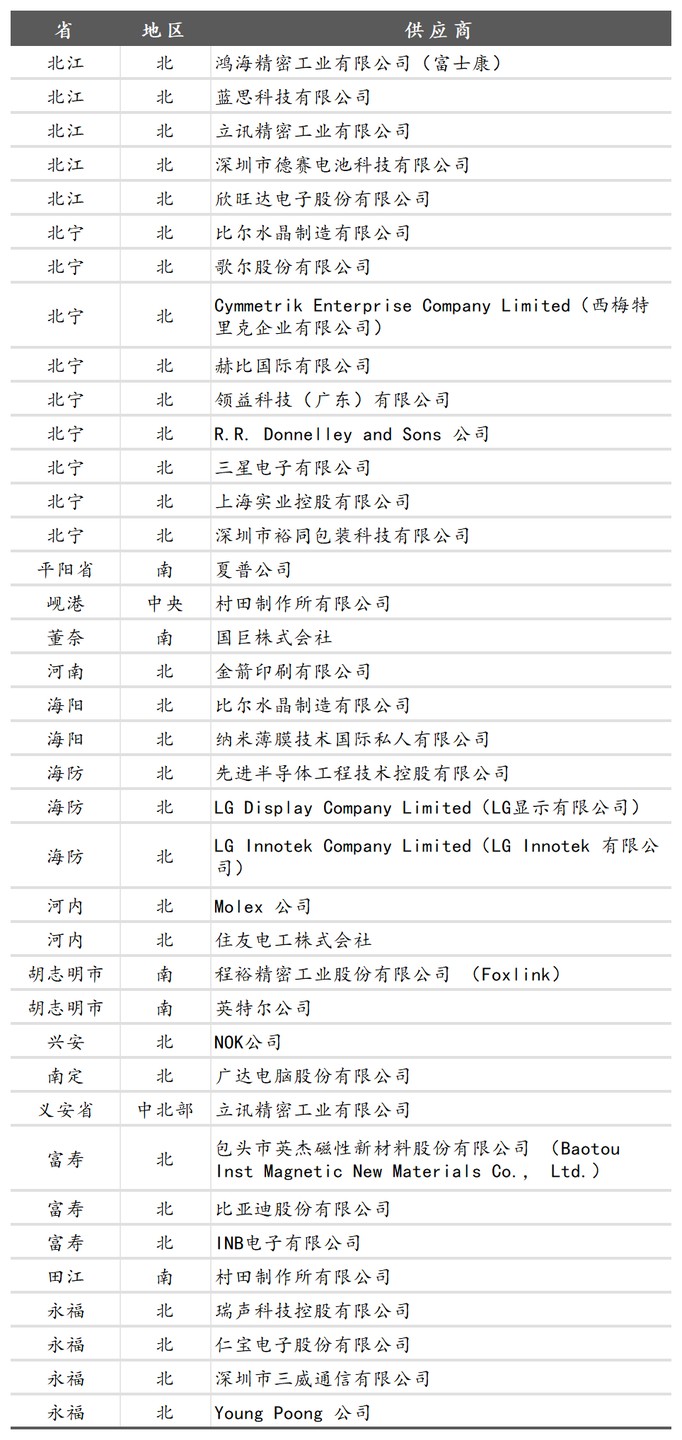
Image Source: Vietnam Briefing
While Vietnam is continuously improving its infrastructure to attract overseas investors, including the existing 13 highways, six railway lines, seven airports, and three major seaports, important infrastructure such as the 155 Provincial Road in Vietnam, the Tuyen Quang Phu Tho Expressway, and the MaiSon45 National Highway Expressway have been put into operation since 2023.
However, there are significant challenges in the operation of AAC TECH's factory in northern Vietnam.
Firstly, Vietnam has high investment barriers. Thao Minh Nguyen, head of Vietnam's business environment and competitiveness research department, stated that the slow reform of customs management and inspection processes in Vietnam results in long clearance times, leading to higher costs for businesses. In comparison, Vietnam's customs procedures are twice as long as Thailand's and three times longer than Malaysia's.
Additionally, Vietnam's regulations are quite cumbersome. In the Hanoi area of Vietnam, if a company wants to construct a factory building, they need to submit their plans for design approval to the Planning and Construction Department, then submit them for project approval to the Planning and Investment Department, followed by submitting them to the Ministry of Natural Resources and Environment for necessary land allocation, and finally submit them to the Construction Department for approval. This not only significantly delays the progress of businesses but also increases their operating costs.
Secondly, for manufacturing industries like AAC TECH, production factories require hiring a large number of stable and skilled workers. Vietnam Briefing reported that in the first half of this year, over 70% of the labor force in the Vietnamese labor market consists of untrained workers, with over 60% of the total employed population engaged in unstable and irregular work.
Not only skilled workers, but Vietnam also faces a severe shortage of high-level talents. According to data from the Ho Chi Minh City Labor Demand Forecast and Labor Market Information Center (Falmi), the proportion of labor shortage in commercial business in Ho Chi Minh City is as high as 28.78%. Out of 654 companies that year, 154 companies reported difficulties in recruitment, mainly engaged in wholesale and retail, manufacturing and processing, as well as administrative and support services.
Both personnel training and management, as well as offering higher salaries to attract talent, pose extremely high demands on AAC TECH's factory in northern Vietnam.
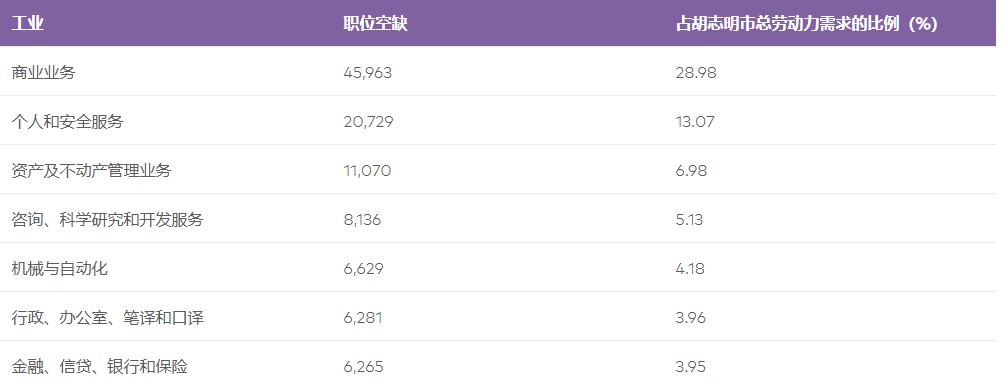
Image Source: Falmi
Thirdly, Vietnam's electricity infrastructure is still inadequate. In the summer of 2023, a widespread power outage occurred in northern Vietnam, resulting in over $1 billion (approximately 13.5 billion new dong) in output losses. Faced with Vietnam's ongoing high temperatures this year, Reuters reported that in May, Vietnamese officials called on Foxconn to reduce its electricity consumption by 30% at its assembly plant in northern Vietnam, and also made similar appeals to other manufacturers In July this year, the Vietnamese government introduced a policy allowing large electricity users to directly purchase electricity from renewable energy power plants, a mechanism currently supported by Samsung. However, the unstable power supply and substantial electricity purchases have both increased AAC TECH's operating costs in the region.
Conclusion:
"What new products should Apple's future rely on?" Bloomberg commentator Mark Gurman poses a soul-searching question to Apple. According to Mark Gurman, looking at Apple's entire M4 Mac product lineup from 2024 onwards, while the iPod paved the way for iPhone sales, the iPhone and iPad are now in competition. Rumored new Apple household devices such as HomePod 3, Apple Glass, new AirPods, personal robots, etc., are also in competition with Apple's other hardware products.
Although the Apple Watch and Apple Vision Pro have helped Apple expand its product categories, the global sales of Apple Vision Pro have been lukewarm, making it difficult to contribute significantly to Apple's revenue. Apple's Q2 2024 financial report shows that the iPhone accounts for 46% of quarterly revenue, remaining a key revenue pillar for Apple. So, where will Apple go next?
This is not just a question Apple needs to consider, but also a question AAC TECH needs to ponder. With major smartphone manufacturers increasingly viewing the Indian market as an important growth market and pursuing localization production under Indian authorities' requirements, how much time is left for AAC TECH to transform?
