【US Stock Decoding】Honeymoon period over? The stories of Walmart and JD.com

JD.com announced that its financial performance for the June 2024 quarter exceeded expectations. However, its stock price plummeted after news of Walmart reducing its stake in JD.com. JD.com's US stock fell by 4.57% to $28.19, and further dropped by 9.54% after hours. Walmart no longer holds over 5% of JD.com's shares, with its previous 289 million shares valued at approximately $4.074 billion. Although the reduction in stake may bring selling pressure to JD.com, the future impact still needs to be observed
Supply chain operation giant JD.com (09618.HK) has just announced better-than-expected financial results for the fiscal quarter ending in June 2024, driving the stock price up, only to encounter a sharp decline shortly after.
The reason behind this is that there are reports from foreign media stating that JD.com's second largest shareholder, Walmart (WMT.US), intends to reduce its holdings in JD.com (JD.US) for cashing out. JD.com's US-listed shares plummeted by 4.57%, closing at $28.19, and further dropped by 9.54% after hours. A few hours later, JD.com's H-shares also fell by more than 10%.
Finet noticed that before the official announcement from both parties, Walmart and JD.com had already filed ownership documents with the SEC in the United States, indicating that Walmart's holdings in JD.com were zero, as shown in the screenshot below.

This means that the reporting person (Walmart) has ceased to be a holder of more than 5% equity in the security category (JD.com Class A shares). In other words, Walmart is no longer a holder of more than 5% equity in JD.com and will no longer need to report related holdings in the future.
In the document released by Walmart on December 31, 2023, Walmart held 289 million ordinary shares of JD.com, equivalent to approximately 144.5 million ADS (American Depositary Shares), with a stake of 9.2%, as shown in the screenshot below.

Based on the current price of JD.com's US-listed shares at $28.19 per ADS, Walmart's holding market value may be around $4.074 billion (Note: 1 ADS is equivalent to 2 ordinary shares of JD.com).
Walmart's reduction of holdings in JD.com will certainly bring selling pressure to JD.com's stock in the market, but in the long run, is this a good or bad move?
Strategic Cooperation between Walmart and JD.com
In the early years, Walmart expanded its e-commerce business in mainland China through Yihaodian.
In 2016, Walmart completed the acquisition of the remaining non-controlling interest in Yihaodian for approximately $760 million.
In June 2016, Walmart sold Yihaodian to JD.com in exchange for JD.com's Class A ordinary shares, representing approximately 5% of the fully diluted outstanding ordinary shares of JD.com.
According to Walmart's 2017 annual report, the JD.com shares acquired through the sale of Yihaodian were classified as available-for-sale securities. Finet noted that in the following fiscal years, Walmart has consistently emphasized accounting for its investment in JD.com separately from its own operations in China However, at the same time, Walmart has had a very deep cooperation with JD.com in China. It can be said that the strong growth of Walmart's e-commerce business and Sam's Club membership business has benefited from JD.com.
According to the strategic cooperation agreement between Walmart and JD.com signed in June 2016, JD.com and Walmart have cooperated in the e-commerce field, including opening Sam's Club flagship stores and Walmart flagship stores on the JD.com website, setting up global flagship stores for Sam's Club, Walmart, ASDA, and various global stores selling specific products on JD Worldwide, as well as providing one-hour delivery services for Walmart supermarkets and Sam's Club through the JD Daojia app in specific cities.
Currently, apart from the official Sam's Club app, only JD.com has a Sam's Club flagship store. Other e-commerce platforms such as Tmall and Douyin do not have Sam's Club. Different from the official Sam's Club app, JD.com members can also purchase exclusive Sam's Club products in JD's Sam's Club flagship store without having a Sam's Club membership (although prices may be slightly higher).
In addition, JD Logistics and Dada (DADA.US) are important logistics and fulfillment service providers for Walmart, Sam's Club, etc., providing fast home delivery services for Sam's Club.
At the performance release conference for the second quarter of the 2025 fiscal year ending on July 31, 2024, Walmart's management stated that the strong membership growth in China and the continued growth of Sam's Club have driven its double-digit sales growth, with approximately half of the sales in China coming from online channels. During the period, Walmart's net sales in China contributed $4.6 billion, a year-on-year increase of 17.7%, with improved gross margin, reduced operating expenses, and increased operating income.
According to Walmart's management, in China, the number of e-commerce orders delivered within hours by Walmart has increased by 28% to 59 million. With the continuous growth of Sam's Club members in China, the Sam's Club membership business has contributed to a 26% growth in revenue for China. The role of JD Logistics for Walmart is undeniable.
The aforementioned strategic agreement signed in 2016 also includes an 8-year non-competition arrangement between JD.com and Walmart. By 2024, this 8-year non-competition arrangement is likely to expire.
What is Walmart's motivation for reducing its holdings?
As of the quarter ending on July 31, 2024, comparable store sales growth in the US was 4.2% for Walmart, 5.0% in Mexico, 3.4% in Canada, and 13.8% in China. From the perspective of growth momentum, China is a very important strategic market for Walmart.
In terms of current logistics efficiency in China, JD.com and Meituan (03690.HK) are the most competitive same-city express delivery logistics providers, and both companies have invested heavily in infrastructure costs to build their logistics empires. Compared to Meituan, JD.com covers more cities in mainland China, therefore, as the penetration rate of e-commerce business continues to increase, the logistics cooperation between Walmart and JD.com remains strategically significant In terms of retail alone, JD's e-commerce business may compete with Walmart. Without JD's non-competition arrangement, Walmart may leverage more flexible new marketing and channels to expand its online business.
More importantly, Walmart seems to want to control its China business from the beginning, rather than entrusting it to a third party. It may focus more on investment returns than JD, so reducing its stake in JD may not be so unpredictable.
As of July 31, 2024, Walmart held $8.8 billion in cash and cash equivalents, a decrease of $1.056 billion from the beginning of the year. Its total liabilities were $47 billion (including finance lease liabilities), slightly up by $100 million from the beginning of the year. At the end of July, its free cash flow was $5.9 billion, a decrease of $3.1 billion. It has spent $2.1 billion to repurchase 33.4 million shares since the beginning of the year.
Walmart expects its full-year capital expenditures for the fiscal year 2025 ending in January 2025 to be approximately 3.0%-3.5% of net sales. According to its performance guidance, the net sales for the fiscal year 2025 could be $666.7 billion to $673.1 billion, which means its capital expenditures could reach $20 billion to $23.6 billion. The reduction of its stake in JD is likely to finance its capital expenditures.
Summary
Currently, Walmart is JD's largest shareholder after Dongge.
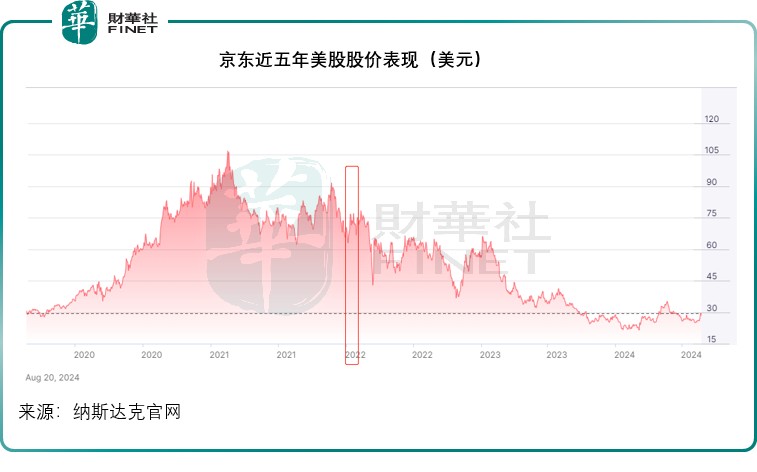
In 2021, JD experienced a reduction in its largest shareholder at the time, Tencent (00700.HK). Tencent announced at the end of 2021 that it would distribute JD Group's Class A common shares to its shareholders as a special mid-term stock dividend. The relevant shares were ex-rights on January 20, 2022.
As shown in the chart below, the fluctuation in JD's stock price during Tencent's reduction announcement to ex-rights period was not significant. The main factors affecting its stock price performance were still JD's fundamentals - the shift in overall consumption trends in the following two years and the rise of new marketing methods. The impact on JD's performance was not due to Tencent's reduction or any changes in Tencent's cooperation model with JD. The evolution of Walmart's cooperation with JD is more worth paying attention to.