


Apple App Store in turmoil: executives resign, team split in two

Apple App Store will undergo a major adjustment, with Vice President Matt Fischer set to resign in October. The team will be split into two departments to separately manage the proprietary app store and third-party app distribution. This move may be in response to regulatory pressure and stagnant hardware sales growth, as Apple aims to address the €1.84 billion fine and related regulatory changes it faces. Fischer, who joined Apple in 2003, has been in charge of the global App Store business

Smart Things, Author: Chen Junda, Editor: Panken, Cover image from: Visual China
According to the well-known Apple whistleblower Mark Gurman, Apple will make major adjustments to its App Store business. Matt Fischer, the vice president who has been in charge of the App Store business for 14 years, will leave Apple in October this year, and the App Store team will be split into 2 departments.
The 2 new departments will be responsible for managing Apple's own app store and third-party app distribution channels respectively. The 2 new leaders are senior executives from the original App Store team.
The App Store is one of Apple's most profitable businesses, generating $20 billion in profit for Apple each year. Its software service business gross margin has always remained around 70%, nearly twice the gross profit of Apple's hardware. Against the backdrop of stagnant hardware sales growth, this business is particularly important for Apple.
Apple's adjustment of the App Store business may be due to increasing regulatory pressure. In March of this year, Apple received a hefty €1.84 billion fine in the EU for monopolistic behavior in the App Store, and had to make multiple revisions to the App Store regulations, relaxing restrictions on third-party app stores and payment methods.
I. Veteran of 21 years leaves, App Store business restructured
Fischer joined Apple in 2003, mainly involved in the iTunes business at that time. Since 2010, he has been serving as vice president at Apple, in charge of the global App Store business.
The decision to adjust the business this time was made by Apple Fellow Phil Schiller, who is ultimately responsible for the App Store business. Schiller joined Apple in 1987, served as Apple's Chief Marketing Officer, and after being promoted to Apple Fellow in 2020, he was responsible for the App Store and Apple Events business, reporting directly to Apple CEO Cook.
After the adjustment, Fischer, who has been managing the App Store business for 14 years, will leave Apple in October this year. The App Store team will be split into 2 teams, one responsible for overseeing Apple's own app store, and the other responsible for managing third-party app distribution channels Fisher officially announced this news to the team in an email on Wednesday, writing, "After 21 years at Apple, I have decided to leave this outstanding company. I have been considering this for some time, and we are also restructuring the team to better address new challenges and opportunities. Now is the best time to pass the baton to two outstanding leaders in the team."
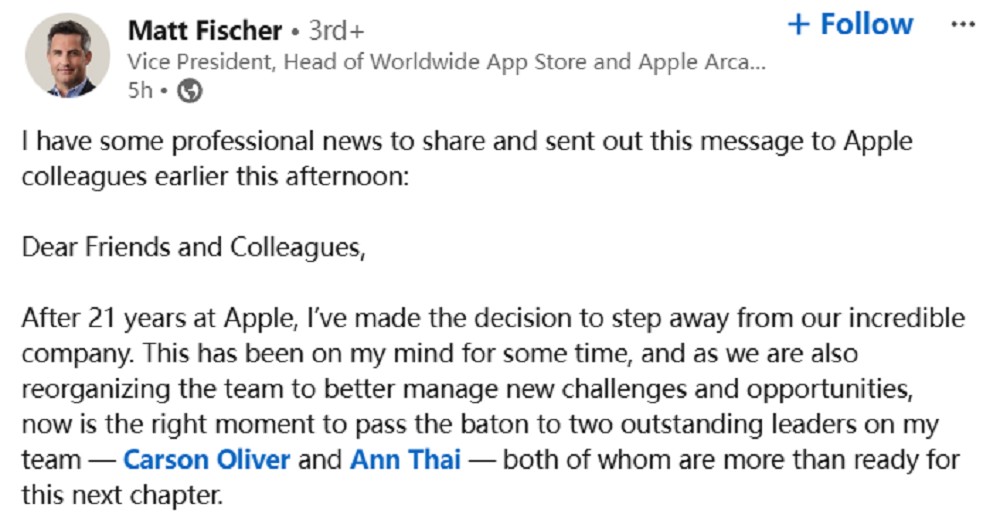
▲ Fisher's resignation letter (Source: LinkedIn)
Carson Oliver, who has long served as a senior director, will be responsible for the operation of the App Store team, while Ann Thai, the director in charge of functions such as search and discovery in the App Store, will lead the new team responsible for third-party app distribution channels. Both will report to Schiller.
An Apple spokesperson declined to comment on the matter.
II. Regulatory Pressure Forces Apple to Adjust
The App Store is one of Apple's most profitable business segments. In 2022 alone, sales and payments in the App Store ecosystem exceeded $1 trillion.
Apple claims that around 90% of this is commission-free, and they take a 15% (developers with annual revenue less than $1 million) or 30% (developers with annual revenue over $1 million) commission from the remaining payments and sales. Goldman estimates that as part of Apple's software services division, the App Store business generates approximately $20 billion in revenue annually.
Apple's financial reports show that the gross profit margin of the software services division has been maintained at around 70%, making it Apple's highest-margin business, with the App Store being the most important segment. In recent years, as growth in major hardware products including the iPhone has stalled, services have become particularly important for Apple.
In recent years, this business of Apple has been facing challenges from developers and regulatory agencies, and this adjustment may be a further response to these issues. Music software Spotify and game developer Epic Games have both clashed with Apple over the "Apple tax".
In early 2024, under regulatory pressure from the European Union, Apple significantly adjusted its commission rates in EU countries, charging fees ranging from 10% to 17%. They also began allowing users to download apps directly from third-party app stores and developer websites.
In March 2024, Apple received a hefty €18.4 billion fine from the EU for monopolistic behavior in the App Store. However, the EU was still dissatisfied with Apple's adjustments, as they found that Apple would restrict third-party payment channels to indirectly extract commissions, with rates ranging from 12% to 27% In August this year, Apple had to once again modify the rules of the App Store in the European Union, further relaxing restrictions on third-party payments.
Conclusion: App Store faces global challenges and may encounter more variables
Apple's App Store business is facing unprecedented challenges. In May this year, Phil Schiller appeared as a witness in the lawsuit with Epic Games. In August, there were reports that Apple is negotiating third-party payment matters with Tencent. Meta's founder and CEO Mark Zuckerberg has also publicly criticized Apple's ecosystem represented by the App Store.
Shortly after the launch of the App Store, Phil Schiller began managing this business and developed it into one of Apple's core businesses. Currently, software services are another cornerstone of Apple's business besides hardware. Schiller's departure may be a prelude to further adjustments to the App Store by Apple.
Zhi Dongxi, Author: Chen Junda, Editor: Panken
