Walgreens stock has fallen apart: is CVS Health any better?

Walgreens Boots Alliance (WBA) stock has plummeted over 68% this year due to issues like retail theft, outdated stores, and failed acquisitions, facing significant competition from major companies such as Walmart and Amazon. Meanwhile, CVS Health, while operating a more diverse model with added acquisitions like Aetna, has also seen its stock fall by over 44% due to rising operational costs, opioid-related charges, and increased competition. Both companies are struggling, with CVS now having a market cap smaller than its Aetna acquisition cost.

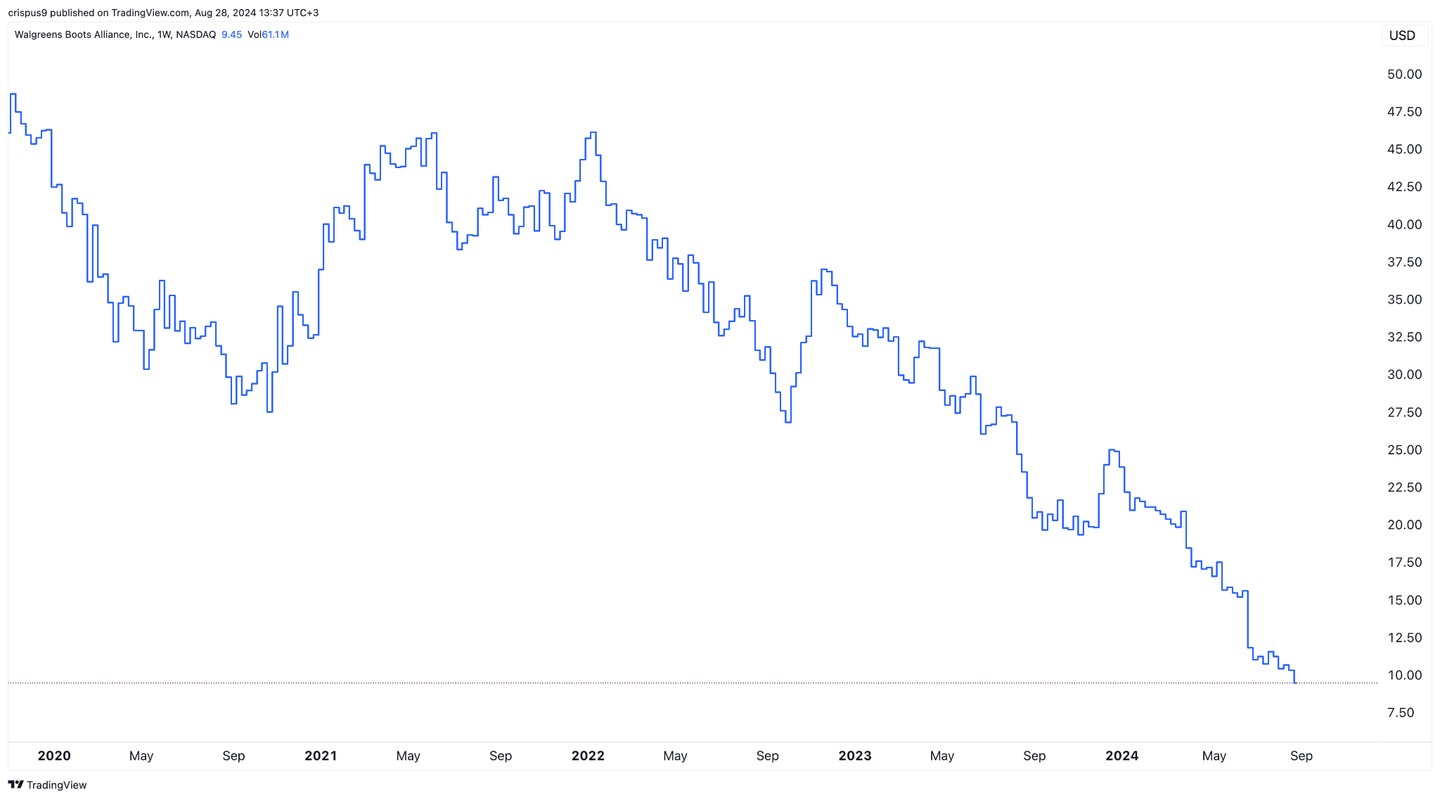
One of the saddest finance stories is unfolding in the United States, where Walgreens Boots Alliance (WBA) is imploding and becoming a fallen angel. The stock has crashed by over 68% this year and by 80% in the past five years. It has dropped to $9.45 and is hovering at its lowest point since 1997.

Why Walgreens has imploded
Walgreens’ market cap has dropped to $8.96 billion, down from over $50 billion in 2019. To understand how low the company has fallen, consider that $1,000 invested in the stock at its peak in 2019 would now be worth just $150, excluding dividends.
The company has faced numerous challenges. Retail theft in key cities has been a thorn in the flesh that has cost it millions of dollars. As a remedy, it has been forced to shut hundreds of stores in the US and lock products. While locking products prevents stealing, it also turns away customers.
Walgreens is also suffering because of its outdated stores and its failed buyout of VillageMD in 2022 as it sought to create a full ecosystem of services. This purchase turned out to be a dud and the company wrote down most of it and fired most of the workers. As a result, it reported a big $6 billion quarterly loss.
Most importantly, Walgreens Boots Alliance is facing major competition from companies like Walmart, Target, and Amazon. Other digital pharmacies have also come up. For example, Hims & Hers (HIMS) has attained a market cap of over $3.48 billion, a good achievement for a company that was started in 2017.
Walgreens has also struggled to offload its Boots stake. Its attempts to take it public have failed and the company is now holding discussions with potential private equity companies.
Walgreens’ woes have led to memories of RiteAid, a company that had the third-biggest market share in the US before it filed for bankruptcy because of its high debt burden.
Read more: Cramer recommends buying Walgreens stock despite recent walkout
CVS Health is not doing good either
On paper, CVS Health and Walgreens Boots Alliance are similar companies since they both offer thousands of pharmacies in the United States.
However, the two companies are significantly different since CVS operates a more diverse business model. In addition to its pharmacies, CVS Health owns CVS Caremark, the biggest pharmacy benefit manager (PBM) in the country. Caremark competes with the likes of Express Scripts, OptumRx, and Humana Pharmacy Solutions.
CVS Health also owns Aetna, a company it acquired in 2018 in a $78 billion deal. By having Aetna, the company is able to offer more solutions to customers. Additionally, it acquired Oak Street Health in 2023 for $10 billion. The purchase gave the company more access in the primary care business.
However, the reality is that CVS Health is also not doing well since its pharmacy business is also facing similar challenges to Walgreens.
Competition has risen while consumers are now opting for companies like Amazon and Walmart that have services like Prime and Walmart+ that offer free shipments. The two services have hundreds of millions of customers. It is also spending billions of dollars improving its stores.
CVS is smaller than the amount it spent on Aetna
Additionally, the cost of running its operations has risen, leading to lower margins. Also, it agreed to pay $5 billion for opioid related charges.
As a result, CVS Health stock has plunged by over 44% from its highest point in 2022 and is hovering at the lowest point since 2020. As a result, its market cap has fallen from over $136 billion in 2020 to $73 billion.
In other words, CVS is now smaller than the amount it spent acquiring Aetna. It is also deeper in debt, with the total long-term debt rising to over $61 billion.
The most recent results showed that CVS Health’s revenue rose by 2.6% last quarter to $91.2 billion while its half-year free cash flow stood at $8 billion.
However, the company also lowered its forward guidance. It expects that its FCF will be about $9 billion, down from $10.5 billion while its GAAP diluted EPS will be between $4.95 and $5.20 from the previous guidance of $5.64.
Therefore, there is a risk that the CVS Health stock price will remain on edge in the near term as traders focus on its turnaround. As such, while it will ultimately rebound, there is a possibility that the recovery will take time.
CVS Health stock analysis

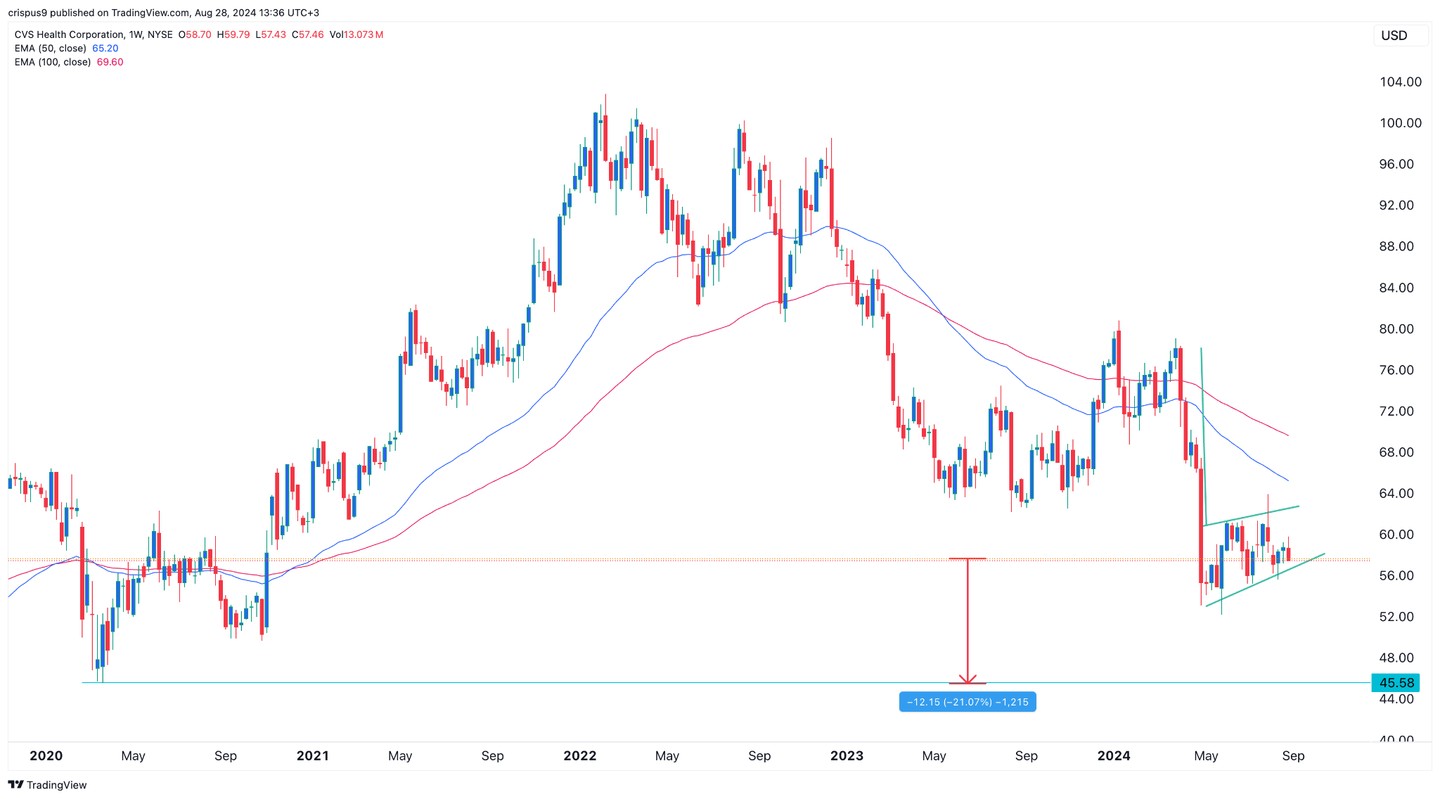
The weekly chart shows that the CVS share price has consolidated in the past few weeks. In this, it has formed a bearish flag chart pattern, a popular sign that it will have a bearish breakout.
The stock has remained below the 50-week and 100-week moving averages. Therefore, the stock will likely have a bearish breakout, with the next point to watch being at $45.58, its lowest swing in March 2020 and 21% below the current level.
The post Walgreens stock has fallen apart: is CVS Health any better? appeared first on Invezz