JEPI: Is JP Morgan’s blue-chip boomer candy ETF a good buy?

Invezz
2024.09.03 09:16
portai
I'm PortAI, I can summarize articles.

The JPMorgan Equity Premium Income ETF (JEPI) has gained over 71% since its 2023 inception, reaching a record high recently. However, it has underperformed the S&P 500, leading to a notable outflow of assets. The fund's total return is 13% over the past year, lower than its peers. Analysts indicate that while JEPI offers substantial dividends, investors should prioritize total return over yield. Catalysts for potential improvement include expected interest rate cuts by the Federal Reserve and corporate earnings growth, though long-term performance compared to passive ETFs remains a concern.

The JPMorgan Equity Premium Income ETF (JEPI) has done well this year, helped by the ongoing surge of American stocks. Its stock has risen in the last four consecutive weeks and is trading at a record high of $58.8. Excluding dividends, the fund has soared by over 71% since its inception in 2023.

Boomer Candy ETF

JEPI, the biggest Boomer Candy ETF, has risen by 7% this year, underperforming the S&P 500 index, which is up by over 17%.

Investors have taken note of this underperformance and have started reducing their investments. Data shows that the fund’s assets dropped by over $21 million last month, the first monthly outflow this year.

Altogether, the fund has added over $2.4 billion in assets this year, bringing its total assets under management to $35 billion. Inflows in other Boomer Candy ETFs like the JPMorgan Nasdaq Equity Premium Income (JEPQ) and the NEOS S&P 500 High Income ETF (SPYI) have started to retreat.

This performance is mostly because of their performance compared to benchmark low-cost ETFs like the Vanguard S&P 500 ETF (VOO) or the iShares S&P 500 ETF (IVV).

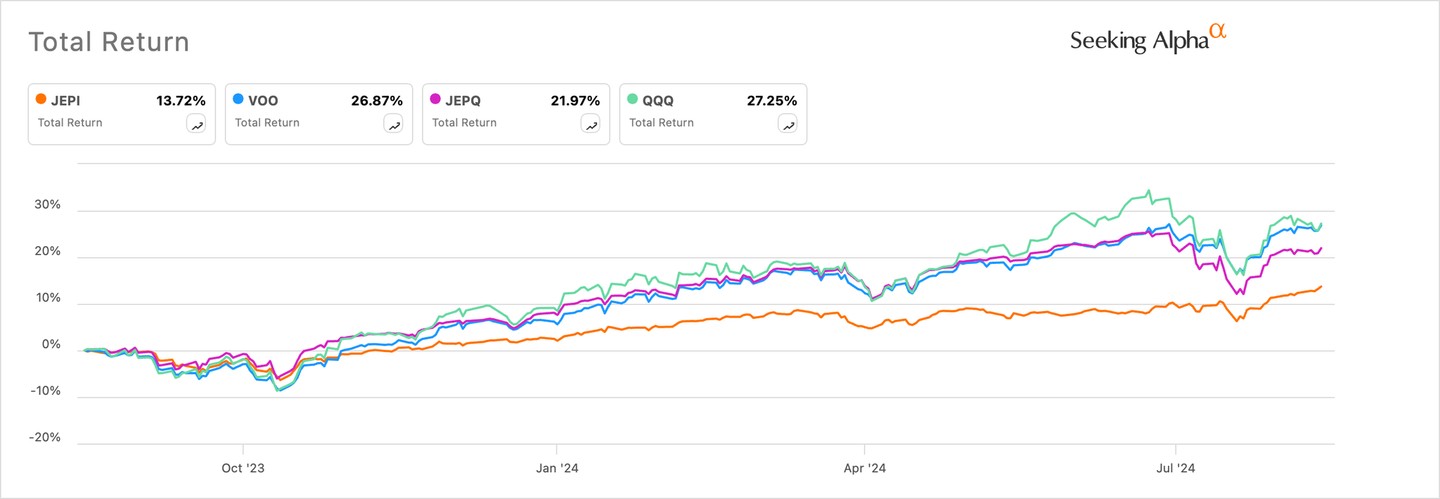
JEPI vs VOO vs JEPQ vs QQQ ETFs

While these boomer candy ETFs have substantial dividends, they always underperform the low-cost passive funds.

JEPI’s total return in the last 12 months stood at 13%, lower than the Vanguard S&P 500 fund. Similarly, the JEPQ ETF has risen by 22% while Invesco QQQ ETF has risen by over 27.25%.

This performance is exactly why investors should always ignore an asset’s dividend yield and instead focus on the total return. In most cases, assets with high dividend yields underperform those with lower yields.

A good example of this is a company like Apple, which yields 0.48% and Verizon, which has a yield of 6.55%. Apple’s total return has been much better over the years.

How the JEPI ETF works

JEPI and other boomer candy ETFs use a very simple approach to generate returns while taking advantage of price movements.

The fund invests in 134 companies across all sectors in the US. Its biggest sectors are technology, healthcare, financials, and consumer discretionary. Some of the biggest companies in the fund are Progressive, Trane Technologies, Meta Platforms, Abbvie, Southern, and Mastercard.

After investing in these companies, the fund then sells call options tied to the S&P 500 index and pockets the premium, which it then uses to pay monthly distributions to investors.

A call option is a financial transactions that lets an investor buy an asset at a certain future price. Unlike a futures contract, in an option, the person is under no obligation to buy the asset.

For example, if a stock drops below the target price, then the options trade becomes worthless since the person can buy it for a cheaper price.

A boomer candy ETF like JEPI, should, in theory, beat the benchmark when it is either moving sideways or is falling.

A key risk is when the benchmark continues rising, as we saw in August. When this happens, the fund tends to miss out on the broader rally.

Catalysts for the JEPI fund

Looking forward, there are several catalysts that could push the JEPI ETF higher. First, the fund may do well when the Federal Reserve starts cutting interest rates later this month.

In most cases, stocks do well when the Fed is slashing rates as investors move from bonds to equities. However, this rotation will likely take longer because interest rates will remain higher for a while.

JEPI, which has a 7% dividend yield, will likely see more interest from income-focused investors.

Second, the JEPI fund will react to the outcome of November’s election in the United States. In most periods, stocks tend to waver ahead of the election and then rally after it happens as they embrace a new normal.

Historically, stocks do well under presidents of both parties, meaning that the outcome will not have a big impact.

Third, corporate earnings will be in the spotlight. The most recent earnings showed that earnings of companies in the S&P 500 index rose by 10.5% and the trend may continue.

Is the JEPI ETF a good investment?

As I have written before, JEPI has a close correlation with the S&P 500 index. However, it often underperforms the index, as we have seen above.

The fund is also more expensive than other passive ETFs like the Vanguard S&P 500 ETF, which charges just 0.03%.

Therefore, while its monthly dividend returns are good, I believe that long-term investors will do better and sleep well at night (SWAN) investing in generic passive ETFs like VOO and Nasdaq 100.

The post JEPI: Is JP Morgan’s blue-chip boomer candy ETF a good buy? appeared first on Invezz