Faraday and Canoo stocks: Do these Tesla wannabes have a future?

Electric vehicle stocks, including Canoo and Faraday Future, have underperformed, with Canoo showing some operational progress despite a significant stock decline of over 73%. The company has substantial orders, yet faces financial challenges needing outside funding. Faraday Future is positioned poorly with a focus on luxury vehicles and negative working capital. Its upcoming announcement regarding software offerings highlights its precarious situation. Overall, the outlook for both companies remains bearish amid broader EV market struggles.

Electric vehicle stocks had another bad performance in August as most of them published underwhelming financial results. Tesla (TSLA), the OG of the EV industry, has tumbled by over 20% from its highest point in July.
Other smaller EV companies like Rivian (RIVN), Faraday Future (FFIE), Canoo (GOEV), and Nio (NIO) had a worse performance in August. Canoo stock fell by 4.60% in August and has fallen by over 73% the last 12 months.
Faraday Future shares plunged by over 66% in August and by almost 90% since January this year as concerns about its future remained.
Canoo made progress but risks remain
Canoo is an electric vehicle company that is building commercial vehicles used by companies like Walmart and organizations like NASA. Walmart will use the vehicles mostly for short or last mile deliveries in some of its locations. It has placed a 4,500 binding agreement for the vehicles.
USPS is another ideal customer for Canoo’s vehicles because of its extensive last mile delivery services.
Therefore, Canoo could see substantial demand as companies work to reduce their carbon footprint.
Canoo’s results released in August showed that it was making progress in manufacturing and vehicle deliveries. Its revenue came to a record $605k in the last quarter as it delivered vehicles to NASA.
The company also reduced its adjusted net loss to 61 cents as it slashed operating expenses by 33%.
Also, it continued its relocation process as it moved its headquarters to Texas and its manufacturing facility to Oklahoma, where it received a Free Trade Zone (FTZ) documents earlier this year. It has also continued receiving assets from Arrival, an EV company that went bankrupt.
Canoo’s biggest benefit is that it has a big backlog from credible companies like Walmart and USPS. It has about $3 billion in orders, with $750 million being binding ones. The company hopes to win some orders from USPS in its upcoming RFQ, which will be between 10k and 12k units.
The challenge, however, is that the company needs money to fund these operations. It will need substantial sums for a few years even as vehicle deliveries start.
Circling back to its earnings report, the company said that it had a net loss of $115 million in the first half of the year, an improvement from the $161 million it lost a year earlier. This means that it wil likely lose a similar amount in the second half of the year.
Canoo’s balance sheet, as it is, cannot support the business since it ended the quarter with $19.1 million. In total, it now has about $33.2 million in cash, including the $14.1 million it raised in July.
In the earnings statement, the company said that it was looking for financing from funds and family offices. It also noted that it would consider raising cash from the public market, which would be highly dilutive.
Canoo stock analysis

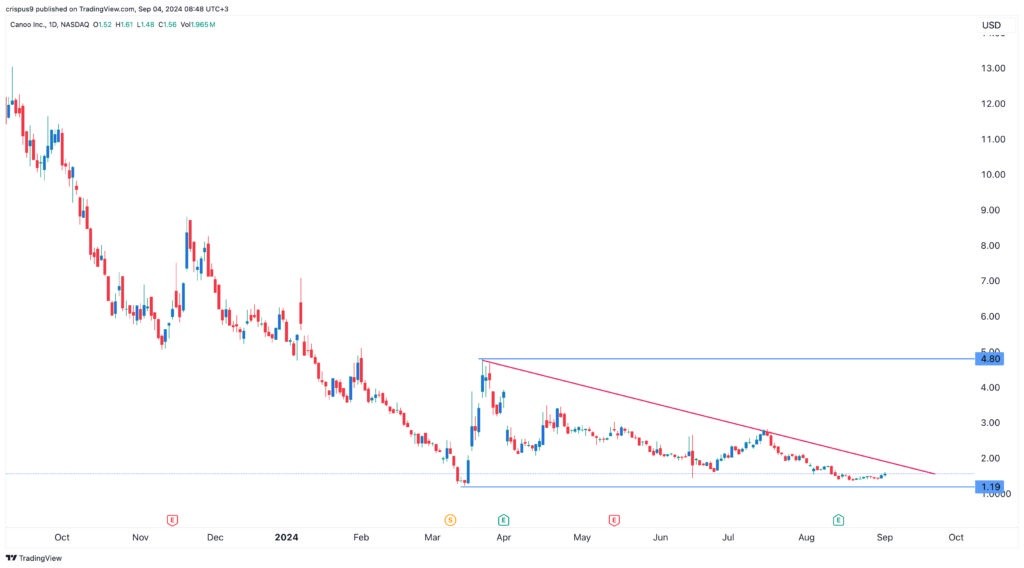
Turning to the daily chart, we see that the GOEV share price has been in a strong bearish trend as concerns about the company have remained. It bottomed at $1.19 in March and then rebounded to $4.48 in April. Most recently, the stock has lost momentum and is approaching the year-to-date low of $1.20.
Canoo shares have remained below the 50-day moving average and formed a descending triangle pattern. Therefore, the outlook for the stock is relatively bearish as going concerns remain. More downsides will be confirmed if it drops below the support at $1.19.
Faraday Future is doing worse

While Canoo is not doing well, Faraday Future is doing much worse. Unlike Canoo, which is building vehicles with a genuine use, Faraday is building luxury electric vehicles that start at over $300,000.
While the market for luxury vehicles is large, I believe that very few people will be comfortable spending $300k for such vehicles. Besides, many who bought vehicles like Porsche Taycan have seen the value of their vehicles tumble. Porsche Taycan EV is losing over $100,000 in value within four years.
Faraday ended the last quarter with total current assets of over $70 million and current liabilities of over $268 million or negative working capital of over $198 million. It had less than $2 million in cash and investments.
Faraday Future is now scheduled to deliver an important statement this month. In it, it will announce that it will start offering its software to Chinese OEMs while still selling its vehicles.
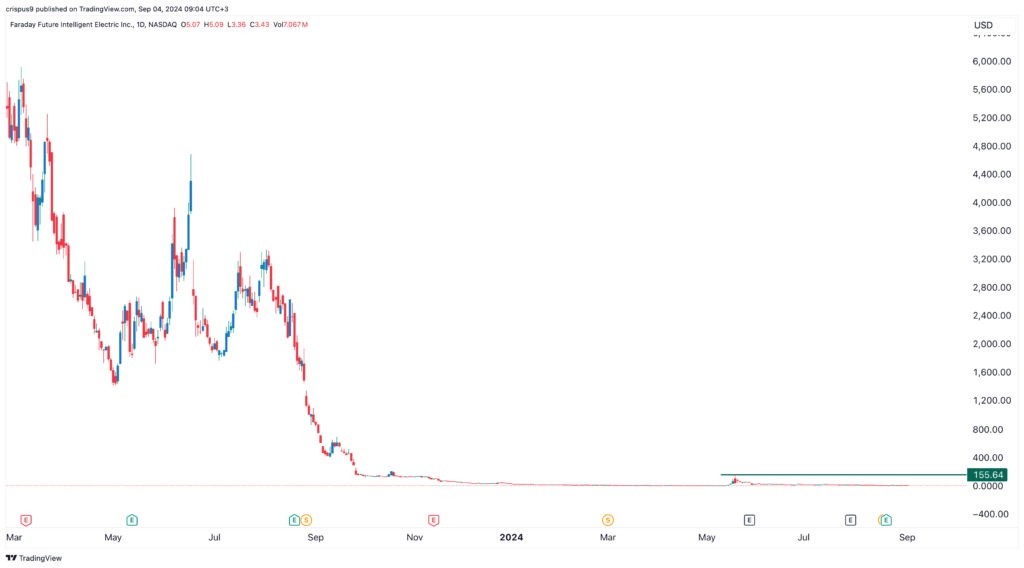
In my last article on Faraday Future, I noted that the stock would drop to below $5. This prediction was accurate as it has crashed to $3.43. If this trend continues, then the stock will crash to below $1 later this year, leading to another reverse stock split.
Remember, the company has implemented three reverse splits in the last 12 months. These splits are mandatory since NASDAQ-listed companies are required to maintain a stock price of over $1 for a certain period.
The post Faraday and Canoo stocks: Do these Tesla wannabes have a future? appeared first on Invezz