


Tesla FSD, entering China within six months?

Tesla is expected to launch Fully Self-Driving (FSD) in China and Europe in the first quarter of 2025, subject to regulatory approval. FSD V12 will go live in 2024 and be pushed in North America. Tesla is investing in an AI supercomputing center to meet the demands of autonomous driving, with FSD accumulating over 1.6 billion miles of driving. Despite the delayed FSD rollout in the Chinese market, Musk expressed his expectation for it to enter China by the end of the year and achieve commercialization in sync with Robotaxi

Science and Technology Innovation Board Daily (ID: chinastarmarket), Author: Song Ziqiao, Cover Image: AI Generated
Today, the Tesla AI team released the product roadmap, expecting to launch Fully Self-Driving (FSD) in China and Europe in the first quarter of 2025, but it is still pending regulatory approval.
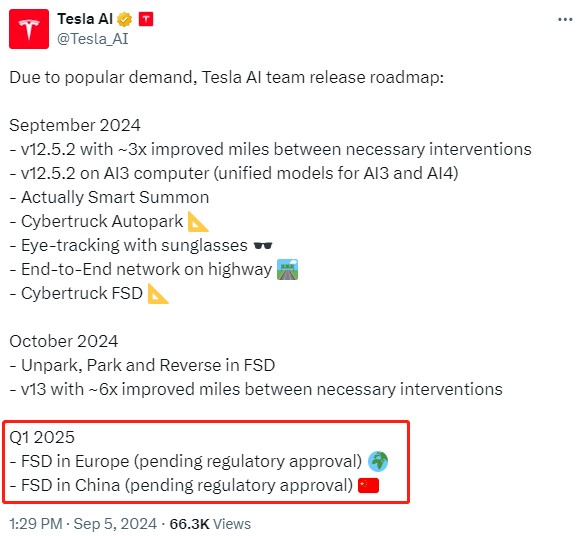
Since 2016, Musk has been exploring Tesla's FSD autonomous driving solution. In 2024, Tesla's FSD V12 was launched and widely deployed in North America. FSD V12 upgrades autonomous driving to an "end-to-end" neural network from perception to vehicle control, with training computing power + data becoming the core barrier.
Currently, FSD iterations are steadily advancing, with the latest 12.5.2 version parameters increased by 5 times from 12.4, merging highway and city technology stacks, further improving driving smoothness. Specific improvements include more natural and earlier lane change decisions, driver monitoring using only the visual system, end-to-end driving on highways, and FSD functions on the Cybertruck.
Meanwhile, Tesla continues to invest in AI supercomputing centers to meet its autonomous driving training computing power needs. As of 24Q2, Tesla's self-built supercomputing center AI computing power exceeds 40,000 NVIDIA H100 equivalent computing power, and is expected to increase to nearly 90,000 by the end of the year.
Musk previously estimated that Tesla's FSD testing mileage needs to reach 6 billion miles to meet global regulatory requirements. According to Tesla's latest financial report, as of the end of Q2, FSD's cumulative mileage exceeded 1.6 billion miles. The company also stated that by the end of the year, FSD's intervention-free driving mileage will exceed that of human drivers, and next year it is confident in achieving unsupervised L5 level autonomous driving.
Since the beginning of this year, Tesla has lowered the FSD price multiple times to attract users. China is an important market for Tesla vehicles, but the timing of FSD's entry into China has been continuously delayed.
Most recently, Musk stated during Tesla's July earnings call that FSD is expected to enter China by the end of the year, and after the release of version 12.6, FSD will land in China, Europe, and other countries, with the unsupervised version expected to achieve commercial deployment synchronously with Robotaxi At that time, he stated that Tesla's autonomous driving technology will not encounter regulatory obstacles in the United States and other regions.
Although Tesla's FSD has not been rolled out in the Chinese market, it was already sold with the Model 3 when it was launched, and a subscription model may be introduced in the future.
Guosen Securities previously stated that in the long term, Tesla is expected to create a series of artificial intelligence terminal carriers (smart driving cars, robots, etc.), empowering new profit models through "hardware cost reduction + software enhancement + Robotaxi shared travel". On the software side, combining FSD software, software store, and subscription services to increase added value, and opening up intelligent driving application scenarios through shared travel.
Ping An Securities further stated that the introduction of FSD to China may become a "catfish" in the domestic autonomous driving field, accelerating the landing process of advanced intelligent driving in China, and leading car companies or suppliers in the advanced intelligent driving field will benefit more.
Understanding Tesla's FSD
Tesla's FSD has iterated from the initial version to V12, with the main technological innovation being the introduction of end-to-end architecture. At the same time, the continuous iteration of Tesla's FSD system signifies that its autonomous driving technology is entering a data-driven rapid development period.
The advantages of Tesla's FSD are:
Algorithm: Achieved deep integration of machine learning throughout the entire autonomous driving process;
Perception: It can perform more difficult driving actions that were previously hard to accomplish, such as relying on real-time road conditions rather than just map-planned routes;
Computing power: Tesla has significantly increased its computing power input, such as using thousands or even tens of thousands of high-performance H100 graphics cards. Tesla also plans to increase the number of GPUs on the basic training platform by two to three times, greatly enhancing data processing capabilities and training.
Currently, Tesla's FSD is implementing a series of promotional policies in the U.S. market. According to the Tesla software tracking website TeslaFi, as of April 26th, among the 19,759 Tesla vehicles registered by its paying users, 7,444 vehicles have installed FSD V12, and 9,724 vehicles have installed FSD V11. The most installed versions are FSD V12.3.4 and FSD V11.4.9, with installation rates of 31.1% and 47.5%, respectively.
Science and Technology Innovation Board Daily (ID: chinastarmarket), Author: Song Ziqiao
