


Behind Broadcom's soaring revenue, there is a "two-tiered" situation: a surge in demand related to AI while non-AI still in the "darkest moment"

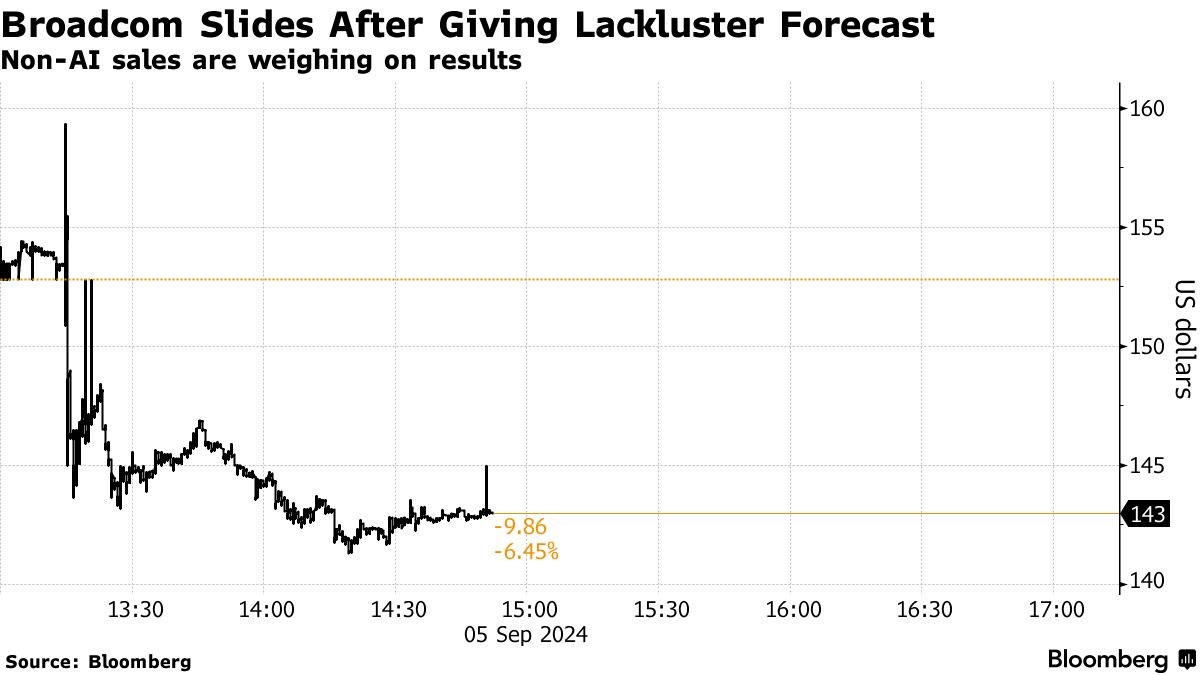
Broadcom's revenue outlook for the fourth quarter is slightly below expectations, mainly due to the drag from non-AI businesses. Despite significant revenue growth from AI, Broadcom's stock price fell over 7% after the financial report was released. The company expects overall revenue of approximately $14 billion in the fourth quarter, lower than analysts' expectations of $14.1 billion. Overall, Broadcom is still benefiting from the AI boom, but growth in non-AI businesses remains weak
According to the financial news app Zhitong Finance, Broadcom (AVGO.US), one of the biggest winners in the global AI boom, announced its financial report for the third quarter of the 2024 fiscal year ending on August 4th, on the morning of September 6th Beijing time. Broadcom is one of the core chip suppliers for Apple (AAPL.US) and other large tech companies, as well as a key supplier for Ethernet switch chips in global large AI data centers and customized ASIC chips in the AI field. After announcing strong quarterly performance and slightly lower-than-expected revenue outlook data, Broadcom's stock fell more than 7% in after-hours trading on the US stock market—similar to the trend of Nvidia (NVDA.US) after announcing its performance. Broadcom's slightly weak revenue outlook is mainly due to the negative drag effect of its non-AI related business.
In terms of performance outlook that Wall Street analysts are focusing on, the company stated in a Thursday statement that it expects overall revenue for the fourth fiscal quarter ending in October to be around $14 billion, slightly below the Wall Street analysts' average forecast of about $14.1 billion.
In the analysts' view, this forecast basically indicates that Broadcom's non-AI business is growing at a much slower pace than the market's expected recovery pace. Although the company has been benefiting significantly from the epic wave of global AI deployment since 2023, the business unrelated to AI is not closely linked to this wealth. The company provides a variety of software and hardware products and services, focusing on Ethernet switch chips, security and data center software, mobile RF chips, data storage devices, and is also a key supplier of customized ASIC chips in the AI field.
After Broadcom announced its financial report, its stock price fell more than 7% in after-hours trading on the US stock market. The stock closed at $152.82 in regular US trading, up 37% year-to-date, significantly outperforming the S&P 500 index, and a staggering 105% increase for the full year of 2023.
In terms of the third quarter performance, for the three months ending on August 4th, excluding some special items, Broadcom's adjusted profit for the third quarter was $1.24 per share, higher than analysts' average expected adjusted profit of $1.22 per share, and higher than the $1.05 per share in the same period last year.
Broadcom's third quarter revenue surged to $13.07 billion, a year-on-year increase of 47%, exceeding analysts' average expectation of about $13.03 billion, driven mainly by the incredibly strong demand for AI-related software and hardware, including strong software business revenue brought by VMware, strong demand for Broadcom's Ethernet switch chips from major data centers worldwide, and strong revenue from jointly creating AI ASIC chips with tech giants like Google and Meta. Compared to a year ago, this company has expanded significantly, partly due to its acquisition of VMware Inc., which focuses on artificial intelligence virtual cloud, for a total value of approximately $69 billion.
In the third quarter, Broadcom's entire semiconductor business unit generated revenue of around $7.27 billion, a 5% year-on-year increase. Benefiting from the strong demand driven by the acquired VMware, Broadcom's Q3 software business unit achieved a revenue of $5.8 billion, a 200% year-on-year growth. VMware's virtual cloud software is considered one of the core software benefiting from the global AI boom.

Looking ahead to next year, Broadcom CEO Hock Tan stated that he still believes there will continue to be strong demand for AI-related hardware and software products.
Hock Tan also mentioned during the earnings conference that most of Broadcom's non-AI chip businesses are either at or about to emerge from their worst phase. Although still far below the levels of a year ago, some of the revenue from these non-AI market segments has started to grow again on a sequential basis. He emphasized that the booking volume, an important forward-looking indicator of future sales, has increased by approximately 20%. He stated that there is no reason to believe that these markets cannot recover to previous high levels.
"Overall, we are essentially bottoming out in the non-AI market, and we expect to see a recovery trend in the fourth quarter," he said during the earnings call with analysts. "There is no doubt that the demand for AI-related products remains very strong."
Broadcom is a leader in RF chips for smartphones like Apple, as well as in the wired and wireless communication fields. In terms of AI underlying hardware, the demand for Broadcom's Ethernet switch chips and AI ASIC chips based on Broadcom's data interconnect technology is extremely strong. Rumors suggest that tech giants like Google and Microsoft often specifically request to purchase Broadcom's Ethernet technology-related core hardware products to equip their large data centers.
Broadcom's Ethernet switch chips are mainly used in data centers and server cluster devices, responsible for efficiently and rapidly processing and transmitting data flows. Broadcom chips are indispensable for building AI hardware infrastructure, as they ensure high-speed data transfer between GPU processors, storage systems, and networks, which is crucial for generative AI applications like ChatGPT, especially those requiring processing of large amounts of data input and real-time processing capabilities, such as Dall-E text-to-image and Sora video-to-text large models. More importantly, Broadcom has now become one of the most important players in the field of custom AI ASIC chips, with Google choosing to collaborate with Broadcom in designing and developing custom ASIC chips, and giants like Microsoft and Meta, as well as more data center service operators, are expected to work closely with Broadcom in the long term to create high-performance ASICs.
Broadcom - The Chip Giant Not to Be Overlooked in the AI Boom
In Broadcom's latest outlook data, the demand for AI-related hardware and software products remains incredibly strong. The company expects the annual revenue scale of AI-related products to reach $12 billion, compared to Broadcom's Q3 total semiconductor business revenue of only $7.27 billion, exceeding analysts' average forecast of $11.8 billion. This forecast further indicates that the revenue gap for the quarter comes from other non-AI areas.
CEO Hock Tan has transformed Broadcom into one of the largest players in the global chip industry through a series of acquisitions. His strategy is to find companies that dominate in certain niche areas, acquire them, and then have them focus specifically on those areas. Tan has also used this approach to expand into the AI software field.
Major tech companies like Google and Meta rely on Broadcom's AI ASIC custom chips and Ethernet switch chips to build their artificial intelligence systems. The company also sells core network hardware covering electric vehicles, smartphones, and numerous internet access devices. Additionally, the company has formally entered the software field in recent years, including large-scale computer software products, network security, and data center optimization products.
Broadcom's Trident series chips are renowned for their high performance, high density, and energy-saving features, making them one of the key technologies for building modern large-scale data center network infrastructure. The latest Trident 5-X12, as part of the series, continues this tradition by providing advanced network bandwidth, low-power operation, high scalability to support the needs of next-generation data center networks, including support for AI training/inference workloads and machine learning workloads. The high performance and high port density of Trident 5-X12 make it ideal for ultra-high-speed network requirements within modern data centers.
The Broadcom Tomahawk series, especially the latest Tomahawk 5, with its unique advantages of high bandwidth, high energy efficiency, low latency, and innovative Co-Packaged Optics (CPO) technology, provides the most advanced network infrastructure solutions for global hyperscale data centers. Tomahawk 5 supports up to 51.2 Tbps of switching capacity, which is currently industry-leading. Tomahawk 5 is integrated into Broadcom's Bailly 51.2 Tbps Co-Packaged Optics (CPO) Ethernet switch platform. CPO technology, by packaging optical engines with switch chips, reduces signal transmission distance and loss, achieving up to 70% power savings. These features not only meet current network demands but also lay a solid foundation for future AI and HPC network applications. Therefore, the Tomahawk series chips are truly Broadcom's "flagship Ethernet switch chips".
On a global scale, some data centers heavily rely on Broadcom's Ethernet switch chips and custom ASIC chip designs to build the underlying infrastructure systems for artificial intelligence, but the company also sells hardware components for automobiles, smartphones, and internet access devices In addition, the company has been continuously expanding into the software field.
More importantly, with its absolute technological leadership in chip-to-chip interconnect communication and high-speed data transmission between chips, Broadcom has become the most important player in the field of ASIC customized chips in the AI field in recent years. For example, Google's self-developed server AI chip - TPU AI acceleration chip, Broadcom is a core participant, and Broadcom and the Google team jointly participated in the development of the TPU AI acceleration chip. In addition to chip design, Broadcom also provides Google with crucial chip-to-chip interconnect communication intellectual property, and is responsible for manufacturing, testing, and packaging new chips, thereby assisting Google in expanding new AI data centers.
The strong demand for Ethernet switch chips and ASIC customized chips closely related to AI can be clearly seen in Broadcom's revenue data for the fiscal years 2023 and 2024, which have consistently exceeded expectations. Especially, ASIC customized chips in the AI field have become an increasingly important source of revenue for Broadcom. Market rumors indicate that tech giants Microsoft and Meta, the parent company of Facebook, are choosing Broadcom as the core partner for their self-developed AI chips. Meta previously collaborated with Broadcom to design Meta's first and second generation AI training acceleration processors, and it is expected that Broadcom will accelerate the development of Meta's next generation AI chip MTIA 3 in the second half of 2024 and 2025.
Furthermore, the formal acquisition of VMware completed in November last year is an important expansion move for Broadcom in the core software business related to AI. VMware's virtualization software (such as vSphere and vSAN) allows data centers and cloud environments to run multiple virtual machines (VMs) on physical hardware, thereby improving resource utilization. AI and machine learning (ML) applications typically require a large amount of computing resources, and VMware's software can effectively manage and allocate these resources to ensure the efficient operation of AI workloads.
Undoubtedly, the long-term growth trend of network security and cloud services closely related to AI will also increase the growth prospects of Broadcom's software infrastructure business VMware. Wall Street analysts expect VMware to become a core business for Broadcom, where Broadcom will create private clouds and virtual hybrid cloud environments for global enterprises and divest non-core assets. VMware's cloud services mainly focus on virtualization and software-defined data center solutions, with its main product being VMware vSphere for building and managing virtualized infrastructure.
Apple is also an important customer for Broadcom: Broadcom provides crucial RF chips for iPhone products. During earnings conference calls, Tan usually updates on the latest developments in the often controversial relationship between Broadcom and the company, discreetly referring to the company as his "North American customer." Tan stated during Thursday's earnings conference call that he expects the next generation of Apple devices, driven by Apple Intelligence AI features, to help drive a quarter-over-quarter revenue growth of about 20% in Broadcom's wireless business in the fourth quarter, despite comparisons with the same period last year This figure will remain flat.
Broadcom - Now and in the Future, One of the Biggest Beneficiaries of the AI Boom
The artificial intelligence spending boom has made Broadcom, along with its chip competitor NVIDIA, the largest and most valuable publicly traded companies in the industry. Although Broadcom does not sell the highly acclaimed data center server AI chips introduced by the AI chip leader NVIDIA, Broadcom provides a range of core hardware components for high-performance computing and large-scale computing networks, including ultra-high-performance Ethernet switch chips crucial for AI data centers. In addition, Broadcom's core leadership position in ASIC customized chips in the AI field has greatly boosted its performance and stock price amid the global AI frenzy.
NVIDIA's so-called data center AI GPUs drive core infrastructure hardware for globally popular generative AI tools like ChatGPT, but Broadcom also fully benefits from the AI boom by providing related AI hardware components and software. Broadcom's Ethernet switch chips and AI field ASIC customized chips built in collaboration with chip giants like Google are crucial for enterprises seeking to build generative AI applications similar to ChatGPT, as well as for the construction of large data centers by tech giants like Google and Microsoft.
According to the latest forecast from the well-known research firm IDC's "Global Artificial Intelligence and Generative Artificial Intelligence Spending Guide," the organization predicts that by 2028, global spending on artificial intelligence (AI) (with a focus on AI-supported applications, AI chips, AI infrastructure, and related IT and business services) will at least double from the current level, reaching approximately $632 billion. Artificial intelligence, especially generative artificial intelligence (GenAI), is rapidly integrating into various end devices and products, with IDC forecasting a compound annual growth rate (CAGR) of 29.0% in AI spending from 2024 to 2028.
IDC points out that software or applications will be the largest category of AI technology spending, accounting for over half of the entire AI market in most forecasts. IDC predicts a five-year compound annual growth rate of 33.9% for AI software. IDC forecasts that spending on AI-related hardware (including servers, storage devices, and infrastructure as a service) will become the second largest technology spending category.
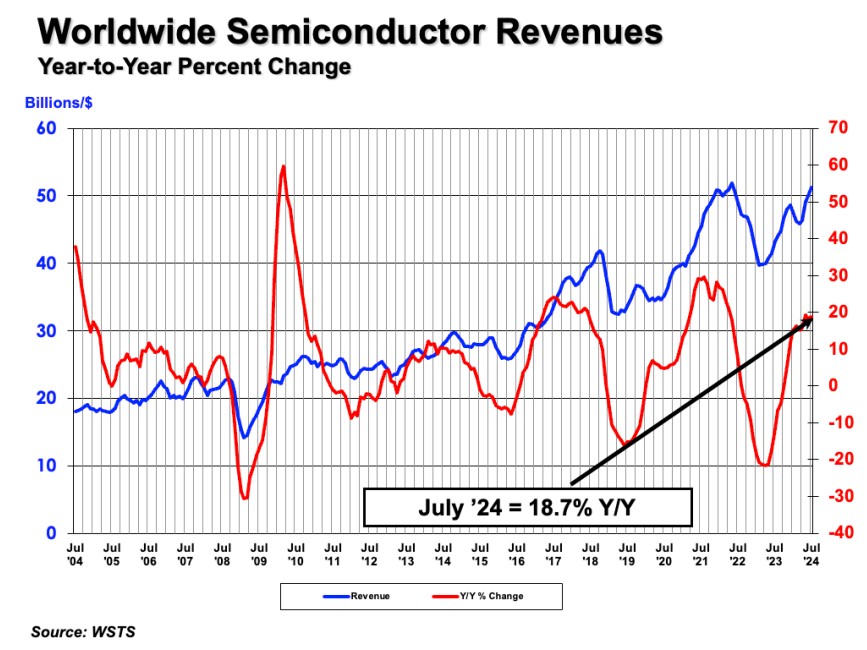
The chip industry's recovery trend led by AI chips is becoming increasingly clear. Data recently released by the Semiconductor Industry Association (SIA) shows that in the second quarter of 2024, global semiconductor industry sales totaled a high of $149.9 billion, an 18.3% increase from the second quarter of 2023, and a 6.5% increase from the already strong first quarter of 2024. Global semiconductor industry sales in July reached $51.3 billion, an 18.7% increase from July 2023, and a 2.7% increase from June 2024's $50 billion
The current AI chip and related hardware demand can be described as extremely strong. With the iteration of large AI models and the vigorous development of AI applications, this trend is likely to continue for a long time in the future. TSMC's management recently stated at an earnings conference that the demand for CoWoS advanced packaging required by chip companies like NVIDIA is expected to continue to outstrip supply until 2025, with a slight easing possible in 2026.
Wall Street bulls believe that the recent tech stock pullback has squeezed out most of the "AI bubble", and in the future market, tech companies that can continue to profit in the AI wave are expected to enter a new round of "major uptrend" surge. Popular chip stocks such as NVIDIA, AMD, TSMC, Intel, and Broadcom are among those expected to benefit. Chips are essential core infrastructure for popular generative AI tools like ChatGPT, making these popular chip stocks the biggest winners in the AI boom.
Prior to Broadcom's latest earnings announcement, many Wall Street investment firms had strongly bullish target stock prices for the company over the next 12 months. Bank of America mentioned in a research report that investors should focus on three major investment themes in the chip industry: cloud computing, automotive chips, and "complexity". Both Broadcom and NVIDIA are "preferred chip stocks" in Bank of America's core stock list, with the institution setting Broadcom's target stock price at $215 over the next 12 months, compared to Broadcom's latest closing price of $152.82
