Tencent Cloud crosses over the mountains

The moment of profitability is getting closer
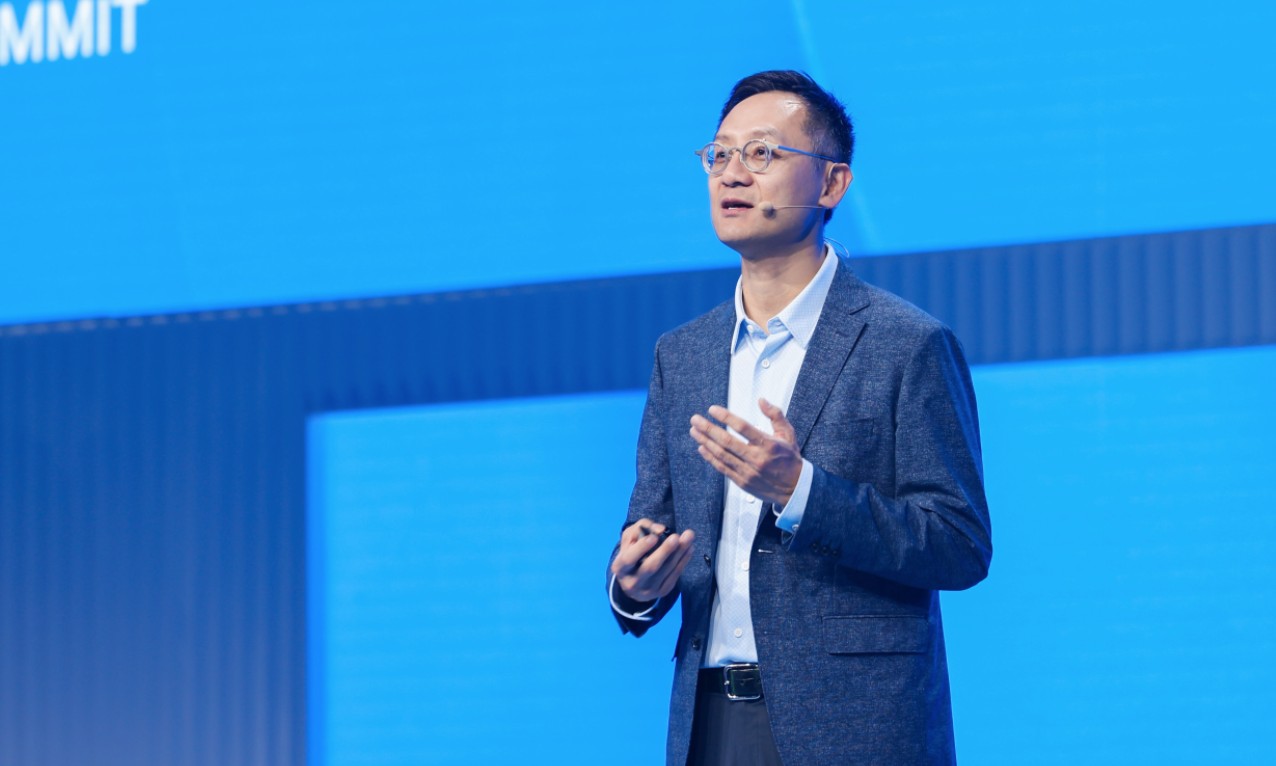
Tencent Group's Senior Executive Vice President and CEO of Cloud and Smart Industries Business Group, Tang Daosheng
Author | Huang Yu
Editor | Zhou Zhiyu
Over the past two years, Tencent Cloud has defied the odds and found its own "Journey to the West", and now it is getting closer to shore.
On September 5, 2024, at the Tencent Global Digital Ecosystem Conference, Tang Daosheng, Senior Executive Vice President of Tencent Group and CEO of Cloud and Smart Industries Business Group, revealed to Wall Street News that he is generally satisfied with the results of the transformation over the past two years. Tencent Cloud has significantly reduced losses this year compared to last year, and the goal of profitability is not too far away.
By cutting off the burden of large-scale integration and focusing on self-research while promoting integration, Tencent Cloud's internal reform has opened up a new situation.
As the moment of profitability draws closer, Tencent Cloud has also found three new growth tracks for the future: AI, going global, and integrated innovation. These three new tracks are expected to become the focus of Tencent's future development as they provide new growth engines for industry development.
In the past year, various industries have faced "zero-sum game" competition and anxiety about large models. In Tang Daosheng's view, if the cake does not grow, the result is a zero-sum game, and everyone will be very painful.
Standing at the starting point of the second decade, Tencent's ToB business, which has been laid out for many years, has come to an important window of development under the influence of waves such as AI and going global, and is expected to benefit more from the industrial internet.
However, as a business that Ma Huateng once described as particularly difficult, Tencent Cloud no longer wants to be constrained by scale and rankings. In the increasingly fierce competition in the cloud market today, it values more whether it can be the first in its own advantageous track.
The cloud service industry is undergoing a profound transformation, and only those who strive for change and break free from zero-sum games may become winners in the second half.
Transformation
Tencent Cloud's transformation began in 2022. In that year, facing internal and external challenges, Tencent Group, feeling the crisis, overall initiated a reform core around reducing costs, increasing efficiency, and converging focus. Tencent Cloud was then stopped from its development model of large-scale integration and instead shifted to a strategic route of self-developed products and integration.
Internally, Tencent believed that Tencent Cloud should not be swayed by external voices about falling behind other cloud vendors in rankings and lagging behind, losing its unique advantages.
By the beginning of this year, Tencent Group once again required that, except for strategically important products and basic investments, many products of Tencent Cloud must be launched as soon as possible. Against this backdrop, Tencent Cloud internally also set a goal to achieve a balance between revenue and expenses this year.
Due to the significant adjustments in the business model, the transformation process of Tencent Cloud is undoubtedly full of challenges. Tencent Cloud must withdraw from a large number of total package projects that are charging ahead and take on the role of a product company, which is also a transformation that Tencent Cloud must make as the domestic cloud computing industry transitions from barbaric growth to rational development.
As the leader of Tencent Cloud, Tang Daosheng is satisfied with the results of the transformation over the past two years. He believes that the transformation has made Tencent Cloud's business more focused, and at the same time, it has allowed the team to have a better understanding of their products, know their shortcomings, and enhance their capabilities in more important areas In this process, the development path of Tencent Cloud has become clearer, understanding more about which issues of customers can be solved through Tencent Cloud's products, and which partners can be chosen to serve together.
Tang Daosheng pointed out that Tencent Cloud will continue to follow the established strategy, insisting on self-research and integration.
Reflected in performance, Tencent Cloud's strategic transformation has achieved good results.
According to Tencent's financial report, in the second quarter of this year, Tencent achieved a revenue of 161.12 billion RMB, an 8% year-on-year increase, higher than the growth rate of the previous two quarters; Non-IFRS net profit attributable to equity holders increased by 53% year-on-year to 57.31 billion RMB, exceeding market expectations. Enterprise services have contributed to revenue growth in double digits, becoming an important driver for Tencent to stabilize performance and significantly increase profits.
Regarding the highly anticipated profit situation, Tang Daosheng told Wall Street News, "We have a relatively rigorous financial model for managing the business. In many aspects, we have set higher requirements for our team in the industry. I think achieving a balance between profit and loss is a matter of time, and we are not far from that point. There are also many expectations from the headquarters."
In addition, Tencent Cloud released a report card: in three years, the number of partners with revenue exceeding one million has increased by 150%; in two years, Tencent Meeting partner revenue has grown by 355%; in the past year, AIGC-related product partner revenue has increased by 550%, SaaS partner revenue has grown by 100%; since the beginning of this year, partner public cloud revenue growth rate has been 1.5 times higher than the market average growth rate.
Over the past three years, Tencent Cloud has strengthened its channel ecosystem to sell its self-developed products and promote product integration. Tencent has stated that in the future, partner-contributed revenue will account for 50% of the overall market, becoming a sales channel parallel to the direct sales team.
After going through a difficult transformation period, Tencent Cloud will leverage the power of partners to embrace a rare opportunity period.
Future
Going back to 2013, at that time, Tencent, which was in the limelight, proposed to retract its sharpness and return to its expertise in communication and social networking, launching the "Internet+" and "Connect Everything" strategies. Against this backdrop, Tencent Cloud, which has accumulated rich cloud experience, officially opened up to society, becoming the soil for Tencent to "connect everything."
With the gradual decline of China's mobile internet population dividend, Tencent underwent a rare organizational restructuring in 2018, with ToB becoming the key word of this transformation, dedicated to "rooted in consumer internet, embracing industrial internet," and the "Cloud and Smart Industry Business Group" (CSIG) was also established.
Tencent Cloud is highly anticipated. Tang Daosheng once said that if, in the past 20 years, the important progress of the Internet has been concentrated in the ToC field; then in the next 20 years, the important development of the Internet will come from the ToB field. The integration of the Internet and industry is the general trend. Tencent is determined to mobilize the entire company to welcome the arrival of the industrial Internet era.
After several years of rapid development, in recent years, the domestic cloud service market has reached its peak in terms of stock, and cloud service providers are fiercely competitive. Tencent Cloud's growth rate has also slowed down, but it still maintains its position in the top tier in China.
IDC data shows that by 2023, the overall market size of China's big data platform will reach 179.3 billion RMB, a 24.6% increase compared to 2022. Huawei occupies the overall first place with a market share of 24.7%; Alibaba holds 19.5% market share, ranking second overall; Tencent ranks third.
As an important strategic business of Tencent, Tencent Cloud must find a brighter future. While striving to achieve a balance between revenue and expenses, finding new growth opportunities has been an important task for Tencent Cloud in recent years.
After a period of exploration, Tencent Cloud has now clearly defined three main growth paths, namely AI, going global, and integrated innovation.
The huge market space brought by AI large models is evident, with various industries participating in this wave. In the words of Pony Ma, AI large models present a once-in-a-century opportunity, similar to the industrial revolution of inventing electricity.
In September last year, Tencent also launched its own Hybrid Large Model. With the underlying technology of AI large models still evolving and the commercialization path for end consumers unclear, Tencent chooses to focus on "AI closest to the industry", first serving Tencent's own business and then opening up large model capabilities to the industry through Tencent Cloud.
It is reported that the Hybrid Large Model has been implemented in over 700 Tencent business scenarios and is making efforts to take root in various industries.
In this wave of AI enthusiasm, Tencent Cloud's related revenue has increased, but specific data is still difficult to quantify. However, it is clear that there is a significant demand from customers for computing power.
Going global is now as popular as AI and has become the consensus of most Chinese companies. As companies go global to find new market growth points, it also brings incremental demand for cloud services.
Tencent Cloud can provide technical product capabilities for overseas companies going global, including audio and video, edge acceleration, cloud-native products, big data and databases, security and compliance, AI, and more. Currently, Tencent Cloud has successfully served over 10,000 overseas customers.
In recent years, China has been vigorously promoting integrated innovation development, with more and more requirements for localization and autonomy from government and state-owned enterprises, which also brings new opportunities for cloud providers.
Pony Ma revealed that Tencent Cloud has developed domestically produced enterprise-level software for full-stack independent innovation, positioning itself at the forefront among integrated innovation providers.
Although three important development tracks for the future have been proposed, Pony Ma once again emphasized that market rankings are not a concern. "From a management perspective, what I ask of the team is more about how to achieve first place in the track. Because the data provided by various vendors may differ, competing in important product tracks may be more accurate and meaningful."
In Pony Ma's view, Tencent Cloud has "top-notch products" in all aspects, such as high-performance computing and StarNet at the IaaS layer; databases, audio and video, security products at the PaaS layer; and connection software like Tencent Meeting at the SaaS layer. These are all Tencent Cloud's advantageous tracks.
With new market opportunities, all cloud service providers are watching closely. Faced with opportunities and challenges, Tencent Cloud must bring out more competitive products and ecosystem strategies to further advance and become the second growth curve of Tencent Group, even realizing its ambition to "connect everything."
This time, Tencent Cloud must go all out