


202 billion in six months! How BYD became the "King of R&D" in A-share market

BYD topped the A-share R&D expenditure list for the first time in the first half of 2023 with an R&D investment of 20.2 billion yuan, becoming the "King of R&D". Its operating income reached 301.127 billion yuan, a year-on-year increase of 15.76%, with a net profit of 13.631 billion yuan, a year-on-year increase of 24.44%. Among independent brands, BYD's R&D investment has significantly increased, ranking highest compared to its industry peers, and has always attached importance to technological research and development. It is expected that R&D investment will reach 50 billion yuan in 2024
In recent years, with the rapid development of Chinese car companies in technology, brand, service, and a profound understanding of the local market and consumer demand, electrification has weakened the technological barriers of traditional fuel vehicles, and the market share of Chinese brands continues to rise. This trend is evident in the 2024 semi-annual reports recently disclosed by major mainstream listed car companies.
The financial report shows that BYD (002594.SZ) achieved a first-half operating income of 301.127 billion yuan, a year-on-year increase of 15.76%, surpassing SAIC Group for the first time and ranking first among domestic mainstream car companies. In addition, BYD's net profit in the first half of the year reached 13.631 billion yuan, a year-on-year increase of 24.44%, also ranking first in the industry.
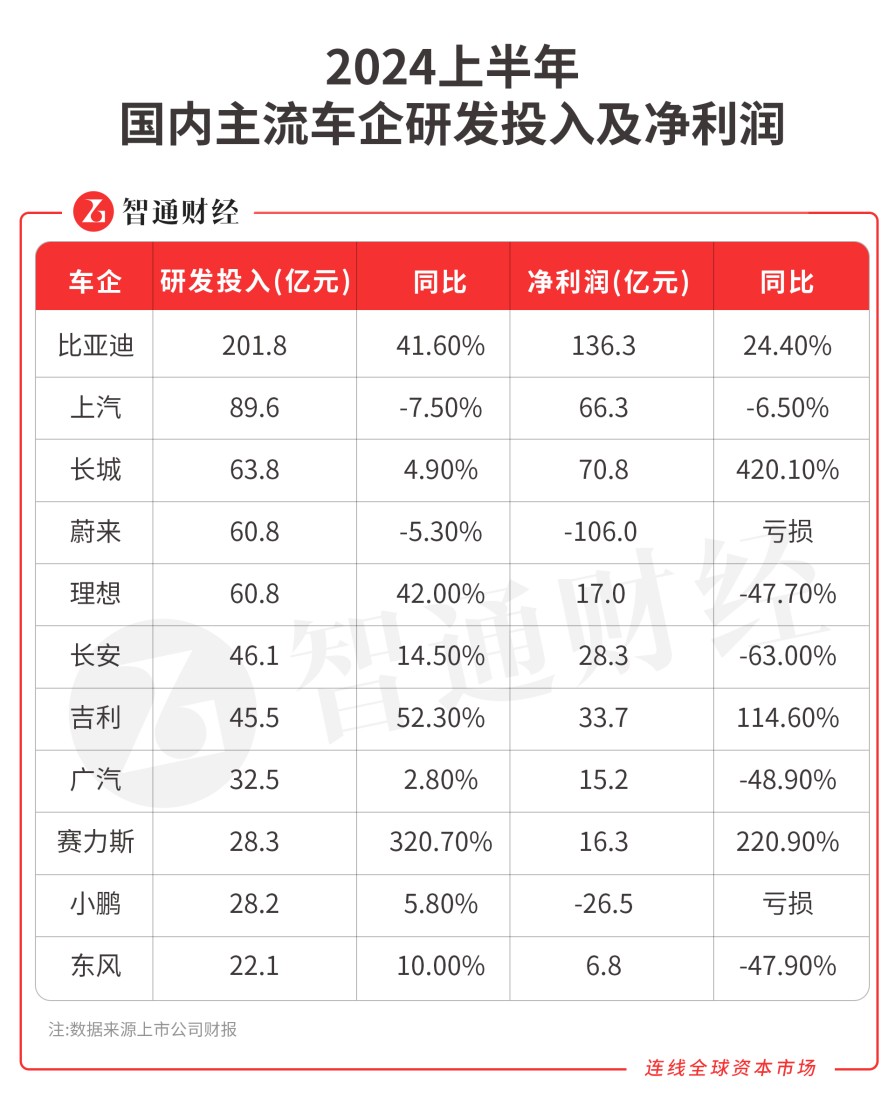
From the financial report, it is not difficult to see that the operating income of independent brands in the first half of the year has grown rapidly. In addition to BYD, brands such as Geely, Great Wall, Sylphy, Li Auto, Nio, XPeng, etc., have seen rapid revenue growth.
In contrast, the once considered "cash cows" and major profit contributors to large automotive groups, joint venture brands are no longer shining. The profits of mainstream joint venture brands have almost all declined, with GAC Group's joint venture profits falling by 40% year-on-year in the first half of the year, Dongfeng Group's joint venture profits falling by 46% year-on-year, and SAIC-GM recording a loss of 2.275 billion yuan.
Behind the high-speed growth of independent brand performance is the comprehensive surpassing of product strength achieved through massive R&D investment. Taking BYD as an example, the R&D investment in the first half of the year ranked first, reaching 20.2 billion yuan, a year-on-year increase of 42%, hitting a historical high, which is 6.6 billion yuan higher than the net profit for the same period. Looking at the first half of the year, BYD's R&D investment exceeds that of Tesla (16.1 billion yuan), almost equal to the sum of Great Wall Motors (6.38 billion yuan), Li Auto (6.08 billion yuan), Geely Auto (4.55 billion yuan), and Changan Auto (4.61 billion yuan).
The significantly higher R&D investment compared to net profit is another proof of BYD's high emphasis on technological research and development. If we compare R&D investment with net profit, in the past 14 years (from 2011 to present), BYD has had 13 years where R&D investment exceeded net profit, sometimes even several times the net profit for the same period. Based on the current momentum, it is estimated that BYD's full-year R&D investment in 2024 is expected to reach the 50 billion yuan level.
Furthermore, looking at the entire A-share market, Wind data shows that BYD has topped the R&D expense list for the first time in the first half of this year, becoming the "king of R&D" among over 5300 listed A-share companies.
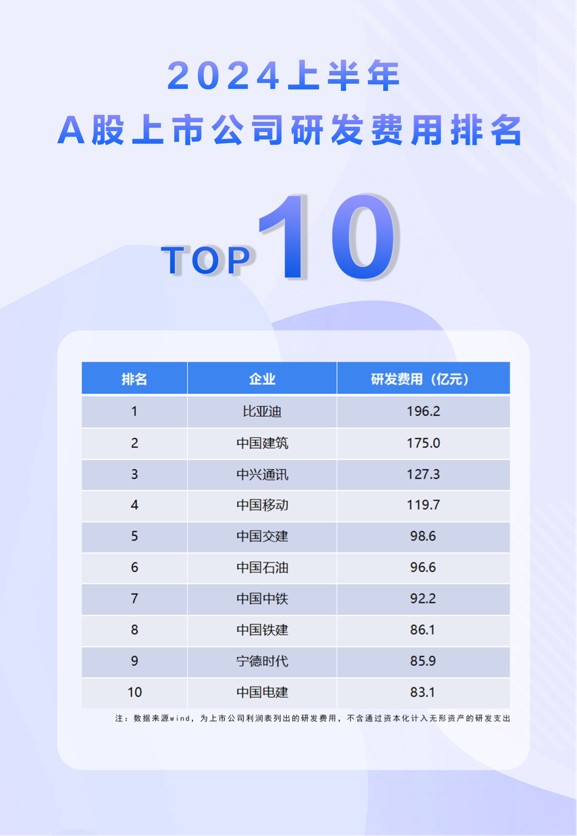 The long-term, high-intensity R&D investment has enabled BYD to establish a large technology talent pool. Since the beginning of this year, BYD has successively released disruptive technologies such as the Xuanji architecture, the fifth-generation DM technology, and the Easy Three-Way, providing strong support for rapid sales growth.
In the first half of this year, BYD achieved sales of 1.61 million vehicles, ranking first in the Chinese automotive market and also becoming the champion of the global new energy vehicle market. In 2023, BYD will enter the top ten in global vehicle sales for the first time. According to MarkLines data, in the second quarter of this year, BYD's sales surpassed Honda, making it the seventh largest global automaker in terms of sales. According to the latest data from Yiche Bang, BYD's monthly sales in July have risen to third place globally, behind only Toyota and Volkswagen.
The leading position of domestic brands surpassing that of joint venture brands comprehensively confirms the increasingly solid position of Chinese brands in the domestic market, and also demonstrates the irreversible trend of new energy vehicles replacing fuel vehicles.
In July of this year, the monthly penetration rate of new energy vehicles exceeded 50% for the first time, a figure expected to continue to rise in August. Nio Chairman Li Bin believes that the domestic penetration rate of new energy vehicles has already exceeded 50%, whether pure electric vehicles or plug-in hybrid vehicles, they will accelerate the replacement of fuel vehicles. He predicts that within 2 years, the penetration rate of China's new energy vehicle market can exceed 80%. In the next few years, joint venture fuel vehicles will face significant challenges, as their market share will be taken over by new energy vehicles.
The current round of eliminations in the automotive industry is already more than halfway through, with all car companies seeking ways to survive. Chinese brands are accelerating, leaving little time for joint venture fuel vehicles
