


Increasing revenue without increasing profits, ineffective transformation, beware of the Haidilao "story" trap

In the first half of 2024, Haidilao released its financial report, showing an increase in revenue but a decrease in profit. The revenue was 21.491 billion yuan, a year-on-year increase of 13.8%; net profit was 2.08 billion yuan, a year-on-year decrease of 9.7%. Due to the reduction of direct-operated stores and the unclear benefits of the franchise model, the revenue growth slowed down, and the net profit margin decreased to 9.68%. The company proposed four major reforms to cope with the difficulties, but the effects were limited, facing fierce market competition
Increased revenue but decreased profitability, what is the reason behind Haidilao's (06862) slowing revenue growth and declining profit margins after opening up franchising?
According to the Zhitong Finance APP, Haidilao's financial report for the first half of 2024 showed a revenue of 21.491 billion yuan, a year-on-year growth of 13.8%, a slowdown of 10.82 percentage points compared to the same period last year. The net profit attributable to shareholders was 2.08 billion yuan, a year-on-year decrease of 9.7%, with a net profit margin of 9.68%, a decrease of 2.28 percentage points compared to the same period last year. As of June 2024, the company had 1,343 restaurants, a decrease of 39 compared to the same period last year.
The slowing revenue growth of Haidilao is partly due to the reduction of directly operated stores, with nearly 40 stores no longer contributing revenue, and the franchise model having limited contribution in its early stages. On the other hand, the decrease in average spending per customer was offset by an increase in table turnover rate. In the first half of the year, the company's average table turnover rate was 4.2 times per day, an increase of 0.9 times compared to the same period last year, with an average per capita consumption of 97.4 yuan, a decrease of 5.3% year-on-year.
Looking at the company's performance history, from 2015 to 2019, both revenue and net profit maintained double-digit growth. During the three years of the pandemic (2020-2022), the first two years still saw revenue growth, but in 2022, the company couldn't withstand the decline, resulting in a cumulative net loss of 2.48 billion yuan over three years, with a loss of over 4 billion yuan in 2021. In 2023, after the end of the pandemic, the company fully enjoyed the catering recovery opportunity, with significant recovery in revenue and profit. However, the sustainability was poor, and in 2024, intensified industry competition and ineffective transformation led to the company falling into a situation of increased revenue but decreased profitability in the first half of the year.
Loud thunder, light rain, "Four Major Reforms" Ineffective
In the first half of 2024, according to Haidilao's financial report, the company made four major reforms to reverse the current situation: first, advancing the "three-table" work, each doing its own job; second, implementing a multi-store model, more work, more rewards; third, promoting the franchise model to penetrate the market; fourth, advancing the "Red Pomegranate Plan" to incubate more new brands. Among these four major reforms, the franchise model and the "Red Pomegranate Plan" had a significant impact on performance.
In March of this year, the company announced that it would start implementing a franchise operation model for Haidilao restaurants, attempting to expand the restaurant network in lower-tier cities through a diversified operation model.
However, Haidilao's requirements for franchisees are very strict. By introducing franchisees in the mode of directly operated stores, the rules, standards, assessment mechanisms, and process systems are consistent with those of directly operated stores. Since the announcement of the opening, the company has received over 10,000 franchise applications, mainly from third-tier and below cities. However, in the first half of the year, only one franchise store was successfully opened, and the progress of franchisees fell far short of expectations.
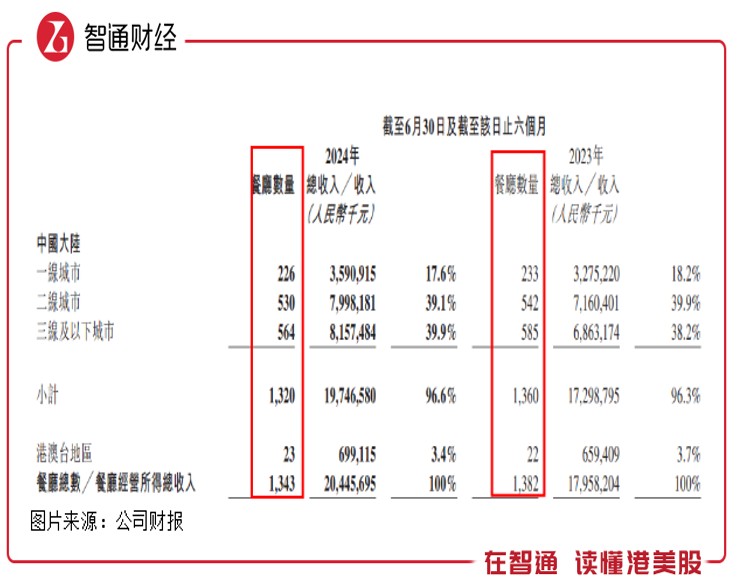 On one hand, franchise stores are slow to open, while on the other hand, the number of directly operated stores continues to decrease. In the first half of 2024, compared to the first half of 2023, Haidilao closed a net total of 7 stores in first-tier cities, 12 stores in second-tier cities, and 21 stores in third-tier and below cities. It can be seen that the company closed more stores in lower-tier cities, raising doubts among investors about its operational capabilities of directly operated stores in these cities. The same requirements for franchise stores as for directly operated stores in lower-tier cities are also likely to affect the investment enthusiasm of franchisees.
In August of this year, the company appointed Zhang Junjie, a post-90s individual, as an independent non-executive director, mainly responsible for supervising the board of directors of Haidilao and providing independent judgment. Zhang Junjie founded the Bawang Tea Princess brand in 2017, rapidly expanding through a franchise model and making a name for himself. Haidilao's invitation to Zhang Junjie is clearly due to his exploration of franchisees and diversified business strategies, hoping that Zhang Junjie can break the deadlock in this area.
If the franchise model is Haidilao's vertical expansion, then the diversified multi-brand strategy is its horizontal expansion—known as the "Red Pomegranate Plan," which encourages the incubation and development of more dining new brands. In the first half of the year, the company had a total of 5 operating entrepreneurial projects, such as "Flame Please BBQ" and "Xiao Hai Hot Pot," including barbecue, hot pot, and Chinese fast food.
Haidilao's Red Pomegranate Plan is different from its peers' multi-brand strategies, such as Xiabu Xiabu's "Coucou" and Jiulaojiu's "Tai'er." The development of diversified multi-brand strategies by peers is mainly company-led investment, with a focused direction and relatively clear development goals, while Haidilao's multi-brand strategy is very loose.
The Red Pomegranate Plan seems to deeply bind employees and company development, but it poses significant risks for the company. Most are entrepreneurial incubation projects with high investment risks, and more importantly, the new brands lack directionality. The lack of focus in diversification brings about significant uncertainty in brand development, leading to the failure of the diversified strategy.
Financial reports show that in the first half of 2024, Haidilao's operating revenue from other restaurants was 182 million yuan, accounting for only 0.8% of revenue, contributing very little to performance and almost imperceptible. In fact, even before the epidemic, Haidilao had already laid out a multi-brand operation, exploring other segmented dining tracks beyond hot pot, but to date, it has not yielded results. Considering the current overall insufficient consumer demand and the increasingly fierce competition in the catering industry, we believe that Haidilao's multi-brand strategy has limited room for imagination in the short to medium term, and its performance prospects still depend on Haidilao's restaurant business.
Intensified Competition, Performance Pressure in the Second Half of the Year
Against the backdrop of intensified competition in the catering industry, the restaurant business, which is the performance foundation of Haidilao, will face significant challenges in the second half of the year in terms of average customer spending, number of stores, table turnover rate, profit margin, and other aspects.
Data shows that from 2020 to 2023, Haidilao's overall average customer spending was 110.1 yuan, 104.7 yuan, 104.9 yuan, and 99.1 yuan, respectively, and dropped to 97.4 yuan in the first half of this year. As the catering industry enters the era of "consumption downgrade" to 9.9 yuan, Haidilao's sub-brand hotpot base has also been priced at 9.9 yuan, and the prices of some dishes have been lowered. It is expected that the average customer spending will continue to decline in the second half of the year In terms of the number of stores, as of the end of June 2024, the company had a total of 1,343 restaurants, a decrease of 31 from the end of 2023, and a decrease of 39 compared to the first half of 2023. Although the company's management stated that they would accelerate store openings in the second half of 2024, the number of Haidilao stores has not shown significant growth since the large-scale closure of inefficient stores in 2022. With subdued consumer demand, a conservative franchise model, and relatively high customer spending, Zhitong Finance believes that Haidilao's store expansion and penetration space are limited.
In terms of table turnover rate, Haidilao's average table turnover rate in the first half of 2024 rose to 4.2 times per day, compared to 3.3 times per day in the same period last year, driving same-store revenue growth. However, in the second half of the year, maintaining the same momentum of expansion as in the first half by keeping the turnover rate at the same level becomes more challenging due to the rising base of the turnover rate and the perceived decline in dining service quality by consumers, leading to higher uncertainty.
Haidilao's core operating profit in the first half of 2024 was 2.799 billion yuan, a year-on-year increase of 13.0%. However, compared to the 13.8% year-on-year revenue growth, the core operating profit growth rate was 0.8 percentage points lower, leading to a year-on-year decrease in core operating profit margin. The net profit margin was 9.68%, a year-on-year decrease of 2.28 percentage points. According to a report by Pu Yin International, in the second half of the year, with limited room for turnover rate improvement and reduced operating leverage, Haidilao's profit margin may face greater pressure than in the first half of the year.
On September 4th, a report by CICC pointed out that Haidilao is expected to continue facing certain pressures in the second half of the year, including macroeconomic drag, high base of same-store sales, and increased employee costs. The same-store sales growth is expected to be at most 5%, and the net profit forecast for Haidilao for the years 2024 to 2026 is revised to decrease by 7%, decrease by 1%, and increase by 4%, respectively. At the same time, the target price for Haidilao was lowered from HKD 21.52 to HKD 15.94.
Valuation is still exploring the bottom, beware of the "story" trap
It is worth noting that as Haidilao faces increasing operational pressures, its balance sheet has also experienced "anomalies" - the most significant change being a significant decrease in property, plant, and equipment, which is related to the company's significant annual depreciation and amortization. It can be seen that the company's fixed assets (property, plant, equipment, and intangible assets) have been decreasing every year, from 19.628 billion yuan in 2020 to 6.463 billion yuan, while property, plant, and equipment have decreased from 12.064 billion yuan to 3.255 billion yuan, a decrease of over 70%.
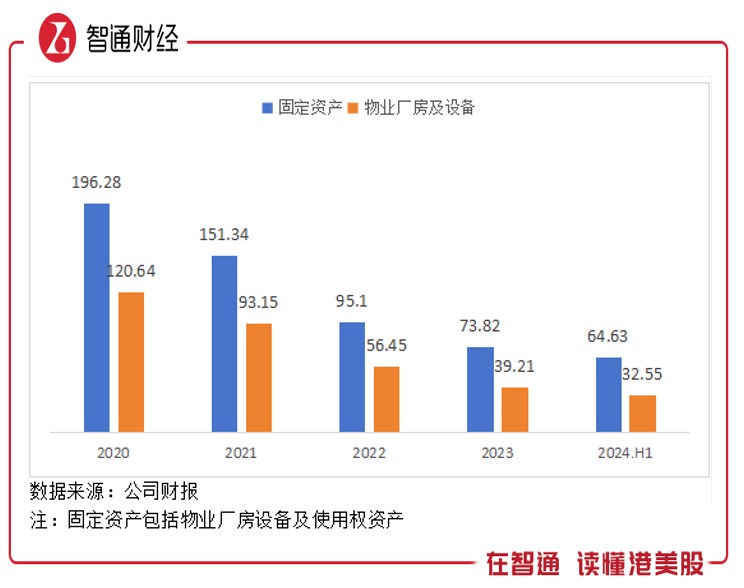
This depreciation and amortization are likely accounting maneuvers. From 2020 to the first half of 2024, Haidilao has incurred expenses totaling 14.789 billion yuan, accounting for 21.5% of fixed assets based on expenses in the first half of the year. During this period, the total number of company restaurants has increased, with 1,343 stores in the first half of 2024, an increase of 45 stores compared to 2020. It is worth noting that these are all directly operated stores, and considering that the assets are consistent across each store, the scale of asset growth for the company can be imagined Currently, Haidilao has announced its active development of a franchise model, not only in line with industry trends, but also to offset this part of the property, plant, and equipment assets on its financial statements. In addition, the company will continue to reduce the number of directly operated stores in the later period, leading to a decrease in depreciation and amortization expenses, and the performance is expected to return to a normal profit level. Therefore, Haidilao can continue to tell the story of light assets to the market, aiming to "easily come ashore" amidst increasing operational pressures.
In summary, Haidilao's performance has certain volatility. This year, it attempted to turn the situation around through the "four major changes," but the progress of new businesses is slow, making it difficult to create a new growth curve in the short to medium term. Coupled with the overall weakness in social consumption and the catering industry, the uncertainty of its performance growth has increased. Although the valuation has dropped by 80% from its peak, it may continue to decline. Investors need to be vigilant and guard against the "light asset" story trap
