


China Literature has finally become the way Tencent hoped | DoNews Finance

China Literature Group announced the establishment of a film and television production system in cooperation with Tencent Pictures and New Classics Media. Despite New Classics Media's underperformance and China Literature's significant losses in 2020, the financial report for the first half of 2024 showed a 27.7% increase in revenue to 4.191 billion RMB and a 33.9% increase in net profit to 504 million RMB. The strong performance of the IP business drove the overall revenue growth

Editor | Li Xinma
Caption | IC Photo
On October 19, 2020, China Literature Film and Television, together with Tencent Pictures and New Classics Media, held a joint press conference in Shanghai, marking the first appearance of the three companies as a whole film and television production system, announcing Tencent's establishment of the "three pillars" in the film and television business.
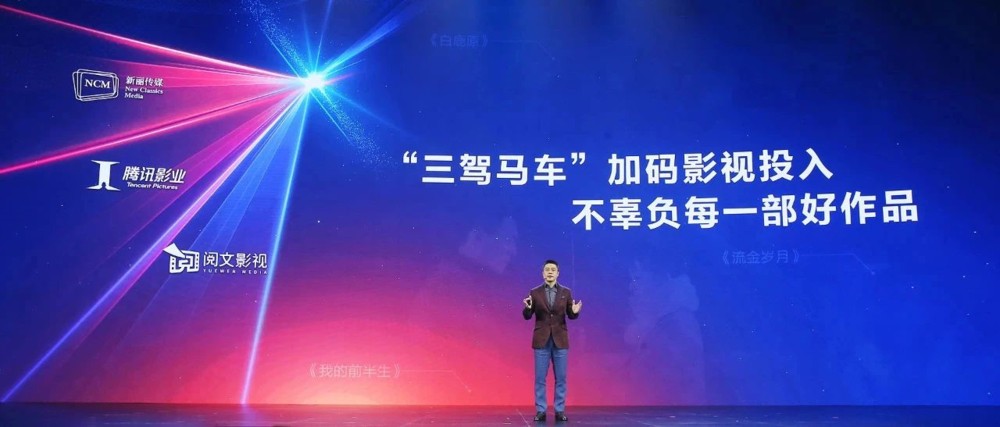
Image Source: China Literature Official
Half a year ago, on April 27, China Literature Group announced that co-CEO Wu Wenhui, Liang Xiaodong, President Shang Xuesong, and Senior Vice President Lin Tingfeng, among other members of the executive team, the founding team of China Literature, had "retired" and resigned from their management positions. Cheng Wu, then Vice President of Tencent Group and CEO of Tencent Pictures, became the second leader of China Literature.
During Wu Wenhui's tenure, online business has always been the focus of China Literature, accounting for up to 70% of total revenue. In terms of copyright operations, there was no excessive dependence on Tencent. However, in August 2018, with China Literature's acquisition of New Classics Media for 15.5 billion, the focus of China Literature's business model shifted from online literature payment to IP business.
Although in the following three years, New Classics Media's performance did not meet expectations, a performance-based agreement was signed at the time of acquisition: from 2018 to 2020, New Classics Media's net profit should not be less than 500 million, 700 million, and 900 million respectively. In reality, New Classics Media only achieved 324 million, 549 million, and 429 million respectively. However, in 2020, China Literature announced that due to the pandemic, they had modified the performance-based agreement with New Classics Media, which was completed in 2020.
In the same year, China Literature suffered a loss of 4.484 billion, mainly due to impairment provisions for goodwill and trademark rights from the acquisition of New Classics Media (40.159 billion and 3.898 billion respectively).
Clearing obstacles and providing full support, this is Tencent's attitude towards China Literature's transformation. But is it worth it? Recently, China Literature released its financial report for the first half of 2024, and the answer is beginning to emerge.
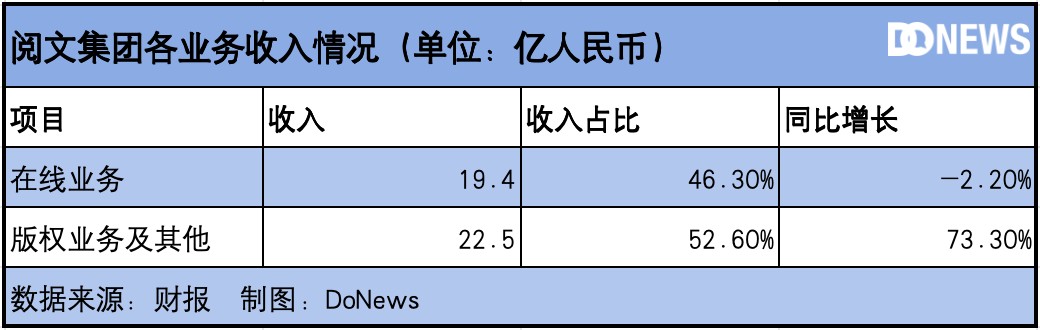
The report shows that China Literature's revenue in the first half of the year increased by 27.7% to 4.191 billion, and net profit increased by 33.9% to 504 million. Among them, the IP business performed exceptionally well. The film "Hot and Spicy" and TV dramas such as "Walking with Phoenix," "Joy of Life" Season 2, and "The Story of Roses" had a "four consecutive explosions," driving a significant 73.3% increase in revenue from copyright operations and other businesses to 2.25 billion, accounting for over half, while online business declined by 2.2% in the same period.
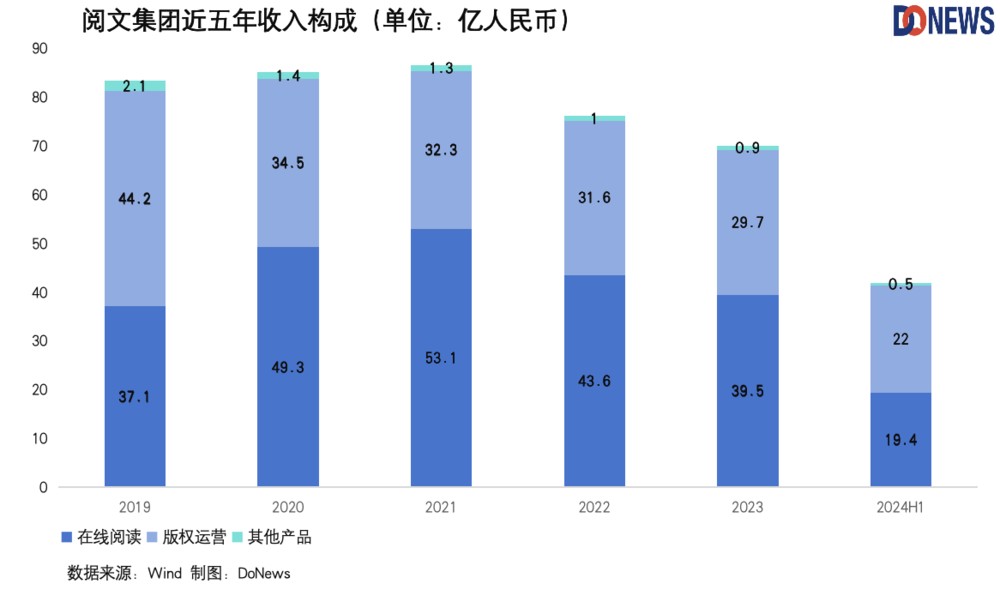
 It can be seen that, except for the relatively special year of 2019 (first merged with New Classics Media), in the first half of the year, copyright operations and other businesses finally became China Literature's largest revenue segment, and are likely to drive China Literature's revenue to stop declining and resume growth.
In response to this, China Literature Group's CEO and President, Hou Xiaonan, stated: In the first half of 2024, the company adhered to a high-quality strategy, made significant breakthroughs in the full industry chain IP construction, and delivered an inspiring report card. At the same time, the ability to incubate high-quality IPs and develop long-term serialized content is the core of the company's long-term competitiveness.
This may also mean that the IP business has finally become the new backbone of China Literature, achieving the "handover" of core business.
01. "Joy of Life Model" Proven Successful
In the financial report, China Literature spent a lot of ink to showcase the significant breakthroughs it has made in the full industry chain IP construction, with the top IP sequel "Joy of Life" Season 2 being particularly emphasized for its successful cross-department, cross-industry upstream and downstream collaborative operation strategy.
Clearly, the "Joy of Life" series has become a benchmark case for China Literature in the development of the full industry chain of online literature IP.
The financial report mentioned that since the launch of "Joy of Life" Season 2 in May, its data performance has been outstanding in the market. Not only did it set a record for Tencent Video's all-time highest popularity value, but it also achieved 18 consecutive days of being the top real-time viewership nationwide, ranking first on various major professional data rankings such as Kuyun, Douban, Maoyan, Dengta, and Yunhe.
At the same time, during its global simultaneous release through Disney, it became the most popular Mainland Chinese TV drama on the Disney+ platform. Currently, it is being translated into 14 different languages for overseas release.
Even Tencent mentioned in its Q2 financial report that, driven by the popularity of TV dramas such as "Joy of Life," Tencent Video's paid membership increased by 13% year-on-year to 117 million.
In addition to its excellent broadcast performance, the financial report also mentioned the spillover effects of "Joy of Life" Season 2 on other businesses. During its launch, the starting point reading app simultaneously launched an activity zone, driving a 38-fold increase in the reading volume of "Joy of Life"; in terms of the linkage of derivative products in the transformation of online literature IPs into films and TV shows, the 11 "Joy of Life" blind boxes sold over 200,000 units; the IP card business GMV reached 20 million yuan, ranking first in sales of series collectible cards.
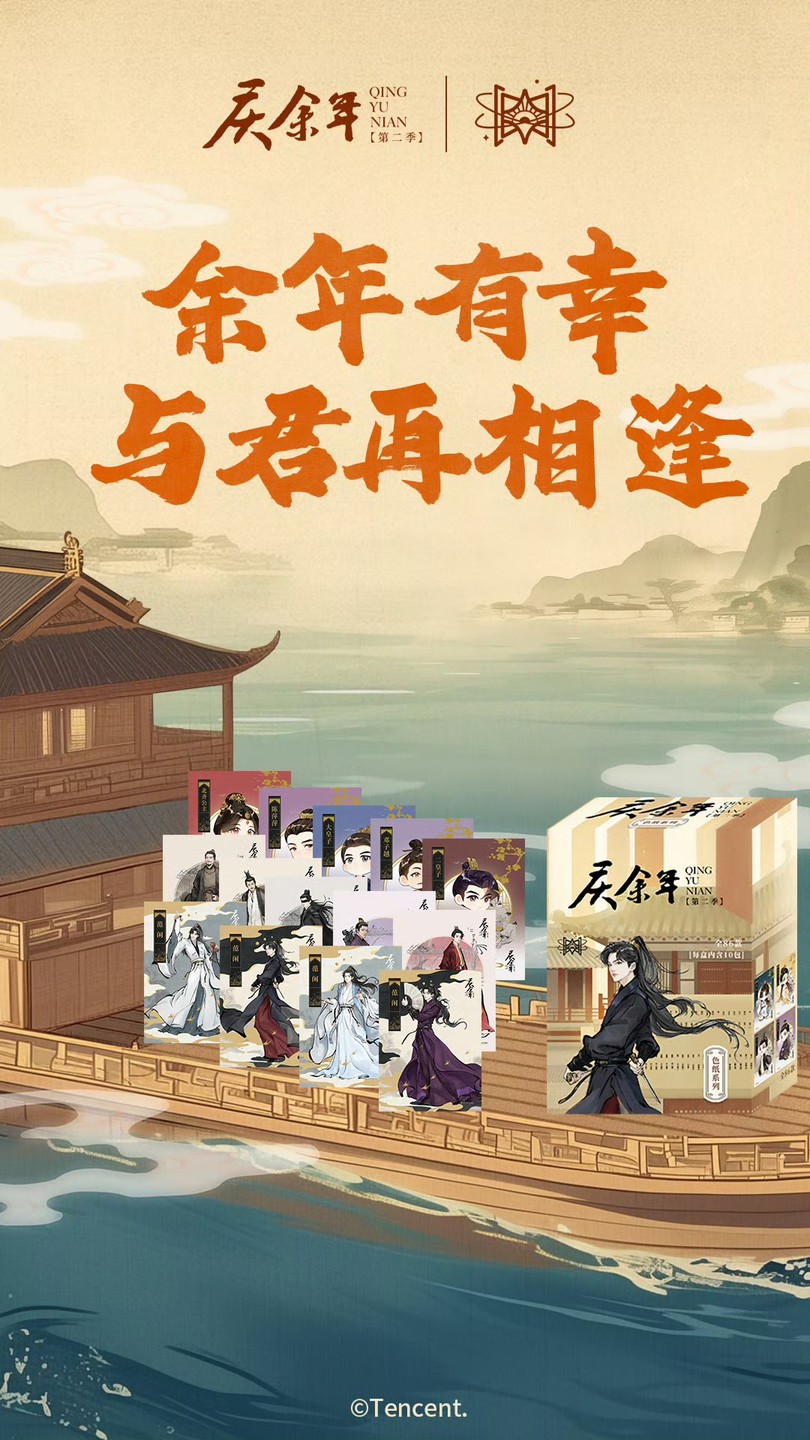
Image Source: "Joy of Life" Weibo
Strictly speaking, although the novel "Joy of Life" ranked high on the monthly ticket list during its serialization on the starting point Chinese website, it did not achieve a breakthrough lead. However, after a series of developments, its current market position is significantly higher than that of the original novel. After the "Joy of Life Model" proved successful, it means that China Literature's vast IP library has a successful template to apply, and the China Literature IP business has a clearer development path 02. Is Transformation Really Worth It?
We can't say for sure if this is the best version of China Literature, but it is definitely the version that Tencent hopes China Literature will become.
Regarding the success of the "Joy of Life model," China Literature stated that it stemmed from the establishment of the largest IP special team in the company's history early on, achieving linkage across the entire industry chain from literature to film, games, derivatives, card games, and maximizing the content and commercial value of IP.
However, the twists and turns in between are far from simple "doing things."
In 2014, Tencent acquired Shanda Literature in full, and the following year, Tencent and Shanda Literature jointly established China Literature Group. Eddie Wu, who was the CEO of Tencent Literature at the time, served as the co-CEO of China Literature Group. At that time, the "father of online literature" Eddie Wu's development plan for China Literature seemed more detached from Tencent.
This clearly did not maximize Tencent's interests. In the China Literature Group's financial report conference in the first half of 2020, Cheng Wu once mentioned that even after the acquisition, XINLI did not achieve a high level of synergy with China Literature, similar to the relationship between XINLI and Tencent. XINLI was largely independent of China Literature. For a long time, XINLI Media excelled in film and television production, while China Literature excelled in high-quality content and user operations but was not good at IP sustainability development, leading to insufficient synergy between them.
After Cheng Wu took over as the head of China Literature, the company experienced events such as the "tyrannical contract" and the "50-50 hiatus festival," revealing the pains of China Literature's transformation. At the 2021 China Literature annual conference, Cheng Wu announced the "Great China Literature" strategy upgrade, clearly stating that China Literature will be based on Tencent's new cultural and creative ecosystem, with online literature as the foundation, IP development as the driving force, and openly cooperate with industry partners to build an IP ecosystem business matrix.
In 2023, after the third CEO, Hou Xiaonan, took over China Literature, continuing the route of developing the entire IP industry chain, after four years of running-in, China Literature summarized in its financial report that the success of the "Joy of Life" series not only proved China Literature's ability to create and stably replicate explosive hits but also validated China Literature's business model, truly achieving linkage in the sense of the IP industry chain.
However, the market's response to this has not been enthusiastic. Before the release of China Literature's financial report, its stock price had fallen by more than ten percentage points throughout the year, and after the release, it opened high but then fell, and is still slightly down at present. Market doubts about China Literature stem from concerns about the stability of IP development and stagnation in its online business.
On one hand, the paid reading market has reached its ceiling, and on the other hand, free reading platforms such as Tomato Novel, Douban Reading, Zhihu, and Qimao are constantly challenging China Literature's market. China Literature's online business revenue in the first half of the year was 1.94 billion yuan, a decrease of 2.2% year-on-year. Among them, Tencent's product channel online business revenue was 130 million yuan, a decrease of 26.2% year-on-year.
Some deep researchers in the online literature industry believe that with the paid reading market reaching its ceiling, a 2.2% decline in China Literature's online business revenue is already a good performance. The 26.2% decrease in revenue from Tencent's product channel online business is mostly from free channels. The financial report also explains that the focus is on developing a high-quality paid reading business model, leading to a continuous decrease in advertising revenue from free reading channels When developing film and television works based on intellectual property (IP), there are certain quality requirements for the IP. Compared to free reading, paid models in online literature tend to lean towards high quality, which can accumulate more premium IPs. Conversely, it can also be seen that in the business of IPs, Yuewen will not shift its focus to free reading, leading to a loss of market share in the online literature field.
Currently, Yuewen remains the absolute leader in the online literature industry. In the first half of 2024, Yuewen's online reading platform added approximately 170,000 authors and 320,000 novels. The number of new signed works averaging 50,000 in the first half of the year increased by 75% year-on-year, while the number of new signed works generating over 2 million RMB in reading revenue increased by 33% year-on-year. The number of paid users also increased from 8.1 million in 2022 to 8.8 million in the first half of 2024.
However, compared to other leaders in online literature, Yuewen plays a more diverse role as a part of Tencent's IP business ecosystem, which is a crucial perspective to consider for its future development.
References: DoNews "Yuewen Storm: Who will be Tencent's 'Shackled Man'?"
Sohu Technology "Tencent's Absorption of Yuewen in Progress: Intensive Integration, Xinli Steps to the Forefront"
