SC Pharmaceuticals staged a "David vs Goliath" scenario: cross-border semiconductor ventures questioned, low-profile father and son from Hainan excel in financial skills

China Finance Online
2024.09.14 07:28
portai
I'm PortAI, I can summarize articles.

SC Pharmaceuticals plans to acquire 100% stake in Ningbo Aura Semiconductor, triggering market discussions. Wang Chengdong and his son Wang Yingpu are the controlling shareholders of both companies. SC Pharmaceuticals has a market value of about 3 billion yuan, while Aura Semiconductor is valued at over 10 billion yuan. After resuming trading, SC Pharmaceuticals' stock price rose from 5.22 yuan to 6.94 yuan, with a market value of 2.878 billion yuan. Despite the announcement that the transaction is a major asset restructuring, the market has expressed concerns about insider information leakage and benefit transfer

SC Pharmaceuticals (002693.SZ) plans to acquire a semiconductor company, which has become the focus of recent market discussions. The former has a total market value of less than 3 billion yuan, while the latter is valued at as high as 10 billion yuan. As SC Pharmaceuticals stages a "small fish swallowing a big fish" scenario, the same controlling shareholder of both companies, Wang Chengdong and Wang Yingpu (Australian nationality), father and son, are also under the spotlight.

On the evening of September 10th, SC Pharmaceuticals disclosed a restructuring plan announcement, stating that the company plans to purchase 100% of the shares of Ningbo Aura Semiconductor Co., Ltd. ("Aura Shares") held by Aura Investment, Win Aiming, and 23 other counterparties through the issuance of shares and cash payment, and intends to issue shares to raise funds from up to 35 specific investors.

At the same time, SC Pharmaceuticals applied to resume trading from September 11th. After resuming trading, SC Pharmaceuticals hit the limit up for three consecutive days. As of the close on September 13th, the company's stock price rose from 5.22 yuan/share before resumption to 6.94 yuan/share, with a total market value of 2.878 billion yuan.

SC Pharmaceuticals explained in the announcement that this transaction is expected to constitute a related party transaction and a significant asset restructuring, but not a restructuring for listing.

Nevertheless, there are still many doubts from the outside about this acquisition. The company's stock price unexpectedly surged before the acquisition information was disclosed. Was insider information leaked in advance? How to avoid conflicts of interest in the game of a pharmaceutical company acquiring a semiconductor company owned by the same controlling shareholder?

Backdoor Listing?

Established in 2000, SC Pharmaceuticals was listed on the Shenzhen Stock Exchange in 2012, mainly engaged in the research, production, and sales of chemical synthetic polypeptide drugs, with main products including thymalfasin for injection, somatostatin for injection, and bivalirudin for injection. Aura Shares, on the other hand, is a semiconductor company mainly engaged in the research, design, and sales of analog and mixed-signal chips, with main products including clock chips, power management chips, sensor chips, and RF chips.

Late on the night of August 27th, close to eleven o'clock, SC Pharmaceuticals suddenly issued a "Suspension Announcement on Planning Major Asset Restructuring and Related Transactions," announcing the news of the planned acquisition of Aura Shares. However, on the same trading day, the stock price of SC Pharmaceuticals surged, even hitting the limit up at one point. By the end of the day, the company's stock price ultimately rose by 9.21%, with a total daily trading volume of 190 million yuan, far exceeding the previous trading day.

The market inevitably suspects whether the news of the acquisition was leaked in advance.

In response to external speculation, on September 13th, a journalist from Times Weekly contacted SC Pharmaceuticals' securities department as an investor. The relevant person responded, "Stock prices rise and fall, which is the result of the secondary market and is beyond our control."

The key factor that enables this acquisition to proceed is that both SC Pharmaceuticals and Aura Shares are controlled by Wang Chengdong and Wang Yingpu (Australian nationality), father and son. Wang Chengdong and Wang Yingpu collectively control 57.52% of Aura Shares through Aura Investment, Ningbo Shuangquan, and Ideal Kingdom Limited SC Pharmaceuticals stated that after the completion of this transaction, the listed company will shift its development focus to the research, design, and sales of analog chips and mixed-signal chips in the semiconductor industry, and will opportunistically divest pharmaceutical-related assets in the future. This means that SC Pharmaceuticals will completely transform from a pharmaceutical company to a semiconductor company.

However, SC Pharmaceuticals emphasized in the announcement that there has been no change in the actual controller of the listed company in the past 36 months. It is expected that there will be no change in the actual controller of the listed company before and after the completion of this transaction. Therefore, this transaction is not expected to constitute a backdoor listing.

However, some industry insiders pointed out in media interviews that although SC Pharmaceuticals' actions do not constitute a backdoor listing as defined by current laws, the comprehensive replacement of the main business through mergers and acquisitions has produced similar actual effects to a backdoor listing. Whether the merger and acquisition review will be stricter still needs to be observed.

According to 21st Century Business Herald, in the view of senior investment banking professionals in securities firms, for companies engaging in backdoor listings in disguise, regardless of whether the acquisition can ultimately proceed, the announcement of the merger and acquisition restructuring plan itself usually achieves the goal of boosting stock prices.

Regarding the doubts about backdoor listings, a relevant person from the securities department of SC Pharmaceuticals emphasized, "I can tell you clearly that this is not a backdoor listing. The company's acquisition this time still requires approval from the China Securities Regulatory Commission. You can pay attention to the company's announcement for specifics."

Losses and IPO Hurdles

Behind the cross-border transformation, SC Pharmaceuticals and Aura Group can be said to each get what they need, with the former experiencing perennial poor performance and the latter having a valuation of billions but facing obstacles in IPO.

Looking at SC Pharmaceuticals' operating conditions in recent years, losses can be said to be the norm. Financial data shows that from 2020 to the first half of 2024, SC Pharmaceuticals achieved operating income of 269 million yuan, 320 million yuan, 275 million yuan, 236 million yuan, and 95 million yuan respectively; and achieved net profit attributable to the parent company of -53 million yuan, -20 million yuan, 9.01 million yuan, -51 million yuan, and -17 million yuan respectively.

The Time Weekly reporter noted that SC Pharmaceuticals is overly reliant on a single product, and its research and development capabilities are not strong. It is understood that the leading product of SC Pharmaceuticals is Thymalfasin for injection (trade name: Ketai), which is a generic drug product. Thymalfasin is mainly used for the treatment of chronic hepatitis B, tumors, geriatrics, infectious diseases, and to enhance the body's immunity. At the beginning of the COVID-19 outbreak in 2020, Thymalfasin was included in the national COVID-19 diagnosis and treatment plan and was once hailed as a "miracle drug." As of now, nearly 20 pharmaceutical companies nationwide have approval numbers for Thymalfasin.

Financial data shows that the sales revenue of Thymalfasin for injection has accounted for over 30% of SC Pharmaceuticals' total revenue for many years. In addition, Octreotide for injection and Bivalirudin for injection are also generic drug products. As of the end of 2023, the total number of research and development personnel in the company was 75, accounting for only 15.50% In recent years, with the rapid release of market demand represented by GLP-1 drugs such as Semaglutide, Liraglutide, and Exenatide, the heat in the peptide field continues to rise. Many domestic enterprises have seized this opportunity to achieve simultaneous growth in orders and performance, but SC Pharmaceuticals has failed to catch this trend.

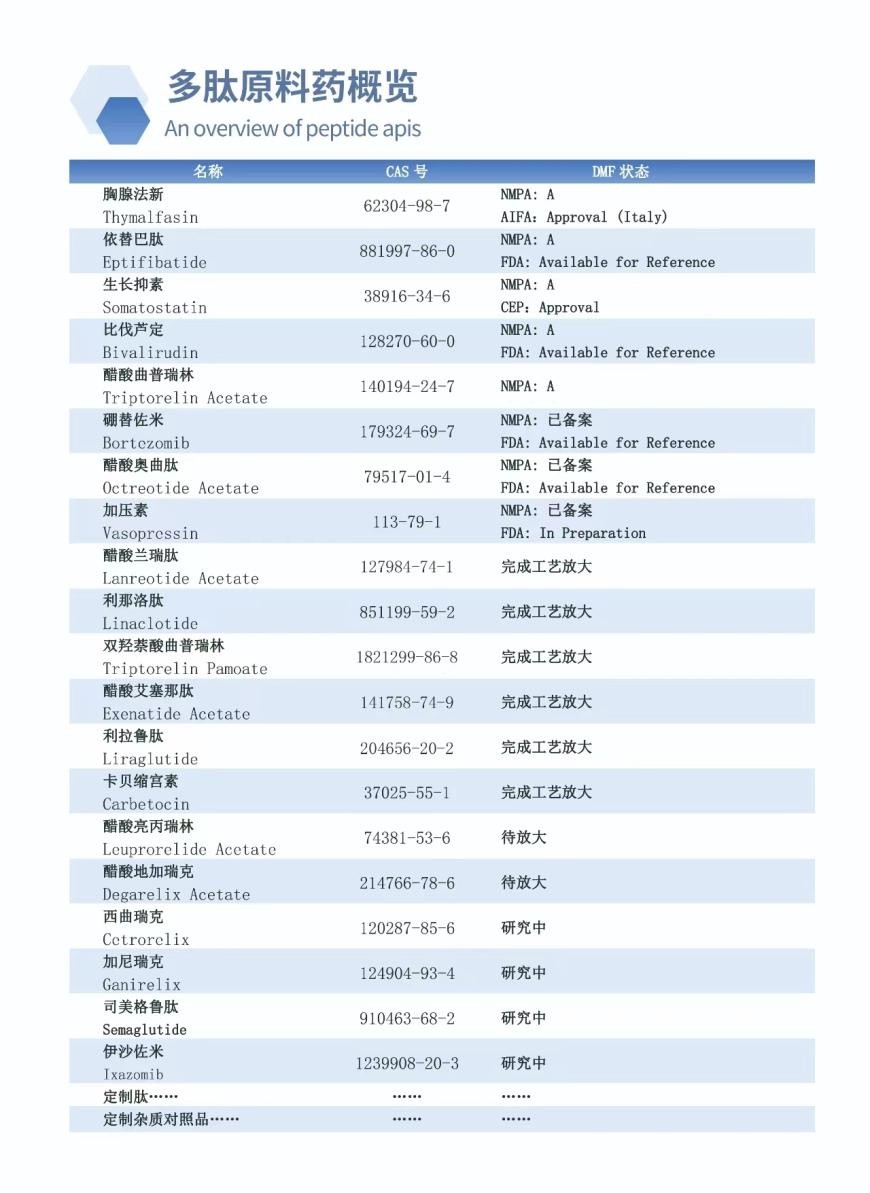
In November 2022, SC Pharmaceuticals released an overview of peptide raw materials on its official WeChat account, mentioning that its Liraglutide's DMF (Drug Master File, detailed information on the entire process of producing excipients provided by excipient manufacturers) status is in the stage of completing process scale-up, while Semaglutide is still under research.

Image Source: SC Pharmaceuticals WeChat Official Account

The Time Weekly reporter noted that the 2020 annual report mentioned that the API (Active Pharmaceutical Ingredient) engineering batch synthesis of Liraglutide had been completed, but due to market reasons, formulation development was suspended. However, in the May 2021 investor relations record, SC Pharmaceuticals informed investors that the Liraglutide project was still in the research stage. Searching the company's annual reports and announcements using "Semaglutide" as a keyword did not yield any mention of related products.

The most direct reason for Aura's transfer to SC Pharmaceuticals is the failure to sprint for a listing on the Sci-Tech Innovation Board. In December 2022, Aura's Sci-Tech Innovation Board IPO was accepted, aiming to raise 3 billion yuan with an issuance of shares not less than 25% of the total share capital. Based on this rough calculation, the company's valuation is 12 billion yuan.

Aura's core product is a clock chip, which is used to provide and modulate clock signals, enabling various electronic systems to operate efficiently and stably. The prospectus shows that this product has contributed over 86% of the company's revenue over the years. Based on the sales amount of the company's clock chip products in 2021, the company holds a 23.51% market share in the Chinese clock chip market and a 61.27% market share in the Chinese debouncing clock chip market.

After news of the IPO came out, there were voices in the market claiming that if successful, Aura would become the leading stock in the clock chip industry.

However, over a year later, Aura withdrew its IPO application in May of this year. During this period, the Shanghai Stock Exchange issued multiple inquiry letters to Aura, requesting Aura to explain the differences and competitive situations between the company's mainstream and top technical products and similar products of comparable companies at home and abroad in terms of application areas, technical indicators, and sales situations, whether they are still mainstream products in segmented fields, whether they are continuously sold, and whether they represent the latest and highest technological levels of competitors; and to explain the legality and compliance of foreign shareholders setting up the issuer through nominee holding.

Regarding the reasons for Aura's withdrawal of the IPO application and the current valuation issue, a relevant person from SC Pharmaceuticals' securities department mentioned, "We are unable to reply to the situation regarding the target. As for the valuation, since the audit is still under evaluation, we have not yet obtained the relevant data." In terms of performance, Ola shares have shown good revenue performance, but the net profit fluctuates significantly. The prospectus shows that from 2019 to the first half of 2022, Ola's revenue was 134 million yuan, 405 million yuan, 502 million yuan, and 221 million yuan, with net profits of 18.93 million yuan, 6.8172 million yuan, -1.096 billion yuan, and -466 million yuan respectively.

Regarding the reasons for the losses, Ola shares explained in the prospectus that it was mainly due to the large-scale equity incentives given to employees starting from the end of 2020. Data shows that from 2020 to the first half of 2022, the company recognized share-based payment expenses of 162 million yuan, 1.204 billion yuan, and 485 million yuan respectively.

According to the latest announcement from SC Pharmaceuticals, Ola shares have now turned losses into profits. Data shows that from January to July 2024, Ola's operating income was 538 million yuan, with a net profit of 307 million yuan.

Regarding the current business situation of SC Pharmaceuticals and the research and development of Liraglutide and Semaglutide, reporters from Times Weekly contacted several employees of SC Pharmaceuticals, but they all expressed inconvenience to disclose information.

Low-key Hainan Wealthy Father and Son

In fact, whether in the pharmaceutical industry or transitioning to chip research and development, the Wang father and son have no relevant professional background. According to the annual reports of SC Pharmaceuticals and the prospectus of Ola shares, Wang Chengdong was born in 1953 in Anshan, Liaoning Province, and graduated from the Foreign Language Department of Liaoning University; Wang Yingpu was born in 1981 and graduated from the Law Department of Macquarie University in Australia.

In 2015-2016, Wang Chengdong and Wang Yingpu successively made it onto the Hurun Rich List with wealth of 3 billion yuan and 2.1 billion yuan, ranking fifth among the wealthy in Hainan. However, as wealthy individuals in Hainan, the Wang father and son are very low-key. Wang Chengdong rarely accepts media interviews, while Wang Yingpu is even more mysterious. Although he joined SC Pharmaceuticals in 2008, his presence or related updates cannot be found on the company's official website or WeChat public account.

Similar to the experiences of most wealthy individuals born in the 1950s and 1960s, Wang Chengdong's success story is also shaped by the times. According to multiple media reports, Wang Chengdong was once a state-owned enterprise employee and became the Deputy General Manager of Anshan International Economic and Technical Cooperation Company at the age of 33. In the course of business dealings, Wang Chengdong came into contact with a Japanese wholly-owned enterprise that intended to register a company in China and hired him as the General Manager.

At that time, Hainan Province was established as the fifth national economic zone, and the famous "Thirty Policies" were also introduced. The Japanese enterprise immediately decided to register the company in Hainan, and in 1988, Wang Chengdong became the General Manager of this newly registered Japanese company.

In 1991, Wang Chengdong established Hainan Shuangcheng Metal Structure Products Co., Ltd., participating in many iconic construction projects in Hainan. As the real estate industry in Hainan rapidly developed, Wang Chengdong also achieved his initial accumulation.

In 1998, Wang Chengdong met Gao Guangxia and Tang Hong. During their interactions, Wang Chengdong became interested in the concept of polypeptide drugs mentioned by Gao Guangxia. He proposed that he would mainly provide funding, while Tang Hong and Gao Guangxia would recommend and organize a team of overseas student experts with relevant professional backgrounds to establish Shuangcheng Limited for polypeptide drug research and development In 2000, Shuangcheng Pharmaceuticals was officially founded in Haikou. In 2012, Shuangcheng Pharmaceuticals was listed on the Shenzhen Stock Exchange ChiNext (now the main board).

In 2010, Wang and his son established Shuangcheng Investment and HSP Investment, two main entities responsible for investment business, and began to venture into the semiconductor industry. That year, Wang Chengdong invested 81.92 million yuan in cash in the semiconductor company, Telink Micro, holding 60% of the shares.

According to media reports, in 2016, Wang Chengdong planned to clear his holdings in Telink Micro to alleviate personal financial pressure. In 2017, although Wang Chengdong and his son fell out of the Hurun Rich List, in August of the same year, Shuangcheng Investment sold its stake in Telink Micro at a high price of 1.252 billion yuan, ultimately making a net profit of over 1.1 billion yuan from this investment.

After exiting Telink Micro, at the end of 2017, Wang Chengdong acquired India's Aura and established Aura Technologies the following year. During this period, Aura Technologies set up a research and development platform overseas, recruited experienced analog integrated circuit designers from around the world, formed a research and development team, and successfully mass-produced the first debouncing clock chip in September 2018.

The story then slowly developed to the failure of Aura Technologies' sprint for an IPO on the Science and Technology Innovation Board, followed by its partial acquisition by Shuangcheng Pharmaceuticals. After Shuangcheng Pharmaceuticals went public, some referred to Wang Chengdong as an entrepreneur, while others saw him as an investor and capital operation expert.

In September 2023, in a video released by the Anshan News and Media Center, Wang Chengdong referred to himself as an "entrepreneur who has gone out of Anshan." He mentioned that he had been entrepreneurial outside for 35 years, focusing on biomedicine and semiconductors.

Wang Chengdong stated that in the semiconductor field, he has established three chip design companies, with the first one already successfully listed, the second one in the process of listing, and the third one in the research and development stage. Although he cannot guarantee absolute success, it is a project of revolutionary innovation.

Furthermore, Wang Chengdong emphasized that the funds he invested in are all in hard and high technology. "My family fund has invested in 16 health industries, all of which have developed well, some have already gone public, and some have exited."