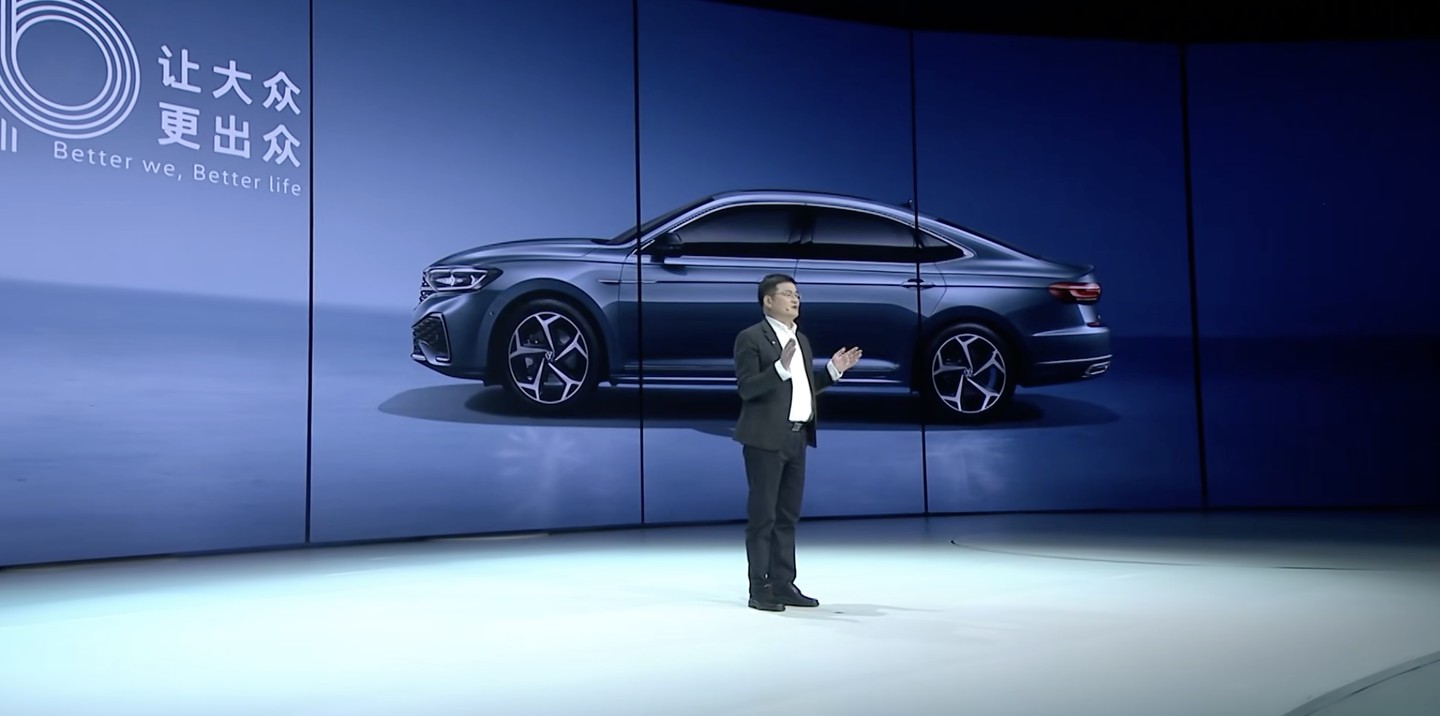
"Santana Divine Car" targets young people

Wallstreetcn
2024.09.14 12:54
portai
I'm PortAI, I can summarize articles.

Charge again

Author | Chai Xuchen

Editor | Zhou Zhiyu

On the evening of September 10th, SAIC Volkswagen held a grand launch event for the Passat Pro.

When it comes to joint venture B-class cars, most people instantly think of the Volkswagen Passat. Forty years ago, its second-generation model was introduced to the Chinese market, known as the legendary "god car" Santana. It can be said that from its entry into China in 1984 to becoming the "top joint venture" today, the shadow of the Passat has spanned the entire development history of SAIC Volkswagen.

Unexpectedly, the predecessor of the "god car" Santana is now entering the market to compete for young users.

With a 2K floating screen, Harman Kardon audio system, a driving system developed in deep cooperation with DJI, voice assistant integrated with Wenxin Yiyuan, and Huawei HiCar, the ninth-generation Passat has completed its intelligent transformation. Not only that, it has also developed a starry sky version front face for young people, and even launched the Black Knight sports package, stepping onto the front line with a Pro halo.

In the current competitive environment where wolves are lurking, this "veteran" of SAIC Volkswagen has entered the melee as a disruptor, wanting to tell the market who the leader of the segmented track is.

The goal of Passat Pro this time is clear: to attract new and old customers, entrusting more hopes and increments to the post-90s consumer group.

Holger Santel, the first deputy general manager of SAIC Volkswagen, revealed that among Passat family users, the proportion of users under 30 years old has reached 36%, and the proportion of users aged 31-35 has also reached 17%. The average age of users choosing the Passat Starry Sky version is only 31 years old.

This is not surprising. As the first batch of post-90s enter their thirties, the Passat also wants to attract these users. In fact, starting from the previous generation model, SAIC Volkswagen has intentionally made the Passat's design more youthful, further deepening its user profile.

Fu Qiang, deputy general manager of SAIC Volkswagen, told Wall Street News that young consumers love high technology, and we have made a lot of optimizations for this, including a fragrance system, internal ambient lighting to cater to female consumers. He bluntly said, "If you were not satisfied with the intelligence of BBA before, Passat Pro is the best choice."

It is evident that Volkswagen is vigorously shedding the aura of "old money," which is a reflection of its pursuit of changes in the Chinese market.

In the first half of this year, Passat's sales increased by 31.26% year-on-year, selling more than 100,000 units in total, surpassing Toyota Camry and Honda Accord, reclaiming the top spot in the B-class sedan segment. However, the current highlight is actually achieved through price reductions. The implicit implication of market share anxiety is that the market's discourse power and pricing power are no longer in the hands of SAIC Volkswagen.

Now, with the rapid advancement of new energy and independent brands, joint venture car companies caught up in the upheaval must make choices between change and stagnation. After losing the top spot in domestic sales to BYD, SAIC Volkswagen has awakened.

Holger Santel sighed, "In 2018, I worked in Germany for 3 years, and when I came back to China, the situation had completely changed." Fu Qiang bluntly stated, "Once joint venture car companies choose to lie down, they will never be able to stand up again. Attack will be the only strategy for SAIC Volkswagen." Therefore, after Jia Jianxu and Yu Jingmin "set things right" and clarified the situation last year, SAIC Group handed over the banner of reform to Tao Hailong and Fu Qiang. Can this new combination lead this giant ship to launch a counterattack?

Currently, Passat Pro has quietly opened the prelude to SAIC Volkswagen's breakthrough.

The following is a dialogue record (edited) with SAIC Volkswagen General Manager Tao Hailong and Deputy General Manager Fu Qiang:

Question: Data shows that users under 30 years old account for 30% of Passat users. What work has Passat Pro done to cater to the younger demand?

Fu Qiang: First of all, in terms of design, Passat Pro has a pioneer face, a starry face, and even a black warrior style. The starry face is generally welcomed by young people, with the average age of users being 2-3 years younger compared to the pioneer face. Some people asked if we would lose traditional users, I said I'm not worried, traditional black, white, and gray are still retained, but there are demands for young groups like pulse green and cyber pink.

In terms of functionality, young consumers love high technology, so we have made a lot of optimizations in L2 intelligent driving, intelligent cabin, including the operation interface of the entire central control screen, as well as the fragrance system and internal ambient lighting.

Question: How can SAIC Volkswagen make the smartest fuel cars?

Tao Hailong: I want to clarify a misconception first, that being smart seems to be only about electric cars and has nothing to do with fuel cars; as if fuel cars are inherently dumb, and new energy vehicles are inherently "smart children". Is a spaceship not intelligent? Is a warship not intelligent?

Being smart or not is first decoupled from the form of energy. When we did the Pro trilogy, we felt that everyone was no longer investing in fuel cars, but we saw an opportunity. If we can do intelligence well, it is a blue ocean. So two or three years ago, we started laying out products like this.

Touareg LPro, Passat Pro, internally we consider ourselves the smartest in fuel cars. The gap in the Internet and intelligence is visibly narrowing. We will continue to invest, especially in software upgrades. There are probably only 2-3 companies doing AI well in the market. After comprehensive evaluation, we chose to cooperate with Wenxin for language models. We hope to quickly extend the large language model horizontally to all product series.

Question: As the flagship product of the brand, has Passat Pro introduced any innovative marketing strategies? What are the sales expectations after the launch?

Fu Qiang: Currently, Passat's monthly sales are about 20,000 units. After the new model is launched, we expect growth. The goal is to smoothly transition the existing customer base to the new Passat Pro and attract more new customers on this basis.

To achieve this, we have launched a series of preferential policies, including providing lifetime quality assurance for the first owners of all fuel vehicles in the lineup, previously priced at ten thousand yuan in the official store. This is also to fully demonstrate our corporate advantages - our quality system is good, craftsmanship is top-notch, and materials are solid.

In the first half of the year, we mainly promoted value renewal, and in the second half of the year, we will try something new. Volkswagen brand products are very popular with insurance companies because our materials are solid, and the accident rate is much lower than that of competitors. Many brands have accident fees far higher than the insured amount, but Volkswagen is not like that. Our strategic focus is on how to translate this advantage into competitiveness in the market Question: Will the Pro series, which is a key tool for SAIC Volkswagen to increase sales, appear on other models in the future?

Fu Qiang: The Pro series is a trilogy, all of which involve upgrades to our flagship products and popular hit products.

The first part is the Tiguan L Pro, which adds comfort and luxury on top of intelligence. It is hard to find a competitor in the B-class cars, and in the C-class cars, only the 5 Series and Mercedes E-Class offer these functions. The second part is the current Passat Pro; the third part will be the flagship product, the Touareg, which will definitely surpass the Passat Pro and continue to add on to the foundation of intelligence and comfort.

The Pro product direction is consistent, driving the entire brand upwards. After the Pro products are launched, they will be sold alongside existing products, forming a complementary relationship within the family.

Behind all of our initiatives is a grand ambition. From the price range of 80,000 to 320,000 RMB, we hope to have good enough products for each ten thousand increment to strengthen product coverage within this price range.

Question: How was SAIC Volkswagen's sales performance in the first half of this year, and what sales targets have been set for the second half?

Fu Qiang: Our cumulative sales this year are around 750,000 vehicles, with a slight year-on-year increase.

This year is a significant year for SAIC Volkswagen's products. Two parts of the Pro trilogy have already been released this year. The Tiguan L Pro currently sells over 3,000 units per month, with almost one Pro model sold for every 3-4 Tiguan family vehicles. This intelligent oil car positioning has been well received in the market.

With the Passat Pro this time, we have adopted a more aggressive pricing strategy, aiming to firmly establish the leading position. The Passat is not just the leading fuel car, but also the leading model in the entire market. SAIC Volkswagen aims to provide the best, most cost-effective products directly to consumers.

While expanding the product matrix, we have also optimized some products. The new Lavida and Tuyue, starting from 79,900 RMB for the new Tuyue, have directly ignited the market. With over 12,000 orders in ten days, the ID. series has also been upgraded with the ID.3 and ID.4X intelligent models. The gap between software iteration and new forces has rapidly narrowed, with features such as remote parking, lane change by lever, and L2 already available. Perhaps the urban NOA is still slightly lacking, but we are working hard on it.

The market performance has been very good, with a 7% market share in the fuel car market in September, 8% in August, and continuing in that direction in September.

Question: Previously, the "Jia Yu combination" laid the foundation for SAIC Volkswagen's rebirth. Is the new leadership team aiming for a counterattack?

Tao Hailong: I am actually an "old Volkswagen," with my career enlightenment and upbringing at SAIC Volkswagen. I also have 12 years of experience in independent brands. At the end of 2008, I joined Roewe and MG, and later spent 4 years at SAIC Transmission.

After being here for 50 days, I have a few feelings: first, the strategic direction is very clear. The entire product spectrum of SAIC Volkswagen is very complete, with different price segments covered from A-class to B-class cars, not just a single model but a series. We have had multiple communications at the executive level and within the team. The unity of understanding between shareholders and the consensus on strategy are crucial for driving various work initiatives forward During this period, I have been in the market, communicating with dealers and investors, and the market feedback has been very positive.

Although electric cars and hybrids currently have a high market share, we are still leading in the gasoline car market. We need to stick to gasoline cars but not be conservative, hybrids and electric cars will definitely continue to develop, and smart technology will also continue to advance. With the Volkswagen brand DNA and high customer acceptance, as well as the confidence from dealers, which is our core competitiveness, we have very good communication with suppliers, including discussions on future product spectrum, strategic cooperation, and how to develop with quality and quantity.

I feel that SAIC Volkswagen's entire system, products, team, market, and strategy are all in place.

Question: With independent brand market share already reaching 63%, how do we view the future prospects of joint ventures?

Tao Hailong: I believe that joint ventures are very important corporate citizens and also make significant contributions to society. At that time, I mainly promoted localization, as it was almost impossible to find suppliers capable of providing corresponding support in China. The components in China, including parts manufacturers in Shanghai, Zhejiang, and surrounding areas of Jiangsu, including many listed companies now, all started with Santana and Passat.

Question: What stage do you think the current trend in the automotive industry has reached, and what are the resources, advantages, and weaknesses of SAIC Volkswagen for future strategies?

Tao Hailong: I believe that the momentum in the Chinese market is far from over, it is far from being "GameOver" yet, and there are still many people sitting at the dining table together. This is a good thing, as more people mean more opportunities.

SAIC Volkswagen has a large foundation, the gasoline car market is currently stable, and we must firmly stabilize the gasoline car market and have taken a series of measures. Secondly, the entire system, especially the dealer system, must be well supported, adhering to a systematic approach. SAIC Volkswagen will never take shortcuts or act recklessly, and we must not lose our composure.

This doesn't mean that we can rest easy. Given the current market situation, SAIC Volkswagen is under immense pressure, requiring our entire team to strive for the market with extreme caution and urgency. The Chinese market changes rapidly, and we must pursue all three paths of gasoline, electric, and hybrid vehicles.

The products to be launched in the future will undoubtedly be at the forefront of the market in terms of technology, with the quality of the Volkswagen brand and the support of its DNA. SAIC Volkswagen can achieve competitive differentiation