


Is the homogenization of the tea beverage track reaching a turning point? HEYTEA says "no" to internal competition

HEYTEA is facing pressure from homogenization in the freshly made tea beverage market and has decided to reject homogenized competition, focusing on creating differentiated brands and products. The company will take four actions: 1) Reject low-price homogenization and focus on user needs; 2) Control the speed and quality of store openings; 3) Increase investment in brand design and user experience; 4) Launch more differentiated products. HEYTEA believes that creating differentiation is the best solution to address industry challenges
When an industry enters a mature stage of development with high market saturation, it often leads to severe internal competition, and industry participants face tremendous growth pressure.
The current ready-to-drink tea track is a typical example. In this highly competitive market, where ready-to-drink tea is widely available, the industry price war is escalating, with many brands lowering their product prices to the 10 yuan price range.
HEYTEA, the leading high-end new tea drink brand in China, is also feeling the impact in such a market environment. However, this time HEYTEA aims to be the industry leader by saying "no" to internal competition.
Rejecting internal competition and becoming a differentiated leader in the tea drink industry
Recently, HEYTEA sent an internal memo to its business partners with the theme "Creating Differentiated Brands and Products for Users."
In the memo, HEYTEA believes that faced with limited consumer demand in the industry, the widespread adoption of homogeneous product and brand strategies has led to an increasingly intense homogenized competition. Homogeneous products and brands are continuously eroding users' enthusiasm for tea drink products and brands.
Therefore, HEYTEA believes that the effective way to address the current challenges is to create differentiated products and brand experiences for users. Breaking away from homogeneity and creating differentiation requires concrete actions and measures from the company.
To reject internal competition, HEYTEA stated four actions to be taken:
1) Rejecting the inertia of homogenized thinking and not engaging in simple low-price internal competition. Focus on areas where the company excels and where users' needs lie;
-
Not pursuing the speed and quantity of short-term store openings, but focusing more on the quality and operational quality of store openings. In the coming months, the pace and quantity of store openings will be strictly controlled, as well as store density;
-
Creating brand differentiation with inspiration, creating a better user experience. The company will increase investment in brand design, packaging, brand event content, store space, etc., highlighting differentiation;
-
Introducing more differentiated products and designs to rekindle users' consumption enthusiasm for tea drinks. Not following the industry's popular product categories, new products will no longer replicate the current product structures, and will explore more differentiated new products and categories in the direction of healthy tea drinks.
In summary, HEYTEA is taking an unconventional approach, not participating in industry low-price competition, slowing down store expansion, and increasing investment in brand and product differentiation. HEYTEA also pointed out in the memo that creating differentiated brands and products for users is the best solution to address any current and future challenges.
Why is HEYTEA the first to reject internal competition in the new tea drink industry?
According to Caijing, there are two reasons. First, HEYTEA is positioned as high-end, with Narrow Door data showing that HEYTEA currently has a total of 4,334 stores, with an average consumption of 17 yuan per person, which is relatively high among the top new tea drink brands. Against the backdrop of consumers becoming increasingly sensitive to tea drink prices and many competitors lowering their product prices, HEYTEA is one of the brands most severely impacted by the internal competition process.
Second, in economically developed provinces such as Guangdong, Jiangsu, and Zhejiang, the density of tea drink shops is high, with the average number of stores per capita far exceeding the national average, making it a "battlefield" for major tea drink companies to engage in a fierce battle. HEYTEA has a strong presence in these three provinces, with Narrow Door data showing that HEYTEA has a total of 1,646 stores in these three provinces, accounting for nearly 40%, indicating that HEYTEA is not immune to the impact of industry low-price competition For HEYTEA, due to its brand positioning, its raw materials, rent, and other costs are higher than those of mid-to-low-end brands, and prices have been pushed down in the industry turmoil over the past year. If HEYTEA further participates in the industry's price war, it may have no product premium, posing a significant challenge to its profit structure.
Therefore, HEYTEA is seeking differentiation to have a better chance of breaking through. However, offering differentiated products outside of popular categories in the industry means that HEYTEA needs to invest more in research and development, and upgrading brand differentiation also requires more funding. Whether HEYTEA can regain its past growth momentum under a differentiation strategy remains to be seen.
Crazy Competition: 126,000 Bubble Tea Shops Closed in a Year
The domestic freshly-made tea beverage industry has entered a stage of intense competition, with the continuous increase in industry concentration driven by capital and the improvement of industry supply chain capabilities.
To seize market share, more and more brands, including HEYTEA, have opened up franchising, giving wings to enterprise brands and rapidly expanding the scale of chain stores. Among them, brands such as Sweet LaLa, Migu Xue Bing Cheng, Chabaida (02555.HK), and Auntie in Shanghai have expanded most rapidly.
With the rapid expansion of tea beverage stores, the overlapping coverage of different brands' stores inevitably affects store traffic, increasing operational pressure. Against this backdrop, the industry is facing a wave of closures.
Data from Narrow Door Restaurant Eye shows that as of September 15th, the total number of tea beverage stores nationwide was 414,000, with 138,700 new openings in the past year. However, the net increase was only 12,500, meaning that a staggering 126,000 tea beverage shops across the country closed their doors in the past year.
Industry's irrational price war has led some tea beverage brands to experience a downturn in business performance.
Nai Xue's Tea, which competes in the high-end track alongside HEYTEA, saw its revenue in the first half of the year drop by 1.9% year-on-year to 2.544 billion yuan, turning from profit to loss with a loss of 435 million yuan.
In the first half of this year, Nai Xue's Tea's same-store performance suffered a setback. The average daily sales per store and store operating profit margin of its directly operated stores in six key cities including Shenzhen, Shanghai, and Guangzhou all saw significant declines, with the negative impact of intense market competition being staggering.
Another listed tea beverage company, Chabaida, also faced difficulties, with revenue in the first half of the year dropping by 10.0% year-on-year to 2.396 billion yuan, and net profit decreasing by 59.7% year-on-year to 237 million yuan Due to poor profitability, Nayuki's Tea and Chabaidao's stock prices have been falling recently, with Nayuki's Tea hitting a new low in recent days, down more than 90% from its peak.
According to Narrow Gate Restaurant Eye data, HEYTEA has significantly slowed down its store opening pace since June this year, with only 18 new stores opened since September, compared to over 200 opened in May.
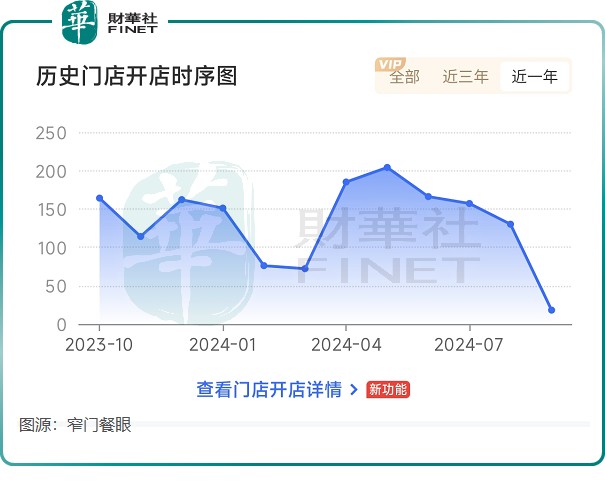
The domestic new tea beverage industry track is becoming increasingly crowded, with a grand price war causing many brands to fall into operational quagmires, and the industry consolidation speed is accelerating.
As the first person to say "no" to internal competition, can HEYTEA's differentiated competitive concept ultimately be successfully implemented and open another door for industry growth? Let's wait and see
