


Which stocks immediately rose after the first rate cut by the Federal Reserve?

The Federal Reserve just cut interest rates by half a percentage point, CNBC Pro has studied the best-performing stocks since the start of an easing cycle in 1984. Apple (AAPL) is the only tech giant, with historical data showing a median increase of about 16% three months after a rate cut. Western Digital (WDC) and Lam Research (LRCX) performed well after the rate cut, with gains of over 26% and 22% respectively. Supermarket chain Kroger (KR) and retail giant Target (TGT) also performed well, with increases of about 16% and 14% respectively
The Federal Reserve has just cut interest rates by half a percentage point. CNBC Pro has studied the best-performing stocks in the past during easing cycles.
If history is any guide, the Fed's rate cut decision may boost some individual stocks.
Using data from easing cycles since 1984, CNBC Pro identified the best-performing stocks after a Fed rate cut. The selection criteria are as follows:
- S&P 500 index constituents
- Top median performance in the three months after the rate cut
Below are the top 10 selected stocks.
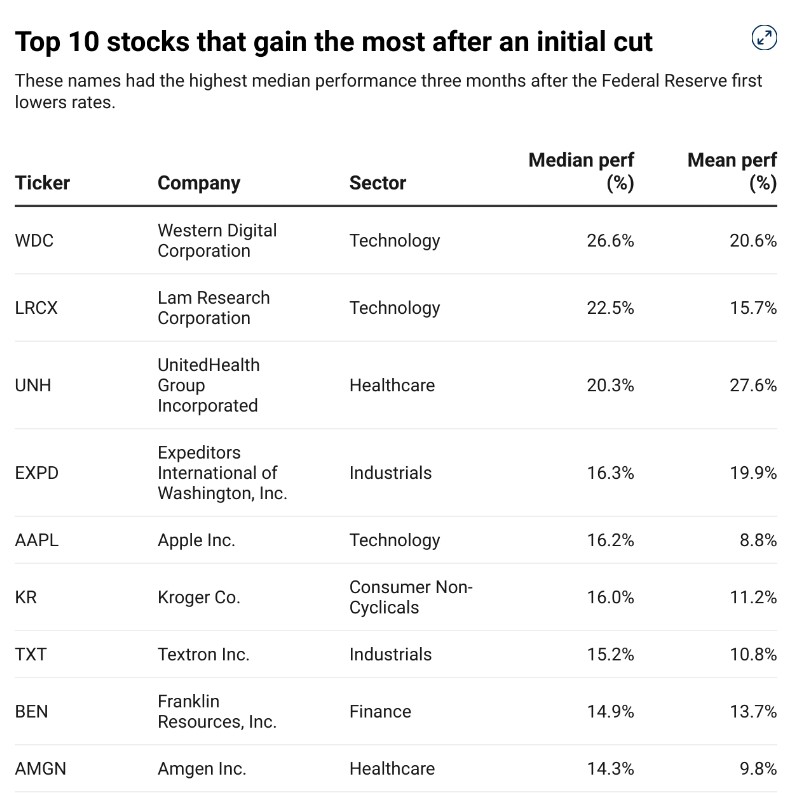

Apple (AAPL) is the only tech giant on this list. The tech giant has already risen by over 12% this year, but recent reports of weak demand for the company's new iPhone 16 have weighed on its performance.
Historical data shows that Apple has a median increase of about 16% in the three months after the Fed's first rate cut. During this period, the average increase in Apple's stock price is close to 9%.
Tech stocks perform well after a Fed rate cut, with data storage company Western Digital (WDC) taking the top spot, followed by semiconductor equipment company Lam Research (LRCX).
Western Digital saw a median increase of over 26% in the three months after the Fed's rate cut, while Lam Research's increase exceeded 22%.
Supermarket chain Kroger (KR) also made the list, soaring by about 16% in the three months after the Fed's rate cut. Large retailer Target (TGT) also performed well, rising by approximately 14% during this period
