China Real Estate Research Institute: Which real estate policies are worth looking forward to after the Politburo meeting?

Zhitong
2024.09.28 08:06
portai
I'm PortAI, I can summarize articles.

The China Real Estate Research Institute pointed out that in the fourth quarter, real estate policies will focus on stabilizing housing prices, expanding demand, improving supply-demand relationships, and promoting market transaction recovery. The Politburo meeting on September 26 released positive signals, and fiscal and monetary policies will be strengthened to stabilize residents' income expectations and promote the stabilization of the real estate market. It is expected that first-tier cities will optimize purchase restrictions, increase home purchase subsidies, reduce home purchase costs, improve local government land acquisition policies, etc., to stimulate the market

According to the Wisdom Financial APP, the China Index Research Institute stated in a document that currently, there are some new situations and issues in the operation of China's economy. Promoting the stabilization of the real estate market is crucial for stabilizing the macro economy. The Political Bureau meeting on September 26 released a more positive signal, and fiscal and monetary policies may be strengthened to stabilize the economy, which will help stabilize residents' income expectations and have a positive impact on the real estate market. At the same time, various real estate policies will also be implemented more quickly to further restore market expectations. The essence of solving the problems facing the real estate market is still to promote market transactions to resume as soon as possible, with the core being to stabilize house prices quickly, as only by stabilizing house prices can the market be effectively activated. It is expected that real estate policies in the fourth quarter will focus on stabilizing house prices, continuously increasing total demand, improving supply-demand relationships, and further leveraging the driving effect of major cities.

The China Index Research Institute pointed out that in the third quarter, several heavyweight meetings were held successively. The meeting of the Central Political Bureau on September 26 placed more emphasis on real estate in the meeting summary, indicating the current importance of real estate. The meeting's tone towards real estate is more positive, stating the need to "promote the stabilization of the real estate market" and explicitly stating "strictly control the increase in commodity housing, optimize existing stock, and improve quality," and "respond to public concerns by adjusting housing purchase restrictions." The central bank also recently released multiple policy benefits, such as accelerating the implementation of reserve requirement ratio cuts and interest rate cuts, and announced the reduction of the minimum down payment ratio for the second home and lowering interest rates on existing home loans, all of which send more positive signals to the market.

Under the reiteration of heavyweight meetings, several real estate policies are worth looking forward to:

① First-tier cities are expected to further optimize housing purchase restrictions, such as Beijing and Shanghai relaxing restrictions on large-sized units above 144 square meters, reducing the required social security years to 1 year, etc.;

② Increase housing subsidies, with the "per capita subsidy" policy driving incremental demand in the market;

③ Reduce housing costs, lowering transaction commissions, transaction taxes and fees, mortgage rates, etc., are also important policy optimization directions;

④ Improve policies on local government acquisition and storage of completed but unsold commercial housing, removing various barriers;

⑤ Improve supporting policies for the construction of "good houses," further promote the "white list" policy for projects, optimize prepayment tax policies for real estate companies, and other supply-side policies are also expected to follow up.

1. Central: Political Bureau meeting reiterates, multiple policies are expected to work together to promote the stabilization of the real estate market

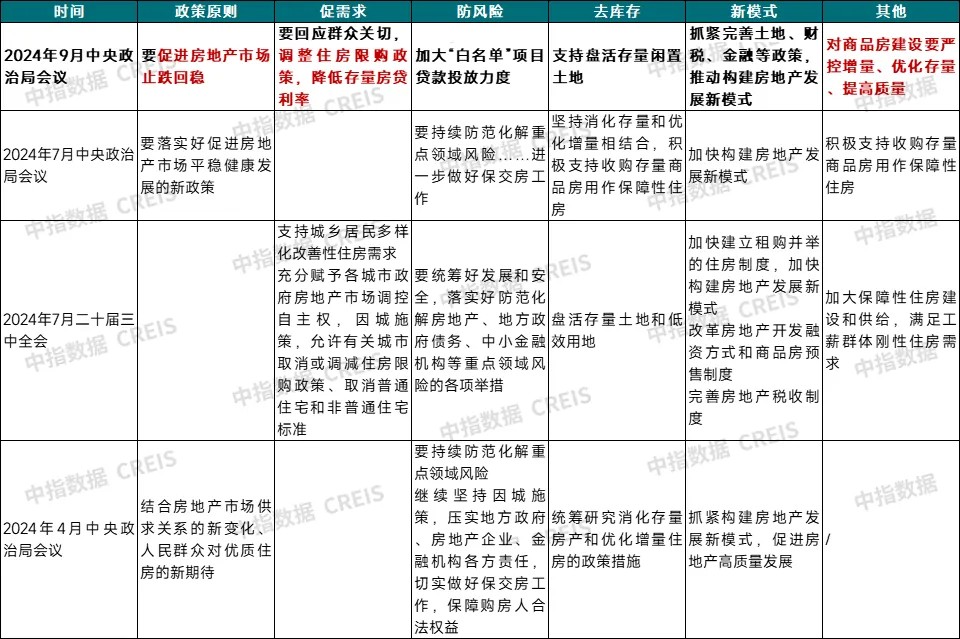
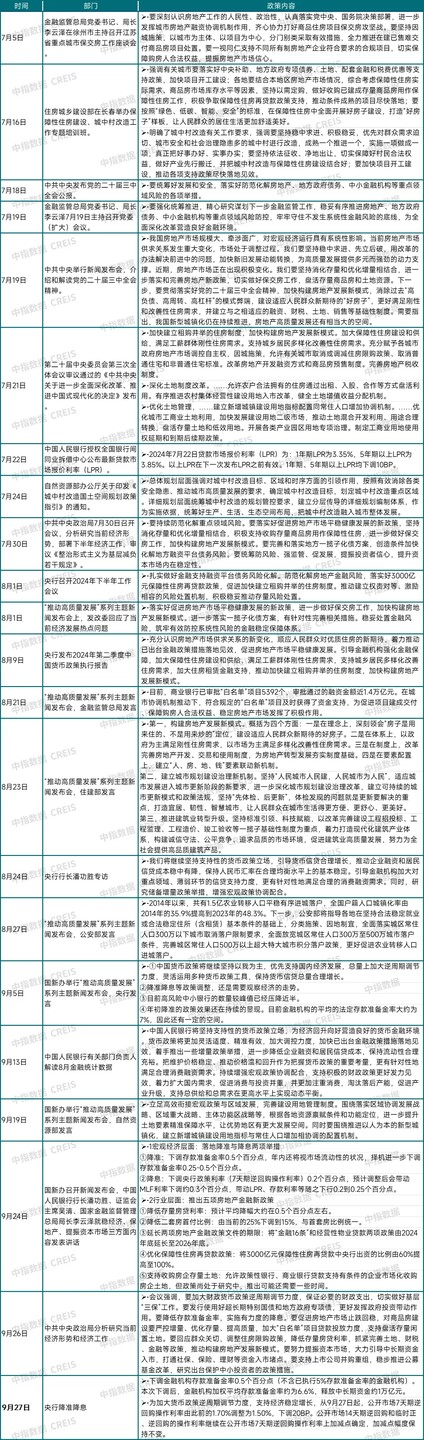
Table: Summary of the content related to real estate in important central meetings since 2024

Source: China Government Website, China Index Research Institute compilation

In July, the full text of the "Decision" passed at the Third Plenary Session of the Twentieth Central Committee extensively mentioned real estate, highlighting the importance of the real estate industry. The "Decision" clearly outlined the long-term reform direction for real estate and also indicated short-term measures.

Regarding short-term measures, the policy focus is on granting more autonomy to local governments for regulation, stimulating demand for improved housing, state-owned enterprises reducing inventory, etc., to achieve stable house prices, stable markets, and risk prevention The "Decision" emphasizes "giving full autonomy to local governments in regulating the real estate market and implementing policies tailored to local conditions." The central bank on September 24 and the Central Political Bureau meeting on September 26 further clarified relevant policies, opening up space for optimizing and adjusting real estate policies in various regions. At the same time, the "Decision" proposes to cancel the distinction between ordinary and non-ordinary residential standards. The central bank announced on September 24 a reduction in the minimum down payment ratio for the second home to 15%, and it is expected that various regions will accelerate the implementation of related measures to boost the release of demand for improved housing.

In terms of medium to long-term reforms, the "Decision" clearly states the need to accelerate the establishment of a new model for real estate development, promote both renting and purchasing, and build a housing system combining "guaranteed + market" elements. Reforming the pre-sale system of commercial housing, improving the real estate tax system, and reforming the land system are all important directions. The Political Bureau meeting on September 26 continued to emphasize the need to "urgently improve land, fiscal, financial policies, and promote the establishment of a new model for real estate development." The term "urgently" indicates the urgency of improving medium to long-term reform measures in the real estate sector. It is expected that in the future, the establishment of land, fiscal, financial, and other systems that adapt to the new model of real estate development, as well as the improvement of supporting policies, will enter an accelerated phase.

The unconventional Central Political Bureau meeting held on September 26 reflects the high level of attention the central government is paying to the current economic situation and underscores the urgency of policy reinforcement to stabilize the economy. The meeting set the tone to "promote the stabilization of the real estate market," which may imply that more market-stabilizing policies will be accelerated and implemented later this year.

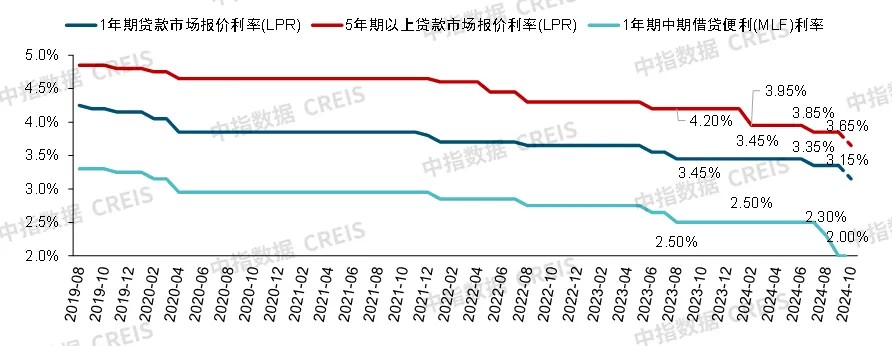
On September 27, the central bank followed up by implementing a 0.5 percentage point reduction in the reserve requirement ratio for financial institutions. After this reduction, the weighted average reserve requirement ratio for financial institutions is approximately 6.6%, releasing around 1 trillion yuan of medium to long-term funds. At the same time, the 7-day reverse repurchase operation rate was adjusted from the previous 1.70% to 1.50%, a 20 basis point reduction. It is expected that the Loan Prime Rate (LPR) and deposit rates in October will also decrease by 0.2-0.25 percentage points.

Chart: Trends of 1-year and 5-year LPR

Data Source: People's Bank of China, China Real Estate Information Corporation (CREIS)

2. Regional: High frequency of policy releases in the third quarter, significant optimization space for future purchase and loan restrictions in first-tier cities

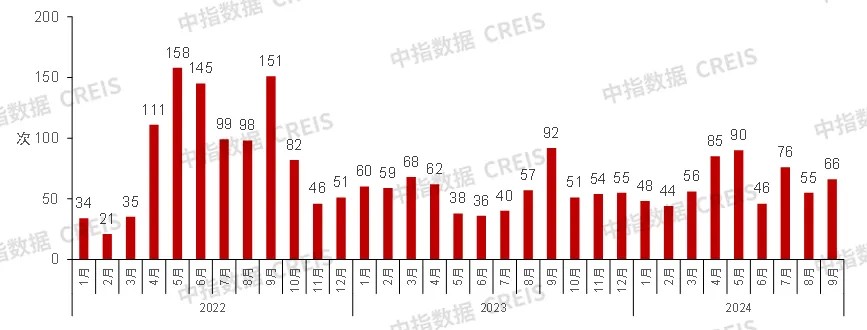
According to China Real Estate Index System (CREIS) monitoring, in the first three quarters of 2024, approximately 270 provinces, cities, and counties nationwide issued over 560 policies. In the third quarter, about 160 provinces, cities, and counties issued around 200 policies, showing a slight decrease in frequency compared to the second quarter but still maintaining a high level.

Chart: Frequency of tailored policies in various regions since 2022 (as of September 25)

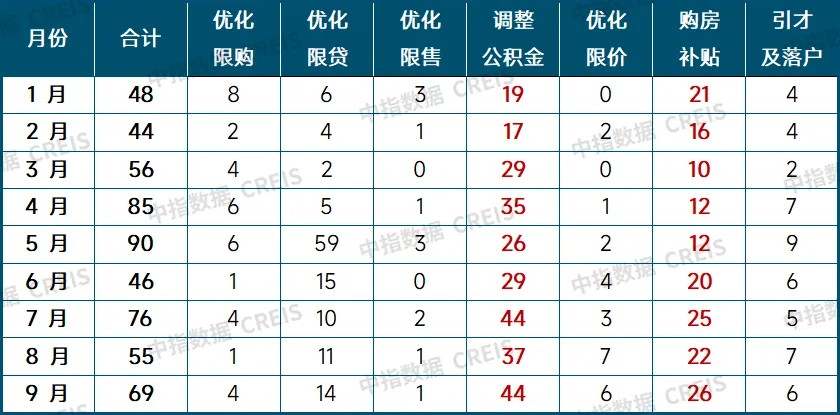
Table: Comparison of the frequency of major policy types issued since 2024 (as of September 25)

Note: One policy in the total column may cover multiple dimensions of data sources: Comprehensive compilation by Zhongzhi Research Institute

(1) Demand-side Policies

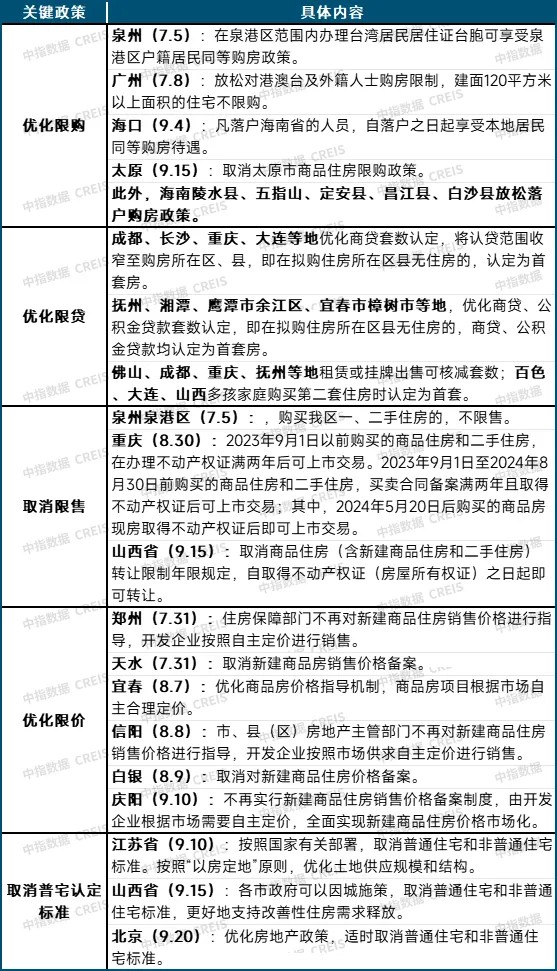
Table: Main Measures of Optimization Policies in Some Provinces and Cities in the Third Quarter of 2024

Data Source: Comprehensive compilation by Zhongzhi Research Institute

Regarding purchase restrictions, apart from first-tier cities and certain cities in Tianjin and Hainan, most cities have already lifted purchase restrictions. In the third quarter, policy adjustments in various regions mainly focused on optimizing specific population groups. For example, Guangzhou relaxed the purchase restrictions for residents from Hong Kong, Macao, Taiwan, and foreigners purchasing properties over 120 square meters, while many places in Hainan relaxed the qualifications for purchasing homes after obtaining local household registration.

In terms of loan restrictions, several core second-tier cities such as Chengdu, Changsha, and Chongqing have narrowed the scope of commercial loans to the district or county where the property is located. If there is no existing property in the district or county where the intended property is located, it will be considered as the first home. Places like Fuzhou and Xiangtan have narrowed the scope of commercial loans and provident fund loans to the district or county where the property is located. In Chengdu and Chongqing, when a buyer lists their property for sale or rent, the number of residential units can be reduced. In Dalian, Shanxi, and other places, the number of residential units for families with multiple children is reduced. Overall, many places have reduced the threshold and cost of home purchases by optimizing the definition of residential units.

Regarding sales restrictions, Chongqing, Shanxi, and Quanzhou Quangang District have lifted the sales restrictions, allowing transfers after obtaining the real estate certificate to accelerate the turnover of second-hand homes.

In terms of price restrictions, Zhengzhou, Xinyang, and Tianshui have lifted price restrictions, allowing developers to set prices independently. Additionally, in places like Shaoyang and Fuzhou, the discounted prices of group-purchased properties are not included in the range of price drop ratios for recorded prices of commercial properties, to some extent relaxing price restrictions.

In addition, after the Third Plenary Session, some regions have explicitly canceled the standard for ordinary residences. In September, Jiangsu and Shanxi issued documents to cancel the standards for ordinary and non-ordinary residences. Beijing also issued a document stating "timely cancellation of standards for ordinary and non-ordinary residential properties, optimizing the trading rules for commercial residential land." The cancellation of the standard for ordinary residences helps reduce transaction taxes and fees for non-ordinary residential properties, lowering the cost of home purchases.

Regarding provident fund policies, optimizing provident fund policies has become the main direction of policy adjustments in various regions. In the third quarter, Guangzhou, Hangzhou Xiaoshan District, Chengdu, Dalian, and other places successively supported the withdrawal of provident fund for down payments; places like Ganzhou and Fuzhou optimized the recognition of the number of provident fund loans, considering it as the first home if there is no property in the district or county where the property is located; Chengdu, Mianyang, Fuzhou, and other places can reduce the number of recognized provident fund loans for leasing or listing for sale; Chongzuo and other places optimized based on the fertility policy, reducing the number of recognized provident fund loans for families with multiple children; Hangzhou Xiaoshan District, Xinjiang, Zhuzhou, and other places expanded the range of provident fund withdrawals to direct relatives; and more than 80 cities raised the upper limit of provident fund loan amounts (2) Supply-side Policies

Various regions continue to follow up and optimize the land auction rules, improve the quality of land supply, and optimize the supply structure to provide a foundation for the supply of "good houses". In terms of land auction rules, in August, Beijing and other regions have optimized and adjusted the transaction rules for newly listed land, with Beijing lowering the qualifications for bidders, bidding increments, and ultra-low energy consumption building standards, reducing the threshold for real estate companies to participate in bidding. At the same time, the upper limit of land premium rates has been raised, from the original 15% premium rate to 25% or 30%.

Regarding the quality of land supply, in August, cities like Hangzhou and Guangzhou provided land with lower plot ratios. Some of the previously unsold or suspended land plots have undergone adjustments, resulting in a significant decrease in plot ratios. For example, the plot ratio of the Linping New City land in Hangzhou has decreased from 2.2 to 1.2, and the building height has decreased from 54m to 24m. In cities like Shenzhen and Guangzhou, land with better locations was supplied in August, with Guangzhou releasing a list of 50 land plots, 20 of which are located in the central four districts.

In terms of supply structure, Shanghai issued a document in August to optimize the "70/90" policy, adjusting the unit type supply structure. After optimization, the standards for medium and small unit sizes have been increased to 100 square meters for multi-story buildings, 110 square meters for low-rise buildings, and 120 square meters for high-rise buildings. At the same time, the proportion of medium and small unit sizes has been slightly reduced, optimizing the future supply structure of products entering the market. This means that more large-sized products will enter the Shanghai new housing market in the future, better adapting to the current changes in housing demand structure. Additionally, the proportion of medium and small units in more core locations will be lower to meet the demand for improved residential living.

(3) Destocking Measures

Local state-owned enterprises have continuously implemented policies for the inventory of completed but unsold commercial housing. Since the beginning of this year, over 30 regions have issued announcements on purchasing existing housing stock for affordable housing, with over 20 cities such as Shenzhen and Changsha issuing announcements in the third quarter, a significant increase compared to the second quarter. In August, projects for purchasing existing housing stock were implemented in Wuhan and Chongqing, with the acquired existing housing stock to be used for affordable rental housing. However, the progress of inventory destocking work in various regions is relatively slow, still facing challenges such as difficulty in price matching, high capital costs for local state-owned enterprises, and mismatch between supply and demand. More targeted policies are urgently needed to provide support in the future.

The "old for new" housing policy continues to make progress with initial results showing. In the third quarter, many regions innovatively upgraded the "old for new" housing policy, with Liangxi District in Wuxi and Qiaokou District in Wuhan expanding the scope of second-hand housing acquisitions. In early August, Liangxi City Development Group in Wuxi clarified that second-hand houses can be purchased across cities (Suzhou, Changzhou), with transactions already completed for properties exchanged across Suzhou and Changzhou. Qiaokou District in Wuhan expanded the acquisition scope to include Jianghan District, Jiang'an District, Changqing Garden area, and some areas in Wujia Mountain, while also adding options to purchase new housing units. Furthermore, Zhengzhou, which has been implementing the "old for new" housing policy since April, has achieved certain results. By the end of August, 3818 sets of intention agreements have been signed, with new housing subscriptions and signings completed for 1500 sets through the acquisition by Chengfa Anju Company, driving new housing transactions through the acquisition of second-hand houses on the state-owned enterprise platform, accelerating the pace of inventory destocking.

In terms of revitalizing existing land resources, some cities are advancing land readjustment and government reclamation of undeveloped land, providing important references for other cities. Wuhan has had over 10 projects this year applying to convert the commercial parts of existing land plots into residential areas; in September, Guangzhou reclaimed four undeveloped land plots in Yuexiu District and paid in the form of promissory notes, which can be used to purchase new land plots in Guangzhou In addition, for commercial projects that have already started, in July, Changsha issued new policies to support the adjustment of apartment-type residential commercial housing to residential housing. After the policy was implemented, the Jiazhaoye City Plaza project applied for a zoning adjustment to change commercial properties to residential properties, in order to include them in the scope of guaranteed housing delivery, realizing the activation and de-stocking of inventory.

Overall, there are some new situations and issues in the current operation of China's economy. Promoting the stabilization of the real estate market is crucial for stabilizing the macroeconomy. The Political Bureau meeting on September 26 released a more positive signal, indicating that fiscal and monetary policies may be strengthened to stabilize the economy, which will help stabilize residents' income expectations and will also have a positive impact on the real estate market. At the same time, various real estate policies and measures will be accelerated to further restore market expectations.

The essence of solving the problems facing the real estate sector is still to promote the recovery of market transactions as soon as possible, with the core being to stabilize house prices quickly. Only by stabilizing house prices can the market be effectively activated. It is expected that real estate policies in the fourth quarter will focus on stabilizing house prices, continuously expanding total demand, improving supply-demand relationships, and further leveraging the driving effect of major cities.

From the policy trend perspective, firstly, it is expected that first-tier cities will accelerate and intensify the optimization of home purchase restrictions. For example, Beijing and Shanghai may relax restrictions on purchases above 144 square meters, encouraging individuals with financial strength and housing needs to enter the market without affecting genuine homebuyers. On the other hand, Beijing and Shanghai may reduce the required years of social security contributions to 3 years or 1 year, accelerating the entry of genuine homebuyers into the market. It is also expected that various regions will further narrow the scope of loan restrictions, and promptly follow up on reducing the down payment ratio for second homes, better releasing demand for home upgrades.

Secondly, increasing home purchase subsidies to drive market growth through "per capita subsidies". For groups that truly need housing security, such as working-class families without homes, families with multiple children, etc., greater home purchase subsidies will be provided to encourage these groups to enter the market. By providing subsidies based on family and talent situations, it is expected to effectively address basic security issues, avoid investment-driven "brick subsidies" approaches, and further prevent resource wastage.

Thirdly, reducing home purchase costs, such as lowering transaction commissions, transaction taxes and fees, mortgage interest rates, etc., is also an important policy optimization direction. For example, expectations include the implementation of canceling standard recognition for ordinary housing, lowering provident fund loan interest rates, optimizing deed tax rates at the national level, reducing the exemption period for value-added tax, and other anticipated policies.

Fourthly, in terms of de-stocking, policies to resolve the bottleneck of government land acquisition are expected to be further improved. This includes guiding local governments to purchase existing housing at more reasonable prices, expanding the scope of land acquisition, the range of acquisition subjects, expanding the range of uses for acquired projects, and introducing more low-cost funds. Purchasing existing housing at reasonable prices is expected to further stabilize house price expectations. Policies to activate existing land resources are also expected to be further improved. If more funds can enter the market in the future, it will accelerate the utilization of idle land and provide more financial support to enterprises.

Additionally, on the supply side, there are expectations for improving supporting policies for the construction of "good houses", advancing the "white list" policy for projects, and expediting the refund of prepaid taxes and fees for real estate companies, all of which will further stabilize corporate expectations.

Appendix 1: Central and related department real estate policies/statements in the third quarter of 2024 (partial)

Appendix 2: Main contents of optimizing real estate policies in some provinces and cities in the third quarter of 2024 (part)

Source: China Index Research Institute comprehensive compilation