


Innovate first, then seize sales, has Apple been stunned by domestic smartphones?

Against the backdrop of a global recovery in consumer electronics in 2024, competition in the smartphone market intensifies. In August, Xiaomi surpassed Apple to become the world's second-largest smartphone brand, while Huawei also challenged Apple with innovative products. According to Omdia's research, global smartphone shipments in 2024 are expected to increase by 7.6%, with Chinese brands taking the lead in the market, and an overall annual growth rate of 15%

Editor | Yang Bocheng
Caption | IC Photo
In the year 2024, when the global consumer electronics market is warming up, it is undoubtedly a "critical year" for mobile phone players. However, domestic mobile phone manufacturers in China have already begun to "out with the old, in with the new", adjusting their competitive strategies to seize current market opportunities. While Apple, with its creativity drying up, seems to be "mediocre" in maintaining its existing market share by relying on its past successes.
On September 18th, the well-known consumer electronics industry research firm Counterpoint Research released a report stating that Xiaomi's smartphone sales in August this year surpassed Apple, making it the world's second largest smartphone brand after Samsung. Just a week before that, Huawei used a three-fold screen smartphone to directly challenge the iPhone 16 series, targeting Apple's innovation.
In today's fiercely competitive smartphone market, no brand can afford to be complacent. Every manufacturer harbors dreams of breakthroughs and rebirth, seeking their own foothold in the unpredictable market environment.
I. Smartphone Manufacturers Face a "Critical Year"
According to the latest research from the Omdia Smartphone Research Team, global smartphone shipments in the second quarter of 2024 increased by 7.6% year-on-year, reaching 289.6 million units. This marks the third consecutive quarter of recovery.
Specifically, the top 10 smartphone brands in global shipments in the second quarter of 2024 are: Samsung, Apple, Xiaomi, vivo, Transsion, OPPO, Honor, Lenovo - Motorola, realme, and Huawei. Among the top ten global smartphone brands, eight are Chinese brands. According to Omdia data, these eight Chinese brands collectively achieved a 15% annual growth, surpassing the overall market's annual growth rate of only 8%.
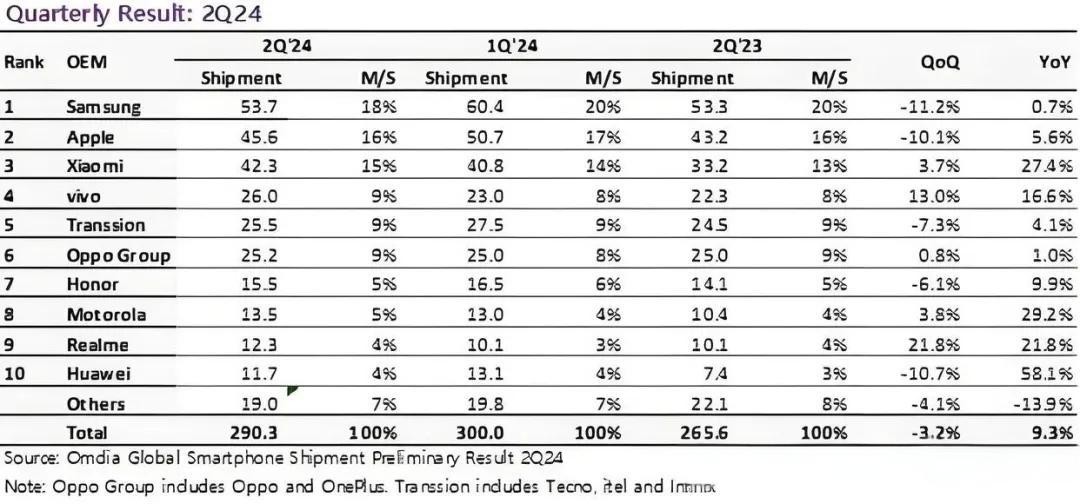
Image Source: Omdia
In the global smartphone market in August, Apple was overtaken by the Chinese brand Xiaomi for the first time in three years (since August 2021), dropping to the third largest smartphone brand globally.

Image Source: Counterpoint
There are several reasons behind this situation:
Firstly, Xiaomi has adopted a more streamlined product strategy this year, focusing on creating a flagship model in each price range, such as the Redmi 13C, Redmi Note 13, and Xiaomi 14, as well as folding screen and Ultra models targeting the high-end market. This strategy has effectively enhanced the competitiveness of its products Furthermore, Apple's iPhone has historically experienced a seasonal sales downturn in August before the September new product release. The decline in August is due to seasonal factors, with September to December being Apple's peak season. However, compared to last year, Apple's sales in August showed a year-on-year decline, which does not seem to be a good sign.
In addition, Xiaomi's success in the lower price segment is also an important reason for the growth in sales.
According to Counterpoint data, in the entry-level smartphone market, the Redmi 13C 4G is the eighth best-selling model globally for the quarter, and the only domestically produced phone on the list.
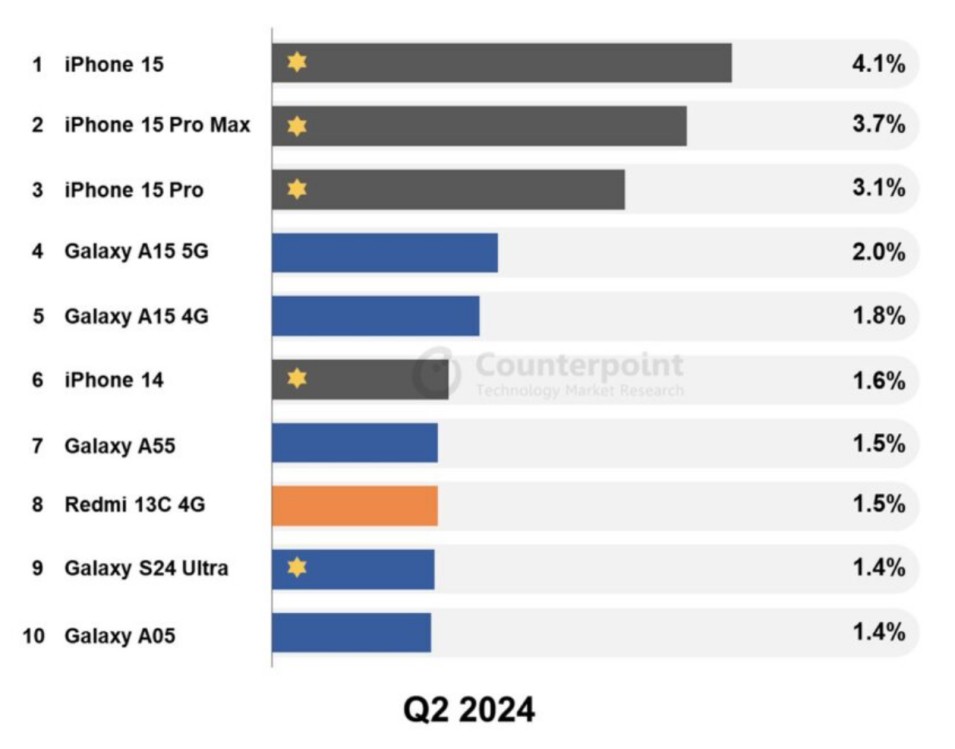
Image Source: Counterpoint
If we narrow the price range to below $150, Xiaomi has three models on the top 10 list. These competitively priced products have seen strong sales in India, Latin America, Southeast Asia, the Middle East, and Africa.

Image Source: Counterpoint
In summary, these various factors have made Xiaomi one of the fastest-growing brands in the first half of 2024, with a 22% year-on-year increase in revenue and the potential to achieve a "strong double-digit percentage" annual growth rate.
After the release of the iPhone 16 series, it is not difficult to predict that Apple will reclaim the global second, or even first, position in October and beyond.
However, the real issue lies in the emergence of domestic smartphone brands such as Huawei, Xiaomi, and vivo, expanding overseas, as well as the deep industrial chain foundation and cost advantages domestically. Apple's "hibernation" in new forms and generative AI fields may not be a good thing for iPhone sales.
II. Adjusting Strategies, Chinese Brands Launching Offensives
In fact, Xiaomi is not the only one adjusting its strategy this year.
For example, in the second quarter of this year, vivo, which ranked first in sales in the two largest global smartphone markets, China and India, chose to optimize its pricing and dual-brand strategy.
It is worth noting that vivo used to rely on a strategy of launching a large number of models to cover different consumer groups. In 2021 alone, vivo released 49 new models, equivalent to the total of Xiaomi and Huawei. In recent years, the smartphone industry has transitioned from an incremental market to a stock market. The effectiveness of launching numerous models is not only weakening but also causing difficulties in supply chain turnover and excessive inventory due to the need for a large number of components for different models.
Therefore, vivo has started to streamline its product line and focus on "value for money." Compared to last year, vivo's products this year have higher specifications but lower prices. Whether it is mid-range or high-end models, vivo aims to sell at a lower price than its competitors to change people's perception of its previous high-priced, low-spec approach vivo has reduced the price of the vivo X100 16GB+512GB by 1049 yuan, and it is now available for purchase at three thousand yuan; the top flagship model, vivo X100 Ultra, is now priced at 5503 yuan, and the 16GB+1TB top configuration version has also been reduced to 6786 yuan. Additionally, the sub-brand iQOO, which lost its momentum to Redmi and Realme last year, has adjusted its pricing and configuration this year to become more competitive.
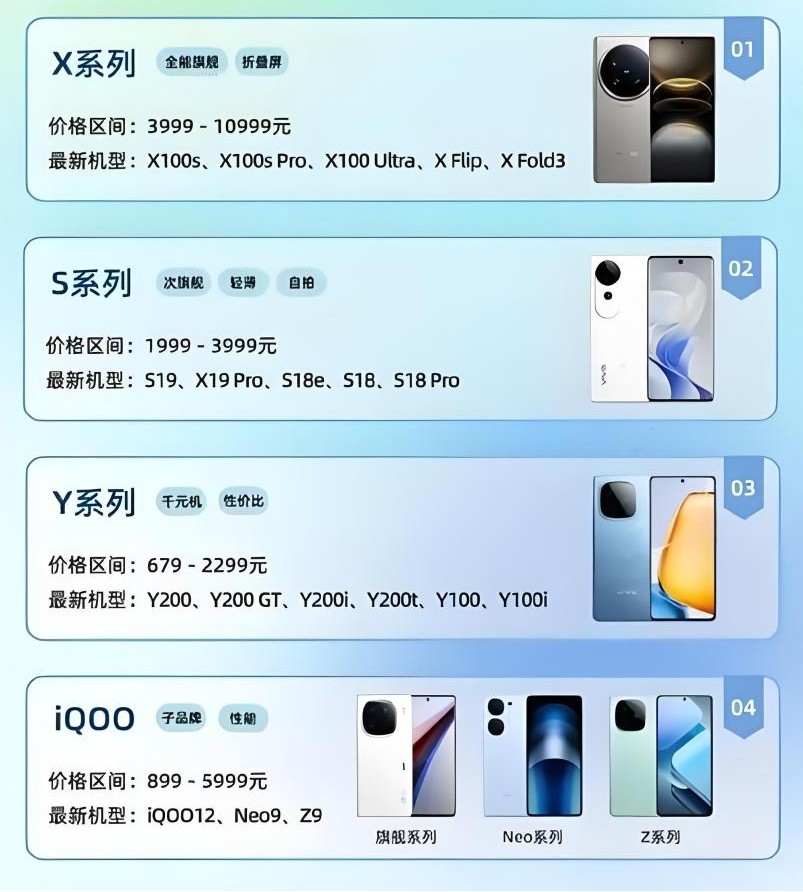
Image Source: Weibo Digital
Currently, vivo has adopted a dual-brand strategy with vivo focusing on offline sales and iQOO focusing on online sales. In terms of product features, vivo emphasizes portrait photography while iQOO focuses on gaming. This clear brand differentiation helps avoid issues such as product cannibalization and product line confusion.
For example, Transsion, a relatively unknown domestic brand but a strong player overseas, became the "fourth largest smartphone manufacturer globally" in the first half of 2024, with a year-on-year increase in smartphone shipments of 84.7%, driven by the smartphone replacement trend in Africa and Southeast Asia.
After achieving success in Africa and Southeast Asia, Transsion expanded its focus to a broader global market, replicating the "African model" in markets such as the Middle East, South Asia, Latin America, and Eastern Europe, while further emphasizing a "user-centric" approach.
In Bangladesh, where motorcycles are the most popular mode of transportation, Transsion launched a marketing campaign offering a free motorcycle with the purchase of a smartphone, specifically the popular Suzuki brand in Bangladesh in recent years. In India, where locals enjoy eating with their hands leading to oily fingerprints on phones, Transsion developed an oil-resistant fingerprint recognition feature. In Iraq, where Samsung's average phone price exceeds 1800 yuan, and Honor and Realme are around 1200 yuan, Transsion managed to offer phones at an extremely low price of around 860 yuan.
According to Canalys data, in the first quarter of 2024, Transsion held a market share of over 40% in Pakistan and over 30% in Bangladesh, ranking first in both countries. In Saudi Arabia, its growth rate reached 230%, with a market share of 25%, ranking first. In Iraq, its growth rate reached 248%, with a market share of 43%, also ranking first.
Furthermore, there is Huawei, the backbone that competes directly with Apple.
From the innovative Mate 20 with a full-screen design to the Mate 30 with 5G performance and a flip camera design, to the Mate 60 with satellite calling and starlight technology, and the extraordinary Mate XT Master, the world's first mass-produced triple-fold screen phone, Huawei remains the only domestic manufacturer that can compete head-on with Apple in the high-end smartphone market.
As Apple's innovation fatigue becomes more apparent in recent years, Huawei's adventurous and idealistic spirit from top to bottom has increasingly resonated with consumers In the second quarter, Huawei's global smartphone shipments increased by 49% year-on-year, ranking tenth. In the Chinese market, according to IDC data, in the first half of 2024, Huawei once again became the top smartphone vendor in the Chinese market with a market share of 17.5%. The shipment growth rates in the first and second quarters were 110% and 50.2% respectively, leading the industry in growth rate.
In summary, under the positive market recovery, Chinese smartphone manufacturers in 2024 are not only focusing on improving their internal capabilities but also actively expanding internationally, placing more emphasis on the global market. With the continued increase in shipments of smartphone manufacturers such as Xiaomi, Huawei, and Vivo, Samsung and Apple can maintain their top two positions in 2024, but their market share will continue to be eroded by Chinese brands.
III. Step by step, there are still many tough battles to fight
With a series of new actions and strategies from various manufacturers, the entire mobile phone industry has formed several major development trends, becoming battles that various manufacturers cannot afford to lose.
One is the increasingly fierce competition in the high-end market, with foldable screens becoming a hot commodity.
Traditionally, the global smartphone market has been dominated by Apple in the high-end segment, while other major manufacturers share the global mid-to-low-end market. However, this situation is changing.
According to Canalys data, in the second quarter of 2024, in mainland China, although Apple still holds a 52% market share in the high-end smartphone market and ranks first, it has dropped by 7%. Meanwhile, Huawei, Xiaomi, Vivo, and Honor, ranked second to fifth, have surged by 82%, 50%, 48%, and 34% respectively. In other words, domestic smartphone manufacturers are gradually encroaching on the high-end market dominated by Apple with their collective strength.
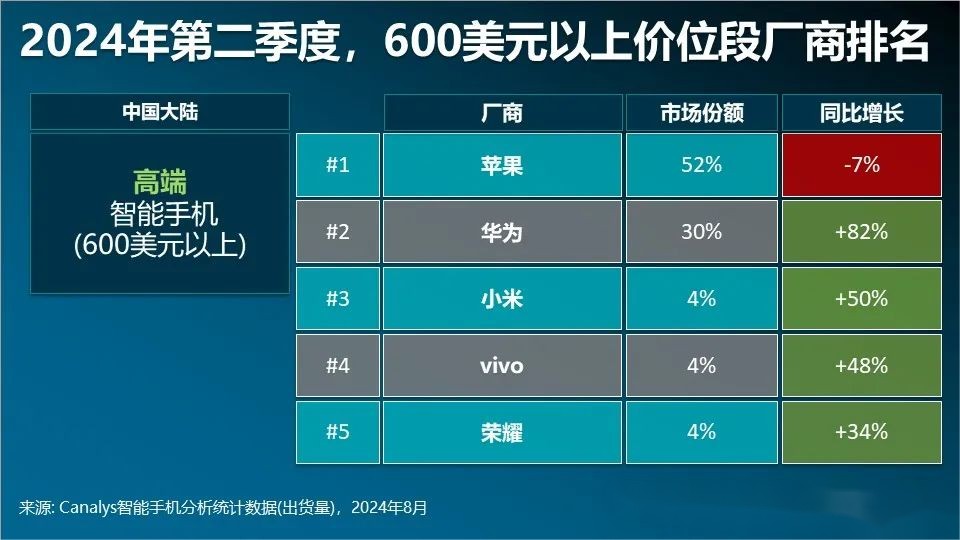
Image Source: Canalys
At the same time, major manufacturers are leveraging foldable screen smartphones to capture more market share in the high-end segment. According to Counterpoint data, in the second quarter of 2024, global foldable smartphone shipments increased by 48% year-on-year, with Huawei leading globally for two consecutive quarters; Honor's Magic V2 series saw a 455% year-on-year growth in shipments in that quarter, surpassing Samsung for the first time in the Western European market and becoming the largest brand in terms of shipments in Europe.
Although Apple still holds a dominant position in the global high-end market, especially through the continued efforts of Chinese brands like Huawei, particularly in differentiated competition through foldable screen smartphones, Apple's market share in the high-end market in China is continuously shrinking.
Two is the trend of self-developed operating systems, with ecosystem construction becoming a priority.
In the past, various smartphone manufacturers mainly released operating systems for their mobile products, such as Xiaomi's MIUI, Vivo's OriginOS, OPPO's ColorOS, etc. Nowadays, the focus is on providing a unified language for the smart, interconnected, and collaborative capabilities of different devices to strengthen their own AIoT product ecosystems, such as Huawei's HarmonyOS, Vivo's Blue River OS, OPPO's Panthalassa system, etc In this regard, Xiaomi's Mijia ecosystem, which started early and has a wide layout, and Huawei's HarmonyOS ecosystem, which has been cultivating for many years and taking frequent actions, have formed a relatively obvious accumulation and advantage. In contrast, OPPO and vivo, although also making attempts in this area, are still in the early stages as seen currently.
Third is the battle for the landing of AI large models.
In addition to foldable screens, AI smartphones are also one of the main trends in the high-end market. How to integrate the capabilities of AI large models into their own operating systems, empower the entire operating system with the capabilities of AI large models, and develop various applications on top of the system is also the focus of competition among manufacturers for the future high-end intelligent phone market.
Fourth is to conquer the overseas market as well.
Unlike the mature domestic smartphone market, there is still a large amount of new demand in markets such as Africa, India, and Latin America due to the transition from feature phones to smartphones. Just by looking at Transsion's growth data in the global market, it is clear that to become a global smartphone giant, the overseas market is a market that must be faced and conquered.
However, it is also clear that the complexity and difficulty of the overseas market are equally high. Chinese smartphones entering the overseas market not only need to design products and services in accordance with local customs but also face many challenges in terms of compliance reviews, and even "unequal treatment."
In summary, in 2024, the rapid progress of Chinese brands in the global smart phone market has brought hope to Chinese smartphone brands, but also many uncertainties.
Whether now or in the future, Chinese smartphone manufacturers still face various tests, from supply chain management, product line strategies, technological research and development, to the landing of AI large models, ecosystem construction, and overseas market layout. Chinese smartphone manufacturers need to proceed cautiously at every step in order to truly navigate the waves and become the trendsetters of the new era
