


ASML's performance collapses, with orders only half of market expectations, lowering next year's sales target, and the stock price plunges 17%|Financial Report Insights

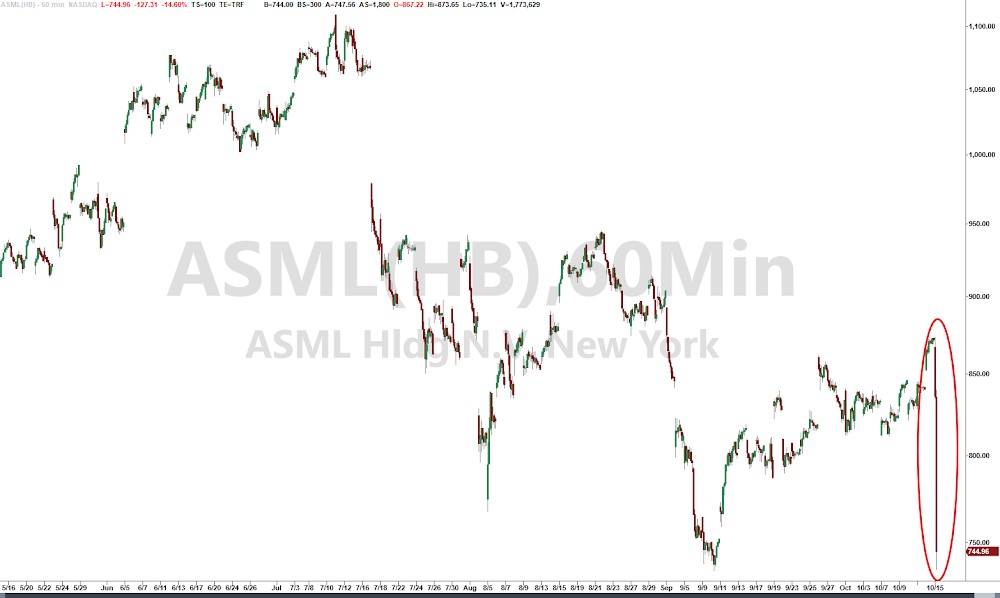
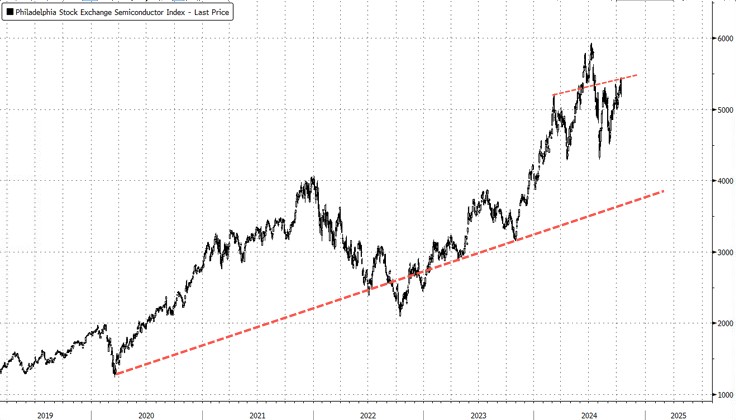
According to the financial report, ASML's order volume in the third quarter was only 2.63 billion euros, a 53% decrease from the previous quarter, and it also lowered its revenue and gross profit expectations for 2025. The company stated that while there was indeed a surge in demand for AI chips, other parts of the semiconductor market were weaker than expected, leading to delays in orders from logic chip manufacturers. The poor performance caused ASML's ADRs to fall by over 17% in the US market, and a 16% drop in the Dutch market marked the largest decline since 1998. ASML's sharp decline also dragged down the Philadelphia Semiconductor Index and other chip stocks such as NVIDIA
Dutch optical technology giant ASML was originally scheduled to release its third-quarter financial report on Wednesday, but due to technical issues, the report was prematurely posted on the website during Tuesday's early trading session in the US stock market. The disappointing performance caused a market uproar: while revenue exceeded expectations, orders were only half of what the market expected, leading to a downward revision of next year's sales target and gross margin guidance.
Key Financial Data:
Net Sales: Net sales in the third quarter were EUR 7.47 billion, a 20% increase from the previous quarter, analysts expected EUR 7.17 billion.
Order Volume: Orders in the third quarter were EUR 2.63 billion, a 53% decrease from the previous quarter, analysts expected EUR 5.39 billion.
Gross Margin: Gross margin in the third quarter was 50.8%, analysts expected 50.7%.
Net Profit: EUR 2.08 billion, a 32% increase from the previous quarter, expected EUR 1.91 billion.
Cash and Others: EUR 4.99 billion, a 0.7% decrease from the previous quarter, expected EUR 4.86 billion.
Performance Guidance:
2024 Full-Year Net Sales: Expected full-year net sales of EUR 28 billion, analysts expected EUR 27.71 billion.
Q4 Net Sales: Expected fourth-quarter net sales of EUR 8.8 billion to 9.2 billion, analysts expected EUR 8.95 billion.
Q4 Gross Margin: Expected fourth-quarter gross margin of 49% to 50%, analysts expected 50.5%.
2025 Net Sales: Expected net sales of EUR 30 billion to 35 billion in 2025, previously expected EUR 30 billion to 40 billion, analysts expected EUR 35.94 billion.
2025 Gross Margin: Expected gross margin of 51% to 53% in 2025, the company originally expected around 54% to 56%.
The company stated that ASML's system sales in the Chinese market accounted for 47% in the third quarter, down from 49% in the previous quarter, still the largest market for ASML. It is estimated that the contribution of the Chinese market to the company's overall revenue in 2025 will be approximately 20%.
After the financial report was released, ASML's ADR in the US stock market fell by over 17% at one point, ultimately closing down by 16.26% at $730.43. The company's stock price on the Amsterdam stock market also fell by 16%, marking the largest single-day decline since 1998, and was temporarily halted during trading.

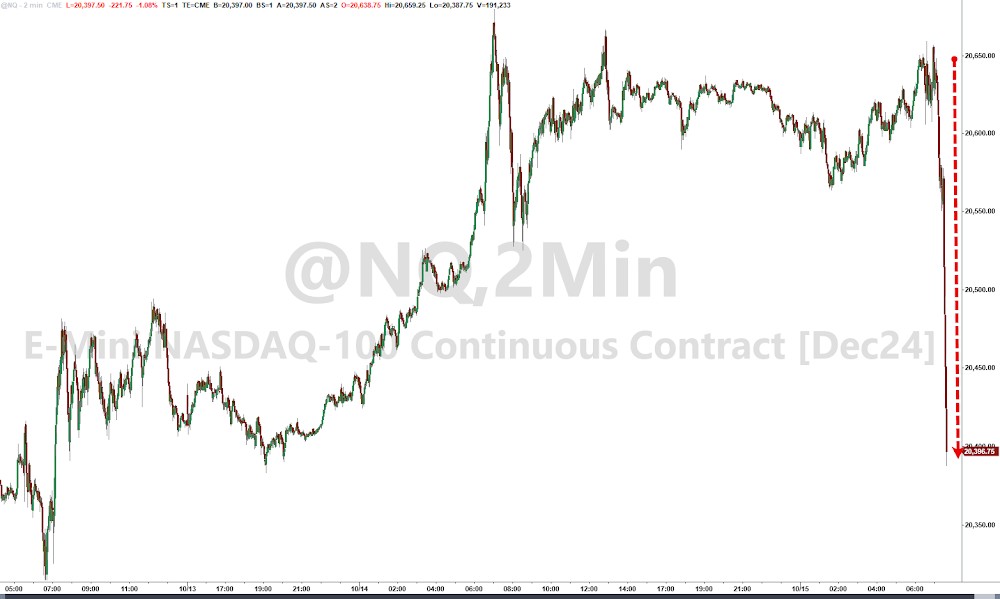
The Nasdaq index fell by 1.34%, the Philadelphia Semiconductor Index fell by 5.24%, marking the largest drop in over a month. Intel fell by 3%, TSMC ADR fell by 2.64%, Micron Technology fell by 3.7%, NVIDIA fell by 4.53%, AMD fell by 5.22%, and Arm Holdings fell by 6.89%
Is the AI Bubble About to Burst? ASML: Strong Demand for AI Chips Continues, But Other Areas Face Issues
ASML is the largest technology company in Europe and a leading supplier of chip-making equipment. Its customers include AI chip manufacturers TSMC, logic chip manufacturers Intel and Samsung, as well as memory chip manufacturers Micron and SK Hynix. As a key supplier to many chip manufacturers, ASML's performance is often seen as an indicator of investment plans and prospects in the chip industry.
Just over a month ago, Jensen Huang, CEO of AI leader NVIDIA, stated at the Goldman Sachs Technology Conference in San Francisco, "The demand for chips in AI is very high, everyone wants to be the first, everyone wants to be in the lead." He added, "Today we may have more emotional customers, and that's natural. It's very tense, and we're doing our best."
Financial media ZeroHedge believes that ASML's disappointing financial report and outlook revision may indicate that the AI bubble is deflating.
However, ASML's CFO Roger Dassen denied this claim in a statement. The company stated that while there is indeed a surge in demand for AI-related chips, other parts of the semiconductor market are weaker than expected, leading to logic chip manufacturers delaying orders and memory chip manufacturers planning only "limited" additional capacity.
"While the AI sector continues to have strong growth and upside potential, the recovery time in other market areas is longer. Currently, the recovery appears to be more gradual than previously expected. This situation is expected to continue into 2025, leading to more cautious customers. In terms of logic chips, the dynamics of competitive wafer foundries have resulted in slower expansion speeds for certain customers' new nodes, leading to multiple fabs delaying and causing changes in lithography demand times, especially in EUV. In the memory field, we see limited additional capacity, with the focus still on technology transitions to support the demand for HBM and DDR5 related to AI."
ASML's CFO Roger Dassen also stated,
"Some very specific competitive issues in the chip manufacturing business have led to a slowdown in the recovery of chip markets that have not benefited from the AI boom demand.
It is clear that the strong performance of AI is still ongoing."
Media reports indicate that over the past two years, AI has driven the development of certain sectors in the chip industry, making NVIDIA one of the world's highest market cap listed companies. Other chip manufacturers less connected to the AI boom, such as Intel, have faced more challenges. In sectors of the chip industry where demand surged during the pandemic, such as automotive and consumer electronics chips, recent demand has also declined Therefore, the analysis suggests that the challenges faced by Intel and Samsung recently seem to have led to ASML's weak performance.
Intel is currently cutting costs through layoffs and delaying new production facility investments, with the company reporting disappointing performance in August. Earlier this month, Samsung also admitted to facing a "crisis" in AI chip manufacturing, as the downward trend in the memory market is looming.
Analysts: Still a Surprise
For analysts, ASML's downward revision of performance guidance is a negative surprise.
Citigroup stated in a report:
"Just earlier this September, ASML management reiterated the 'conservative' nature of the lower end of the 2025 performance guidance range."
"We look forward to more detailed information on recent demand changes, understanding the impact of this on ASML's 2025 expectations downgrade, and what it means for customer plans in 2026."
Analyst Michael Roeg from Degroof Petercam Bank expects ASML's warning to drag down the entire industry, but he noted that sales for ASML in 2025 are still expected to grow compared to 2024.
"Despite a soft chip end market, equipment demand has not declined."
Bernstein analysts, in a report following ASML's financial results release, stated that ASML's guidance downgrade indicates that "delayed cyclical recovery and challenges from specific customers severely impacted the expectations for 2025."
Meanwhile, analysts at Cantor stated that ASML's pessimistic outlook is "clearly disappointing" and will put pressure on semiconductor stocks. However, the analysts added, "The company's updated outlook does not in any way imply a change in the AI growth story."
