


US Media: Complacent BBA, Far Behind Chinese Electric Vehicles

German car manufacturers are facing challenges in the Chinese market as consumer interest in traditional selling points weakens, leading to a decline in sales. Mercedes-Benz, BMW, and Audi's electric vehicles have failed to attract customers, with sales declining in the third quarter, with BMW experiencing a 30% decrease. German carmakers have been complacent and underestimated the threat from Chinese competitors, as local brands such as Tesla and BYD have quickly risen to prominence
Key Points:
-
As Chinese consumers pay less attention to traditional selling points like horsepower, their perception of German cars is starting to decline.
-
After dominating the era of gasoline cars, German manufacturers became complacent and underestimated the threat from Chinese competitors.
-
Mercedes-Benz, BMW, and Audi are now "hardly seen as luxury cars".
-
German carmakers hope to reverse the situation as the Chinese market is irreplaceable.
For German car manufacturers, Ryan Xu is a dream customer. This Guangdong entrepreneur and her husband own a Porsche 911, a Mercedes G-Class, and were among the first consumers to purchase a Porsche Taycan electric car. The Taycan is priced well over $100,000.
However, as Chinese consumers increasingly favor technological advancements over traditional selling points like horsepower and handling, her perception of German cars is starting to decline. The 36-year-old mother of three stated that the software system of the Taycan is "terrible" and "it's just an electric version of a Porsche, nothing more".
She is not alone in this assessment. China has long been the largest and most profitable market for Mercedes-Benz, BMW, and Audi's parent company Volkswagen. However, as China transitions from the era of internal combustion engine cars to electric vehicles, these three major German luxury car manufacturers have struggled to launch appealing electric cars in China, putting their €35 billion (approximately $38 billion) investment at risk.
Last week, the three German carmakers sounded another alarm as their sales in China declined in the third quarter. BMW's sales in China plummeted by 30%, marking the largest drop in over four years; Mercedes-Benz saw a 13% decrease in sales due to weak demand for high-end models like the S-Class and Maybach.
With global demand for the Taycan nearly halved, Porsche's sales in China plummeted by 19%, marking its worst third-quarter performance in a decade. Meanwhile, Volkswagen's sales dropped by 15%. "Competition in China is particularly fierce," said Marco Schubert, Volkswagen's sales director.
The Cost of Complacency
After dominating the era of gasoline cars, German manufacturers became complacent, underestimated the threat posed by new competitors, and were unwilling to give up the profits from large-displacement cars. This allowed Chinese domestic manufacturers like Tesla and BYD to catch up and introduce affordable plug-in cars equipped with advanced technology. Now, the Chinese market no longer needs or wants them.
"These German car manufacturers are at a crossroads," said Stephen Dyer, Managing Director of AlixPartners in Shanghai. "They need to drastically change their market strategies."
The next challenge has already emerged at this week's Paris Motor Show. Chinese manufacturers are intensifying efforts to seize market share in Europe. Companies like BYD, XPeng, and others will showcase their latest technologies at the Paris Motor Show, the largest automotive event in Europe this year A leaky roof always meets a night of rain. Faced with the fierce competition from Chinese car manufacturers, Volkswagen originally wanted to take advantage of the Paris Motor Show to showcase the company's future electric vehicles. However, during Volkswagen's presentation, the microphone and slides were interrupted for a few minutes, which clearly frustrated Martin Sander, the head of sales and marketing.
Chinese car owners are also frustrated. After experiencing brake and other quality issues, Ryan Xu's family sold their Porsche Taycan and purchased an ET5 from the Chinese brand Nio. They also considered the Mercedes-Benz EQE, but the ET5 is not only about one-third cheaper, but also has a more luxurious interior design and smoother voice control. When the children climb into the car, the ET5 greets them by calling out their names.
"It's difficult for German cars to reach this level of technology," said Ryan Xu, who runs a business with her husband. She believes that Mercedes, BMW, and Audi "are now hardly considered luxury cars."
Declining market share
Although German car manufacturers still control nearly 15% of the Chinese car market, this share is lower than the previous one-fourth. Worse still, their market share in electric vehicles is less than 10%. If they cannot quickly reverse this decline, the downturn could turn into a collapse, pushing the three major German car manufacturers into a struggle for survival. In fact, the market value of Volkswagen, Mercedes-Benz, and BMW is only about half of BYD's stock market value.
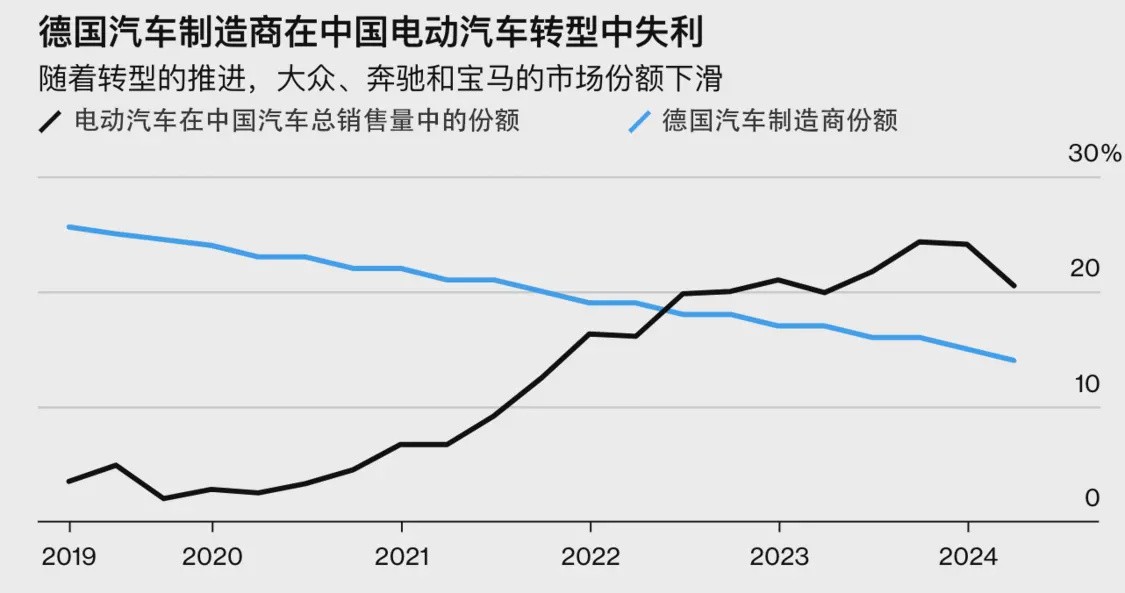
Decline in market share of German car manufacturers in China
Compared to their international counterparts, German car manufacturers have made more thorough investments in China. While some competitors have cut their losses, German car manufacturers have not given up but have shifted more resources to regain market share. However, this seems to be a tough battle.
Volkswagen plans for the long term. A company spokesperson stated that the Chinese car market likes to offer significant discounts, but Volkswagen will not sacrifice profits to gain market share. They adhere to the strategy of "In China, For China" to protect their long-term development prospects. BMW and Mercedes-Benz also plan to stick to a localized strategy to attract Chinese consumers.
Importance of China
The reasons why German car manufacturers are doubling down on China are obvious. The European car market may have passed its peak, and the US car market is already saturated. Therefore, in terms of sales and profit levels, they have no other alternative market to replace China.
Their significant investments in China have also attracted attention. Overall, German car manufacturers operate over 40 factories in China, even more than they have in their home country of Germany. This is a huge investment that cannot be easily abandoned, which also explains why they oppose the EU's plan to impose tariffs on Chinese electric vehicles For BMW, Mercedes-Benz, and Volkswagen, it is almost unimaginable to exit China like Japanese small car manufacturers such as Suzuki and Mitsubishi. Moreover, any restructuring plan would be complex, making it a top priority for them to focus on developing features that meet the needs of Chinese consumers.
By the end of 2022, the situation became increasingly urgent. At that time, Ralf Brandstätter, head of Volkswagen China, warned the company's supervisory board that Chinese automakers were rapidly taking the lead. Subsequently, Volkswagen chartered planes to send hundreds of employees to attend the Shanghai Auto Show in April 2023 for on-site inspections.
This inspection made German executives see the reality as if waking from a dream. They were facing rapidly emerging affordable Chinese economy cars, products with rich technological features, and increasingly intense price wars. In addition, Chinese car companies have a range of innovative ideas, such as cars that can jump and in-car karaoke systems. These features may seem somewhat quirky, but they are redefining the benchmark for automotive trends among Chinese consumers.
Response Measures
Since then, Volkswagen has taken a series of response measures. Shortly after participating in the Shanghai Auto Show, Volkswagen CEO Oliver Blume dismissed the head of the software department Cariad to accelerate technology improvements. Volkswagen not only established new partnerships in China for autonomous driving, infotainment, and user experience but also invested in XPeng to leverage the startup's expertise in electric vehicle manufacturing.
After issuing a profit warning in September, one of the first actions taken by Mercedes-Benz CEO Ola Källenius was to fly to China to inspect the progress of reshaping its business in China, including cooperating with CATL to produce batteries and partnering with Tencent to provide digital services. In response, BMW teamed up with Great Wall Motors to produce electric vehicles for its Mini brand.
With a series of measures accumulating, German cars in their largest market, China, are gradually becoming less Germanic. Gregor Sebastian, an analyst at Rongding Consulting, stated that German automakers' efforts to maintain their market position in China are "a huge gamble," and if everything goes wrong, the German government may need to bail them out, "they hope to be too big to fail."
Although Chinese people have been enthusiastic about buying German cars for many years, the market has changed, and capturing a younger and more technology-focused customer base than Europe is a major challenge. As China shifts towards electric vehicles, local brands have proven that they can compete with Volkswagen, BMW, and Mercedes-Benz in terms of quality, and surpass them in price and technology.
What does all this mean for Germany? The answer can be found in the production workshop of the flagship S-Class sedan at the Sindelfingen plant near Stuttgart. This is where the S-Class, which has always been popular among China's new wealthy class, is produced. However, its demand has now significantly declined, leading to production being reduced to a single shift for the first time Despite the cost reduction and efficiency improvement sweeping through the German automotive industry, the most obvious threat is Volkswagen's threat to close its German factories, but German automakers' business in China remains unaffected. This sign indicates that executives are hopeful of reversing the situation, but they have almost no other choice.
In China, it is difficult for foreign companies to downsize their operations because large-scale layoffs often require discussions with domestic partners, making more radical adjustments such as closing a factory even more difficult. This puts pressure on German automakers, forcing them to revitalize sales.
Although German automakers face structural headwinds (such as changing consumer preferences), this decline could have been avoided if they had made more forward-looking investments in the Chinese market. However, after dominating the automotive industry for decades, German manufacturers did not take Chinese competitors seriously. When their decisions are made by a board of directors thousands of miles away, the views of their Chinese subsidiaries on the market are also ignored.
They also did not pay enough attention to the fact that the transition to electric vehicles is not just about changing one power system to another. Their early software was full of bugs. For example, Volkswagen launched its first Chinese electric vehicle model in 2020, but it took several years to finally achieve remote updates.
This means that owners had to take their cars to dealerships for in-store upgrades, sometimes taking several days. To dispel owners' resistance, some dealers even offered cash rewards to encourage customers to fix faults.
Mr. Zhou, an IT engineer living in Wuhan, purchased an ID.4 at the beginning of 2022 and then had to endure software failures. During driving, his car screen went black multiple times, and what he experienced was a malfunction, not German quality. System updates were often delayed or could only be obtained through dealerships.
He now wants to change his car and will still buy an electric vehicle. "But this time, I won't go to any German car dealerships again," he said. "I will only choose domestic brands or Tesla."
