Hermès International Société en commandite par actions, when will the distribution end?

Huxiu
2024.10.17 03:25
portai
I'm PortAI, I can summarize articles.

Hermès International Société en commandite par actions faces its third collective lawsuit, with consumers accusing its allocation system of violating antitrust laws by forcing the purchase of high-priced accessories to qualify for buying a Birkin bag. The lawsuit includes allegations of false advertising and fraud, with the plaintiffs claiming that Hermès enticed consumers to buy accessories but did not provide the Birkin bag. Judge James Donato expressed skepticism towards the consumers' claims, stating that Hermès has the right to choose its business practices and that its actions may promote competition in the luxury goods market

Hermès collective lawsuit has new developments.

According to Reuters, three consumers from California submitted the third lawsuit against the French luxury brand Hermès last Friday, continuing to target Hermès' controversial allocation system, accusing Hermès of forcing consumers to purchase other high-priced accessories before being eligible to purchase the platinum Birkin bag, alleging violations of antitrust laws, false advertising, and fraud.

In March of this year, two plaintiffs first accused Hermès of only providing platinum bags to customers with sufficient purchase history, leading to thousands of consumers who had purchased Hermès products or were required to allocate to purchase the platinum bag joining this class action lawsuit, attracting widespread attention in the industry.

One of the plaintiffs claimed that she had already purchased tens of thousands of dollars worth of products from Hermès and owned more than one platinum bag, but when she inquired about another platinum bag at a store in 2022, she was told that the product was only sold to "customers who have always supported our business."

Subsequently, Hermès requested the San Francisco federal court to dismiss this high-profile case.

Hermès denies any wrongdoing, telling U.S. District Judge James Donato that these accusations are far-fetched and stating that the company faces fierce market competition.

This group of consumers continues to appeal, adding more accusations and details than before. The revised lawsuit adds charges of false advertising and fraud. The lawsuit mentions that Hermès and its salespeople knew they were inducing many people to purchase allocations, but these people would not actually receive the platinum bags.

They are trying to convince the skeptical Judge James Donato, a former antitrust lawyer. At a hearing in September, he expressed doubts about the consumers' claims.

He believes that Hermès can operate its business in its own way. If it chooses to produce only five platinum bags per year and price them at one million dollars each, that is entirely its prerogative. Many customers may not be able to buy the platinum bags, but that does not constitute an antitrust issue.

The judge also pointed out that Hermès' behavior may even promote competition in the luxury goods market.

He admitted that if Hermès forces consumers to pay a high premium for their bags, it is creating opportunities for every competitor, allowing other brands to attract customers by saying, "Come buy our beautiful handbags, and you don't need to spend $3,000 or $30,000 on a belt."

As of now, Hermès has not responded to this.

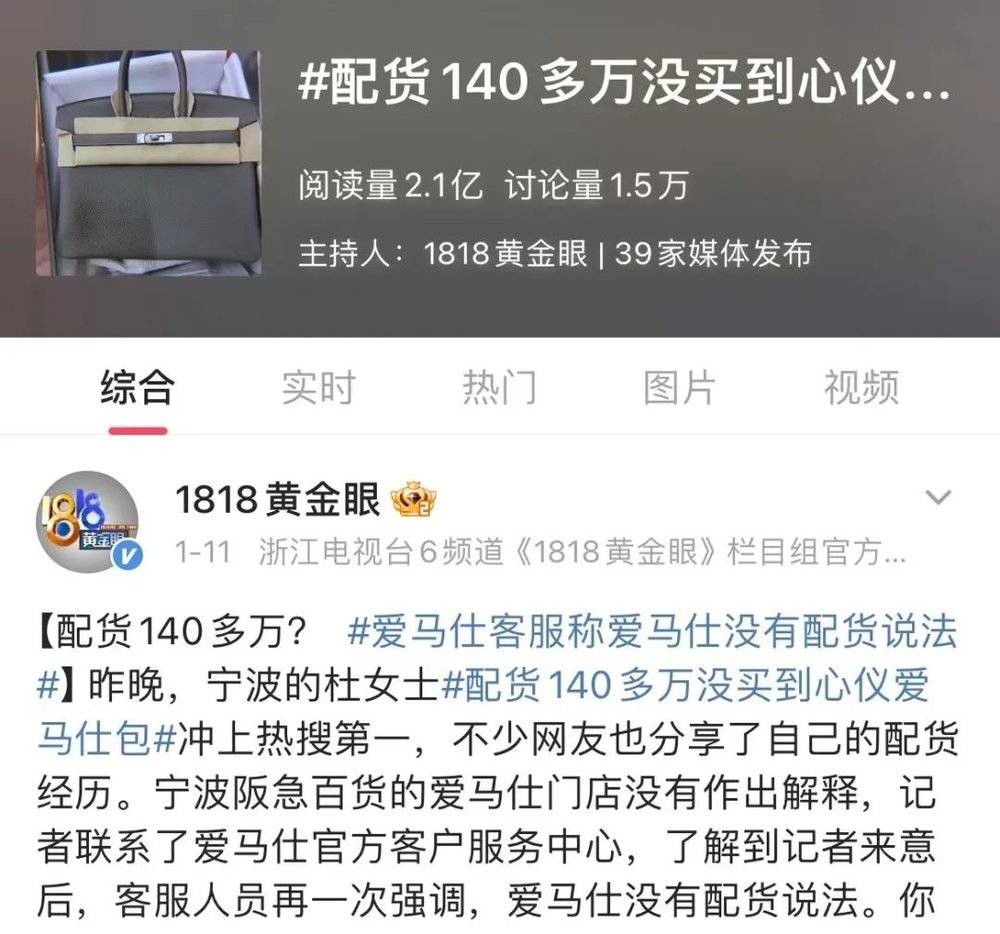
The class action lawsuit reflects consumers' deep grievances against Hermès' allocation system. In addition to the anger sparked by the issue of purchasing allocations but not receiving bags mentioned in the lawsuit, some consumers are also dissatisfied with Hermès' practice of allocating bags but denying the existence of this unwritten rule.

Regardless of public controversy, Hermès has always insisted that there is no allocation system in place.

Over the years, Hermès has mostly denied allegations regarding the hidden rules of allocation, stating that the brand strictly prohibits selling certain products as a prerequisite for purchasing others.

However, in practice, allocation has long become an established process for purchasing popular Hermès handbags, reaching a stable level in terms of allocation ratios. This largely indicates that the brand is aware of this and deliberately controls it.

Taking the most classic 30 Noir/Gold Birkin bag from Hermès as an example, consumers typically need to purchase around 80,000 to 100,000 RMB worth of other non-leather products, about 1.5 to 2 times the retail price, in order to have the opportunity to receive a notification from sales staff to pick up the bag. The allocation ratios for two other popular handbags from Hermès, Constance 19 and Kelly, are also around 1.5 to 2 times the retail price.

Since the beginning of this year, with an overall cooling in luxury consumption, Hermès has also faced sales pressure. Many consumers have reported that the allocation ratio for Hermès' cash cow BKC has decreased this year, making it more difficult to purchase.

Although some popular color styles are still hard to obtain, compared to the situation where allocation did not guarantee receiving the bag in the past, some consumers have revealed that Hermès is now willing to negotiate allocation ratios and provide the bag on-site this year, showing a more relaxed attitude and transparency towards consumers.

Some opinions believe that a decrease in Hermès' allocation ratios may damage the trust of high-net-worth individuals in the brand, as Hermès' allocation ratios are almost a barometer for the entire luxury goods market.

Unlike price-sensitive consumers, high-net-worth clients of Hermès are not chasing individual items, but rather buying out of recognition for the brand's positioning at the top of the pyramid. Therefore, the more expensive, the more they buy, purchasing whatever the brand releases. If the brand excessively caters to consumers, it may lead to a loss of respect from this consumer segment.

Insiders have pointed out that after attempting to increase allocation ratios following a decrease this year, Hermès received poor market feedback, leading to a subsequent decrease in allocation ratios again. Supply of popular Hermès handbags in the second half of the year is more abundant compared to previous years.

Some consumers admit that weakening the brand's strong stance and increasing supply is a positive development for consumers. In recent years, with luxury goods prices skyrocketing and Hermès' allocation ratios soaring, many consumers have grown tired of the psychological games with sales staff and are considering completely stepping out of the luxury goods comparison game.

Undeniably, despite Hermès investing a significant amount of effort in building a brand aesthetic world, this brand is still more closely associated with consumers' social status symbols than with its aesthetics.

Overall, allocation has become a unique sales tactic for Hermès.

While allocation phenomena have also appeared in many other brands, such as consumers being required to make additional purchases equivalent to or even higher than the original price when buying classic Chanel handbags or new products in recent years, this situation is not long-term and stable, with strong individual differences and no established allocation ratios for reference.

Behind this is the fact that demand for Chanel's classic products has not been consistently higher than supply in the long term. Chanel's aggressive price increases in recent years and implementation of allocation have been seen as imitating Hermès, which is precisely what Hermès mentioned in rejecting litigation as fierce market competition However, Hermès' successful model is almost impossible to replicate. The long-term objective existence of Hermès' distribution system is based on the solid core position of handbags, and secondly, the brand's strong position is recognized by consumers. For Chanel, the strong position formed by short-term price increases needs time to settle into consumer awareness and cannot be achieved overnight.

Considered a hard currency, Rolex also has bundling sales, but Rolex's bundling sales are also linked to the unique sales format of the watch industry. Unlike luxury goods sold through direct stores, Rolex relies on a vast network of distributors worldwide to sell its products. Therefore, the bundling sales model of popular Rolex watches does not solely depend on the brand, but also on the distributors.

Currently, Rolex's bundled products are generally from another watch brand under its group, Tudor. However, there have been reports that Rolex has suggested to distributors to adopt a loyalty points consumption system similar to Hermès for customers, which means that the range of bundled products will be limited to the Rolex brand.

After Rolex completed the acquisition of the global leading watch distributor BUCHERER Bucherer in August 2023, the transformation of the brand's sales model has begun, and adjustments are likely to be made to the bundling model around the brand. Recently, Rolex opened its first flagship store in China, and consumers are concerned about whether they can purchase Rolex at the official price and which brands are allowed to be bundled, which has become a closely watched issue in the market recently.

Objectively speaking, the distribution system has provided Hermès with a sales cushion during the cooling period of luxury goods, allowing it to adjust in different market environments.

Under this mechanism, Hermès has built a strong moat by establishing a relative balance in the sales of various categories of the brand through distribution rules, alleviating the chronic problem of high inventory in the fashion industry and achieving a relatively high sell-through rate overall. It is reported that for every platinum bag sold globally, three to five Hermès backlog items are simultaneously sold out.

In the first half of the year when luxury goods giants such as LVMH and Kering faced sales pressure, Hermès still delivered outstanding results with a 15% increase in revenue to 7.5 billion euros.

The group's operating profit increased by 8% to 3.1 billion euros during the period, and net profit increased by 6% to 2.4 billion euros, with the leather goods and saddlery department where the platinum bag is located seeing a revenue growth of 15.7% to 3.22 billion euros, the highest increase.

The group stated that Hermès' market share in China has declined very slightly, mainly due to inventory shortages and currency exchange rate effects. The group still maintains stable expansion, including opening a new store in Wuxi earlier this year and the reopening of the renovated Beijing SKP store in the middle of the year.

The remarks of Judge James Donato in this collective lawsuit undoubtedly open up new levels of understanding for the controversial Hermès distribution system. For luxury brands to establish themselves in the market in the long term, in addition to the uniqueness of products and brands, innovation in sales models also determines the brand's development.

For Hermès, the possibility of no longer distributing as suggested by the collective litigants is extremely low, but there is indeed ample room for optimization in this system. Treating other categories besides handbags as accessories actually reduces the importance of these categories. For example, the jewelry and watch series that the brand has vigorously developed have the potential to become Hermès' second growth curve, but many Little Red Book users do not consider them worth investing in, partly because these categories are seen as quotas for buying handbags.

How to optimize the attractiveness of clothing, jewelry, and watch categories to consumers, rather than forcing them to buy products they do not appreciate, is a fundamental issue that even Hermès has not solved.

For example, its clothing category has not made appropriate size adjustments for local consumers, especially in key Asian markets. Even at the moment when the quiet luxury trend became the driving force behind Hermès' clothing series, the brand, despite having a creative director and conducting seasonal fashion shows, fell behind in the competition in the last round of high fashion markets compared to brands like The Row, Brunello Cucinelli, and Loro Piana.

Cushions are not a panacea, and under external intervention in collective litigation, Hermès adjusting its allocation mechanism may just be a matter of time.

In other words, Hermès cannot avoid competition just because its clothes sell well. Since Hermès now actively mentions the fierce market competition, it also means that the brand has not isolated itself from today's luxury goods market