


Stock price on a "roller coaster", what's going on with NVIDIA?

NVIDIA experienced drastic stock price fluctuations in 2024, with a nearly 180% increase at the beginning of the year. However, due to market concerns about delayed production of new products and US export restriction policies, the stock price plummeted significantly. On September 3rd, the stock price plummeted by 9.5%, causing a market capitalization shrink of $279 billion. On October 15th, it dropped again by nearly 6.8%, leading to a market capitalization evaporation of $158.71 billion. The global semiconductor market's weakness and poor financial reports from ASML triggered a collective decline in tech stocks, putting pressure on NVIDIA from competitors like AMD
In 2024, it is destined to be an extraordinary year for NVIDIA.
Since the beginning of this year, NVIDIA's stock price has risen by nearly 180%. Behind the rise in stock price is the optimistic expectation of global capital for long-term demand in the AI field, as well as NVIDIA's leading position in the AI chip market.
However, with skyrocketing prices often come sharp declines. The higher the market's expectations, the more intense the reaction when disappointed.
After reaching a historic high in June and briefly becoming the world's most valuable company, NVIDIA's stock price has been fluctuating. One reason is the market's concern that the production of NVIDIA's new products may be delayed, but more importantly, it is due to the export restrictions imposed by the United States on NVIDIA.
Meanwhile, even though NVIDIA has been leading the market by a wide margin, it is not without competitors. In recent years, AMD has made a significant impact on Intel's market share in the CPU field, and now it intends to secure a place in the artificial intelligence GPU market.
What lies ahead? NVIDIA urgently needs to give countless investors a definite answer.
Stock Price on a Roller Coaster Ride
Following a 9.5% plunge in NVIDIA's stock price on September 3, resulting in a market capitalization shrink of $279 billion (approximately RMB 19.8 trillion), NVIDIA recently experienced another significant drop.
On October 15, local time, NVIDIA's stock price took a heavy hit, plummeting nearly 6.8% intraday, evaporating $158.71 billion (approximately RMB 11.3 trillion) of market value overnight.
On the news front, global lithography giant ASML recently released its financial report ahead of schedule, predicting that due to the sustained weakness in certain areas of the semiconductor market, sales and orders for 2025 will be lower than expected.
The premature "thunderstorm" in performance caused ASML's stock price to plummet by over 16%, marking the largest single-day drop since 1998 for the company. Such a significant decline shook the entire tech market, triggering a collective decline in the US chip sector.
As a key player in the chip industry, NVIDIA, despite being in the hottest artificial intelligence race and being a "leader," is still inevitably impacted.
Furthermore, there have been reports from foreign media that the United States is discussing setting limits on export licenses for American companies such as NVIDIA and AMD for certain countries in the field of artificial intelligence (AI) chips. These restrictions will focus on Gulf countries, where the demand for artificial intelligence data centers is growing, and the measures will affect the AI capabilities of some countries.
Facing significant negative factors in the industry's upstream and a further challenging market environment, NVIDIA's recent stock price plunge is understandable. However, surprisingly, just one day later, on October 16, NVIDIA's stock price "counter-trend" rose by 3.13%.
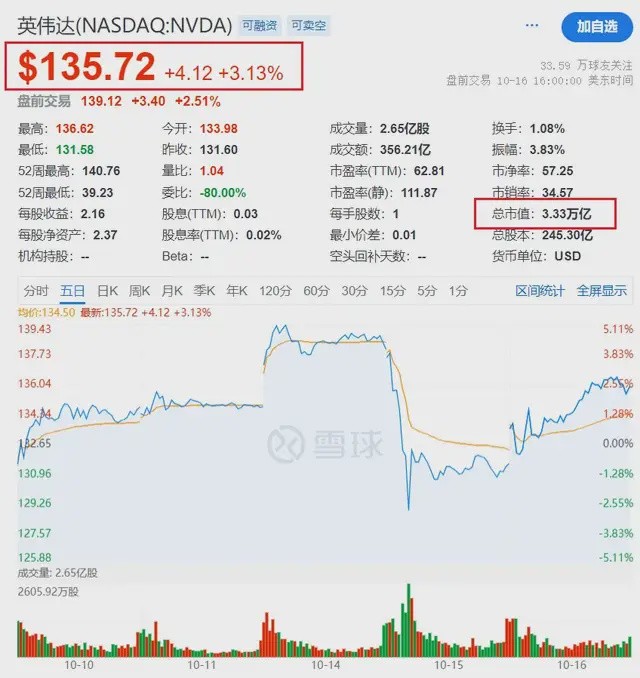 In the financial market, short-term fluctuations are random, unpredictable, uncontrollable, and irregular, but long-term trends are traceable, can be diversified, and follow certain patterns.
In the AI era, with the continuous development of AI technology, the market's demand for NVIDIA chips is also increasing. Even if its stock price experiences a sharp short-term decline, it seems unable to stop the long-term upward trend.
Billionaire investor and founder of the Duken family office, Drew Miller, recently stated in a media interview, "In my investment career, I have made many mistakes, one of which is selling all of my NVIDIA shares at around $800-950. NVIDIA is a great company, and if the stock price drops, we will participate again. But now, I am licking my wounds for the bad sell-off."
However, this does not mean that NVIDIA can rest easy.
Relentless Pursuit by AMD
In recent years, NVIDIA has dominated the data center GPU market, almost forming a monopoly. However, under the AI wave, facing huge profits and market prospects, AMD, which has long been in second place, has been continuously trying to catch up.
Earlier this year, NVIDIA released its most powerful product, the B200, with a computing speed nearly 30 times faster than the previous generation H200 chip. As planned, the B200 will be mass-produced and launched in the fourth quarter of this year, further widening the gap with its competitors.
However, AMD recently released a new generation of products that directly confront NVIDIA's Blackwell chip, accelerating its pace to catch up with NVIDIA.
On October 10th, AMD CEO Su Zifeng delivered a nearly 2-hour speech, focusing on the release of the AI chip named Instinct MI325X.
According to public data, compared to NVIDIA's H200 integrated platform H200 HGX, the MI325X platform offers 1.8 times the memory capacity, 1.3 times the memory bandwidth, and 1.3 times the computing power.
In addition, AMD also unveiled the latest AI chip roadmap at the event, with the MI350 series adopting the company's CDNA 4 architecture set to launch next year, and the MI400 series to use a more advanced CDNA architecture.
However, it is currently difficult to estimate the future positions of AMD and NVIDIA in the AI chip sector, as both companies claim superiority based on their disclosed data. However, in terms of current market share, NVIDIA is undoubtedly significantly ahead, a lead that AMD cannot surpass in the short term.
Nevertheless, AMD's AI business continues to win a large number of orders, mainly due to NVIDIA's insufficient production capacity, leading to overflow orders flowing to AMD.
In fact, compared to taking on overflow orders from NVIDIA, the real turning point for AMD lies in the fact that as the scale of AI large models training reaches a certain height, enterprises will gradually shift their focus to the application layer. If enterprises want to reduce the cost of AI services and apply AI to a wider range of fields, GPUs with high inference efficiency are a must-have choice The positioning of AMD MI325X is quite clear: to provide enterprises with lower-cost AI computing power to support the implementation of AI applications.
Therefore, it can be seen that companies like Microsoft and OpenAI are supporting AMD not only to reduce NVIDIA's control over them but also to be able to purchase more MI325X in advance and use it as a key for popularizing AI services.
Undoubtedly, this is an opportunity for AMD. Even if it cannot shake NVIDIA's leading position, it can still capture a considerable market share.
Restrained Hands and Feet
Compared to issues such as competition with competitors and production supply, the biggest challenge facing NVIDIA is the export restrictions from the United States.
In recent years, the export restrictions from the United States to China have become increasingly stringent, especially in the high-tech field, where these restrictions have almost become the norm and are showing a trend of escalating. Particularly in the key field of AI chips, the competition is particularly intense.
In fact, before the recent exposure of restrictions on exporting chips to Gulf countries, the United States had already restricted companies like NVIDIA and AMD from exporting AI chips to more than 40 countries in the Middle East, Africa, Asia, and other regions, mainly out of concern that these companies' products might end up in China.
However, as China is the world's largest computer manufacturing base and a highly potential market for AI applications, it holds a strategic position in NVIDIA's global market layout. The United States has repeatedly tightened export controls on advanced artificial intelligence chips, leading to a decline in NVIDIA's revenue in China and overall performance.
In the 2023 fiscal year, China's sales accounted for only 19% of NVIDIA's total data center revenue. This proportion continued to decline to 14% in the 2024 fiscal year, dropping to single digits in the fourth quarter.
However, under pressure from the U.S. government, NVIDIA has not completely given up on the huge Chinese market.
Previously, NVIDIA launched special AI chip versions for the Chinese market, such as A800, H800, H20, L20, L2, and also shifted some of its operations to mainland China and Hong Kong, including testing, verification, supply, and distribution.
Based on this, in the second quarter from April to July this year, NVIDIA's revenue in China reached $3.7 billion, a year-on-year increase of 33.8% and a quarter-on-quarter increase of 47.2%. However, this data is still lower than the level before the implementation of export controls.
One noteworthy development is that in the second quarter, NVIDIA introduced the latest Blackwell architecture chip, which outperforms the previous Hopper architecture chip. According to Reuters, NVIDIA has developed a new AI chip based on the Blackwell series specifically for the Chinese market, temporarily named B20.
In the long run, the U.S. government's export control policy not only ties the hands and feet of American chip companies like NVIDIA but may also lead to the loss of advantage for the U.S. technology industry in global competition. Especially in recent years, China's chip industry has made a series of important breakthroughs, breaking through many barriers, and the initial trend of domestic chips replacing imported chips is becoming increasingly evident For NVIDIA at the moment, facing heavy pressure from the US government and the gradual rise of the Chinese market, the future path is bound to be challenging
